In 1858 Loren Andrus (1816-1901) with help of his brother in law David Stewart built, over a period of two years, his two story, eight sided home. The roof has extravagant Italianate supporting brackets and an octagonal cupola with weatherboard sheathing on top. A large porch supported by wooden Neo-Corinthian columns wraps around seven sides of the house. The family home has three-foot-thick brick walls in the basement and 15-inch-thick exterior walls.
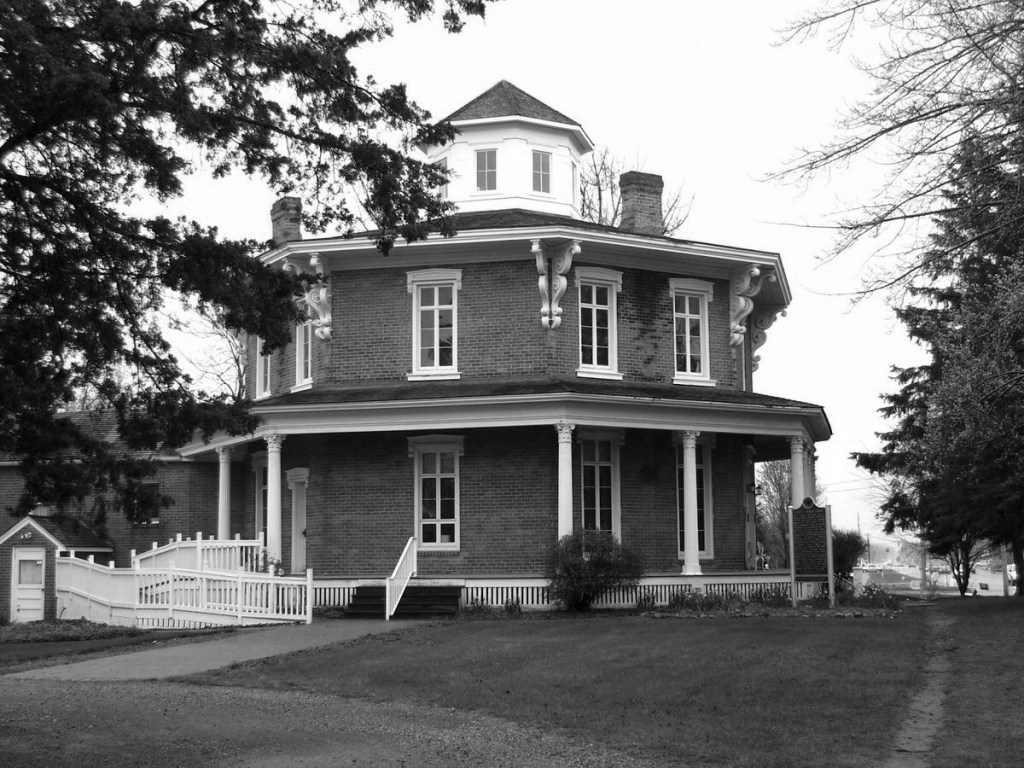
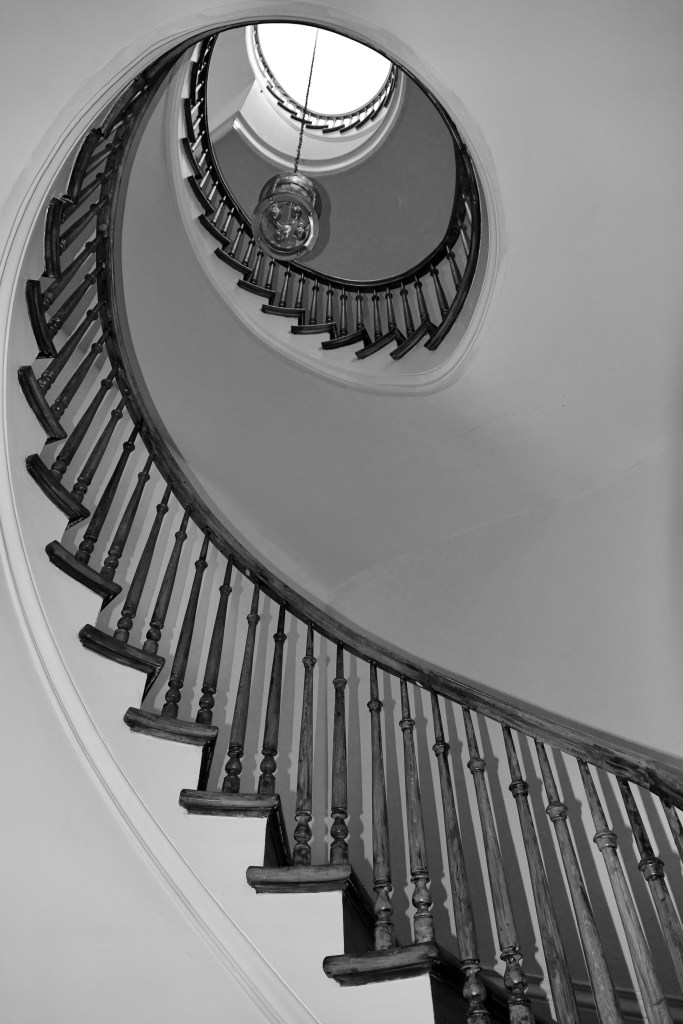
The interior of the house has four rooms on each level. In the center of the structure is a dramatic staircase that extends upward from the main floor all the way to the cupola. There are 12-foot ceilings and 8-foot windows throughout the first floor, with 11-foot ceilings with 6-foot windows on the second floor. The rooms were equipped with iron stoves for heating. Next to each room is a triangular alcove, making hallways unnecessary.

With 16 rooms, it made up a total of 3,200 square feet of living space for Mr. Andrus and his family. Loren married Lucina Davis in 1841, and by 1849 he had received a land patent for 160 acres, just north of 26 Mile Road on Van Dyke where the Octagon House stands today. In 1854 Loren purchased an additional 80 acres fir $700.00, which is on the east part of the present day farm. Loren and Lucina went on to raise 8 children in the Octagon House.

Loren’s brother-in-law, David Stewart, was a famous architect and carpenter, well known for his building skills. One home built by David Stewart is the brick home on Van Dyke and 30 Mile Road, now owned by the Huntington Bank also the Washington Union Church, also still standing in Washington.
While the Andrus family owned the home until 1894, there would over the years be numerous other owners who made this 8 sided home the place to reside. While many others also attempted to run businesses out of the house and farm, money difficulties made it necessary for something more permanent to take place. It wasn’t until the ‘Friends of the Octagon House’ purchased it in 1987 did the house’s security become apparent.
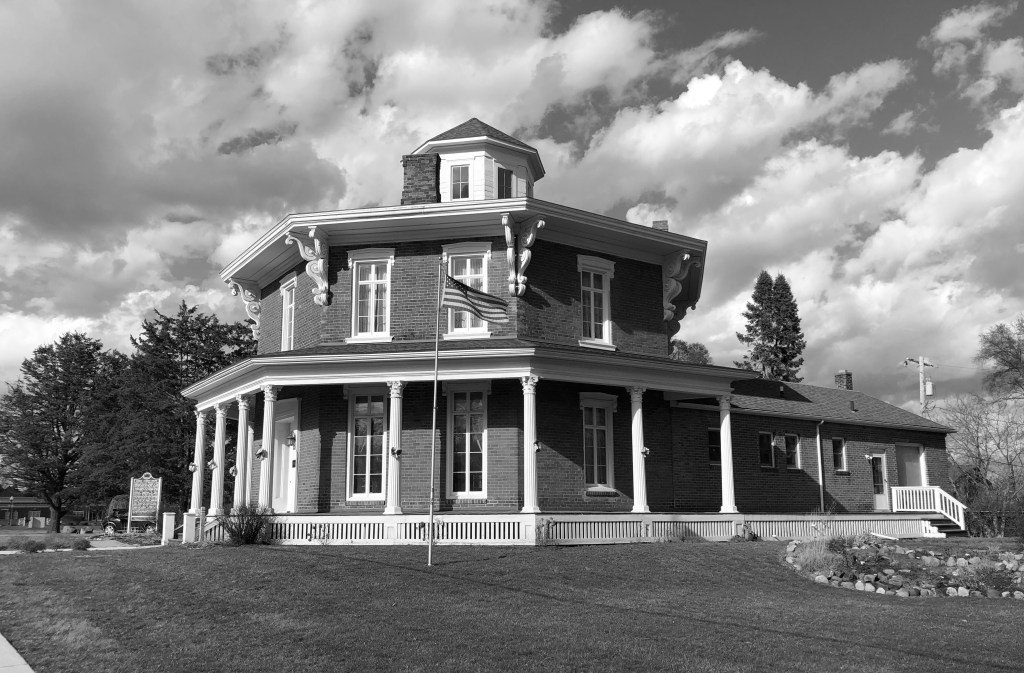
Many rumors and stories have followed the house through the years, most difficult to prove or disprove, but on fact stands on its own. If given a chance the house needs to be seen to truly understand the treasure Washington Township is gifted to have. Today, many talks and lectures are given (pre-pandemic) on many interesting topics by many local historians. I was honored to be able to give a book talk on Arcadia’s ‘Washington Township’ in 2019.
If you haven’t been out to visit the Octagon House recently, please add it to your ‘to do’ list, it’s well worth seeing and it helps support the care of this beautiful preserved home. The stories and tales go much farther than I have been able to talk about here.
I want to thank the Greater Washington Area Historical Society and Friends of the Octagon House for use of information used in this blog. The Octagon House, Diary of Phyllis Hamilton.
On the ‘wee note’ till next week.
Thank you for visiting and reading today. Besure to share with your friends using the share button below if you haven’t already please enter your email address in the form below to receive my stories by email.
 Linda Osborne Cynowa
We took some of the middle school kids from our church on a tour there once many years ago and the guide told us that there was a tunnel they found between the Octagon House and the barn and that the house was used to help with the Underground Railroad. They helped hide people escaping slavery on their journey to Canada.
LikeLike
Steve, everything I have found debunks those tunnel theory’s. Basically the people who owned it in the 1970’s thought it would create more foot traffic with
LikeLike
sorry, these stories. But nothing has been found to verify that the underground really happened right there. In Romeo it seems to have. One of the sources I found, stated that it didn’t make sense for Andrus to build this house so close to the road and put his family of very young children in harms ways to be involved like that. So I kind of reserve my thoughts. But there are some great books that have written a lot about the subject.
LikeLiked by 1 person