Linda’s Monthly Monday Morning Moaning’s February 6, 2023
Part One:
I am now getting to the point of wrapping up this latest book with vintage postcard images that I have been working on these past few months, and getting it to the publisher with in a few weeks. Here is a sample of the different chapters and the different type of lighthouses, that will be covered in the book.

Chapter One: Burnt Coat Harbor (Hockamock Head), Swans Island, Maine
At the entrance to Burnt Coat Harbor, a light station was built on the southern most point called Hockamock Head on Swans Island in 1872. Originally built with twin towers, to be used as range lights, the second light was removed in 1884. A story-and-a-half white clapboard keepers house that connected to the thirty-two-foot tower, was erected for a lantern room to house the fourth-order Fresnel lens. In 1975, the original Fresnel lens was removed and replaced with an automatic light nearby, soon found to be not as bright, in 1978 the tower was relit with a 250-mm optic lens. Now maintained by the Town of Swans Island, it is now listed on the National Register of Historic Places.
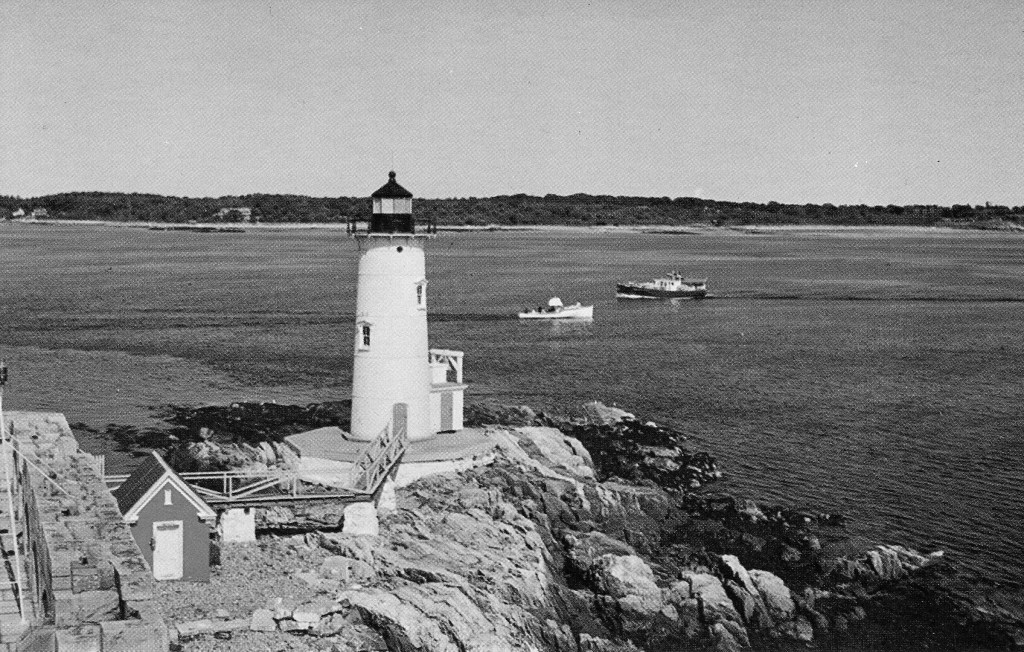
Chapter Two: Portsmouth Harbor Lighthouse, New Castle, New Hampshire
The fort of William and Mary, so named by the British, was rebuilt after the War of Independence and renamed Fort Constitution in 1800. A new light was built in 1804 a short distance from the original and a bridge built of wood was used to access the light. The light tower was eighty-feet tall, with the keeper residing in the village, not at the light. By 1851 the tower was shortened to fifty-five feet, and a fourth-order Fresnel lens was added. The lighthouse was replaced in 1877 with a cast iron tower lined with brick. A brown color was used as it’s day mark. In 1902 the color was changed to white. The light became automated in 1960. It came under the care of the Friends of Portsmouth Harbor Lighthouses in 2001.

Chapter Three: Edgartown Harbor Lighthouse, Edgartown, Massachusetts
In 1828, the first lighthouse was a two-story dwelling with a side-gabled roof where a lantern room was centered on the roof, with a 1,500 foot walk way built to connect the dwelling to the mainland. A stone pier was soon replacing the original wood used to support the light. In 1938 a hurricane caused enough damage to the light to give thought to demolishing the building. From 1939 through 1980 the light was maintained by the Coast Guard and they would refurbish the dwelling in 1985. By 2014 the Town of Edgartown took ownership of the lighthouse.

Chapter Four: Block Island North Lighthouse, New Shoreham, Rhode Island
There were at least four lighthouses built over the years on the north end of the six-mile long Block Island. In 1837 saw a rectangular, granite keepers dwelling, with a light tower at each end of the roof, on the top of the buildings roof. These two lights were lined up on a north-south axis, where they would look like one light until the ships were within two or three miles of the lighthouse. In 1867, the currant lighthouse was built in the Victorian and Gothic Revival style as a two-story dwelling with Connecticut granite, with a pitched, slate covered roof, where the iron lantern room and tower were situated on the northern end of the roof line. Block Island Lighthouse was automated in 1956 and by 1973 it had been deactivated.
Next month, Connecticut, New York, New Jersey and Delaware, and by that time a cover image. I hope I might have peaked your interest, if you are a lighthouse lover, as I am. On that ‘wee note’ till next month. Monday March 6, 2023.
Thank you for visiting and reading today. Be sure to share with your friends, using the share button and if you haven’t already, please enter your email address in the subscription form below to receive my stories by email.
 Linda Osborne Cynowa