Linda’s Monthly Monday Morning Moaning’s March 6, 2023
Part Two:
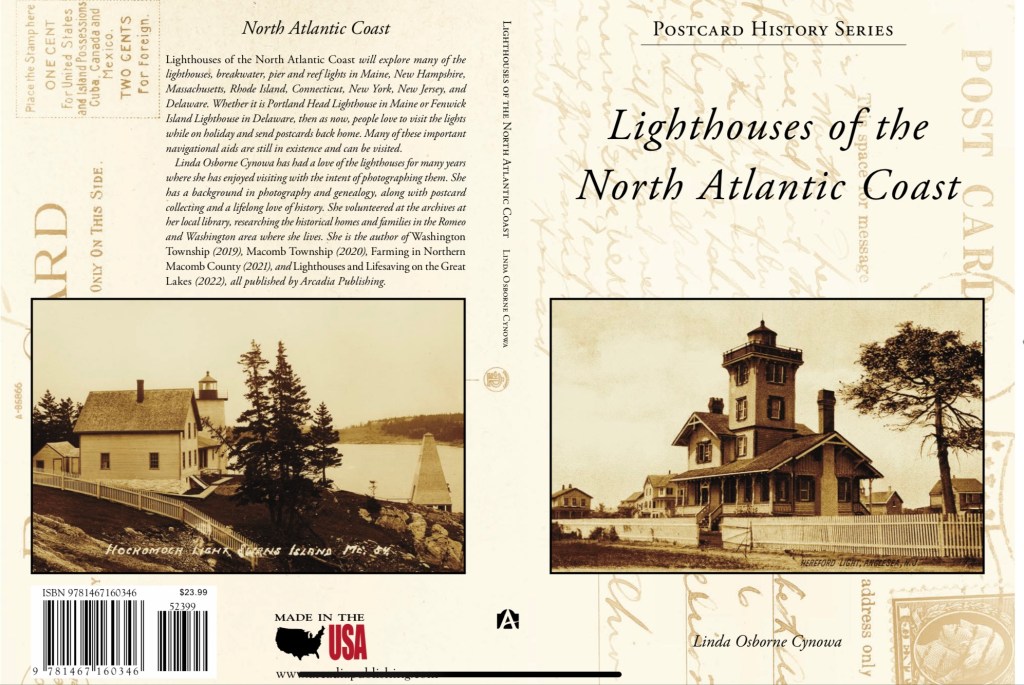
I am very humbled to write, that my fifth book with Arcadia Publishing will be released on July 26, 2023, and once again the excitement begins in the editing process that happens twice along the way and then receiving the finished form of a book. When you are ‘presented’ with your new cover, this images below is how you receive it, both back and front images.
Chapter Five- Sheffield Island Lighthouse, Norwalk Harbor, Connecticut
While previously called the Smith Island Light, it is one of many names the light was called through the years. There are sixteen islands in the Norwalk Island chain and Sheffield is known to be the largest. In 1869 a new school house style, keepers dwelling, with two-and-a-half-stories, made out of granite stone was built. The tower with lantern room were forty-six-feet tall. The tower, was fitted with a fourth-order Fresnel lens. The old light tower was torn down and the previous keepers house was used as a storage building. The light was deactivated in 1902 and went into private hands after being put up for auction in 1914.

Chapter Six- Hudson-Athens Lighthouse, Hudson, New York
Located between the towns of Hudson and Athens, on a sandy ridge called Middle Ground Flats a lighthouse was constructed in 1874. A Second Empire style brick dwelling with a mansard roof, situated on a granite foundation. A sixth-order Fresnel lens in the light tower is centered on the western face of the redbrick, eight-room dwelling.The light was automated n 1949.

Chapter Seven – Point Comfort Lighthouse, Keansburg, New Jersey
Keansburg had two lighthouses that worked in conjunction with one another. In a range line, the lower one, the Point Comfort Beacon on Raritan Bay and the higher one Waackaack Light (yes that is what it’s called) on Creek Road. The Point Comfort Beacon was built in 1856, a wooden, one-and-a-half-story, school house type structure that served as the keepers dwelling, with a square wooden tower attached to the middle of the roof line. By 1867, repairs to the kitchen, and roof reshingling were needed, along with a coat of paint. In 1883, jetties were built because of the erosion of the bank, riprap was added to aid protection to the lighthouse foundation. 1904 was to see 400 tons of riprap deposited again to help the jetties hold back the erosion. The lighthouse was destroyed by fire in the 1950’s.

Chapter Eight – Cape Helopen, Lighthouse, Lewes, Delaware
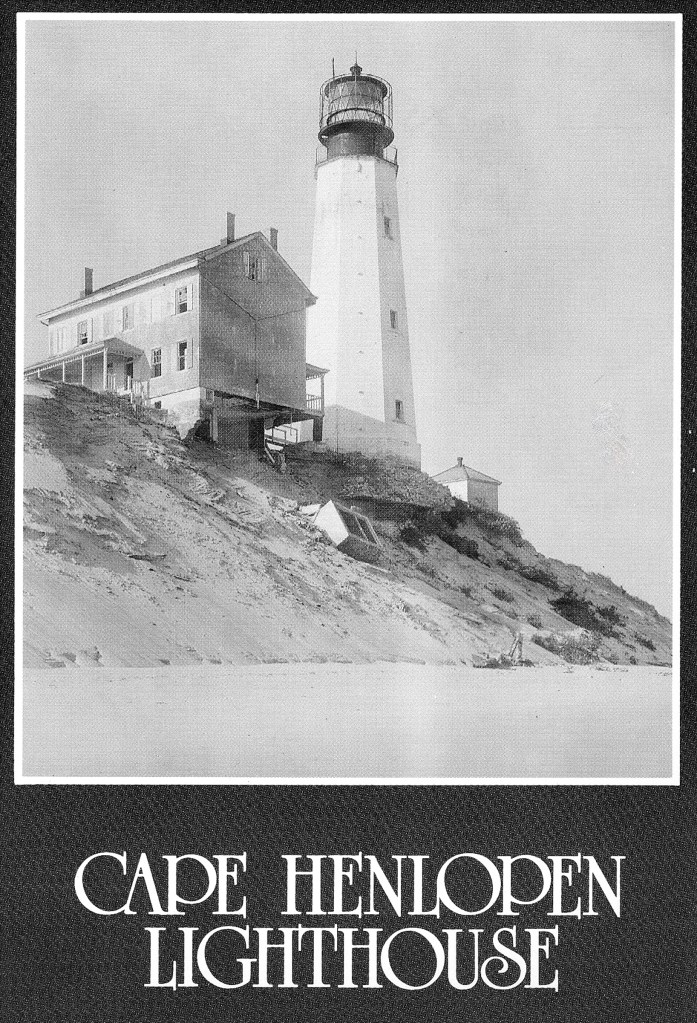
In 1926, the Cape Helopen Lighthouse collapsed into the Atlantic Ocean. The light was built on a foundation on top of a sand dune. Although at a great distance from the sea, with erosion encroaching on the shoreline the stability of the light tower was endangered. In 1914, the Lighthouse Service found that the costly erosion could not be halted except at great cost. The stone built, sixty-nine-foot tower was first built in 1767, and survived the British in 1777. The keepers had a two-story wood-framed dwelling with a wrap-around-porch. The lantern room was fitted with a first-order lens. By 1897, the sand surrounding the tower was thought to be blowing away at a rate of 3 to 5 feet each year. The light was deactivated in 1924 shortly before its collapse.
I hope that this small taste of ‘The Lighthouse of the North Atlantic Coast’ may have peaked your interest in how much more will be between the pages of this up coming book.
On that ‘wee note’ till next month. Monday April 3, 2023.
Thank you for visiting and reading today. Be sure to share with your friends, using the share button and if you haven’t already, please enter your email address in the subscription form below to receive my stories by email.
 Linda Osborne Cynowa