Linda’s Monthly Monday Mornings Moaning’s for April 3, 20023
Two of the early lighthouses established on Lake Superior were at Whitefish Point in 1849 and on the northern end of Grand Island in 1856. In 1867, the Lighthouse Board felt that the eighty miles between these two early lights remained unmarked and requested $40,000 for a lighthouse to rectify this situation. The Lighthouse Board repeated its request annually, and then in 1871, it added that the lighthouse was “more needed than any other light in the district.” This seems to have prompted Congress to act, as the following year $40,000 was appropriated for “a light between White Fish Point and Grand Island Harbor.”
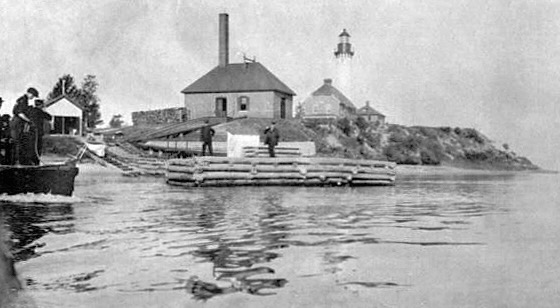
The Lighthouse Board selected Big Sable Point, named for the towering nearby sand dunes, as the site for the lighthouse, and work at the point began in July 1873. A circular brick tower was built on a cut-stone base with cut-stone lintels and sills. The eighty-six-foot-tall tower tapers from a diameter of sixteen-and-a-half feet at its base to twelve feet, at the circular gallery that is supported by sixteen cast-iron corbels. A spiral cast-iron stairway leads to the top of the tower where arched windows provide light for the watchroom. A third-order, L. Sautter & Cie. Fresnel lens was installed in the tower’s lantern room to produce a fixed white light, which thanks to the lofty bluff on which the lighthouse stands, has a focal plane of 107 feet. For the convenience of the keepers, a twelve-and-a-half-foot-long passage was built to link the base of the tower to the two-story dwelling. While the tower was whitewashed, the redbrick dwelling was left unpainted.
By the end of June 1874, work at the station was finished except for plastering, outside whitewashing, and installing the Fresnel lens. After this work was finished, Keeper Casper Kuhn displayed the light for the first time on the night of August 19, 1874.
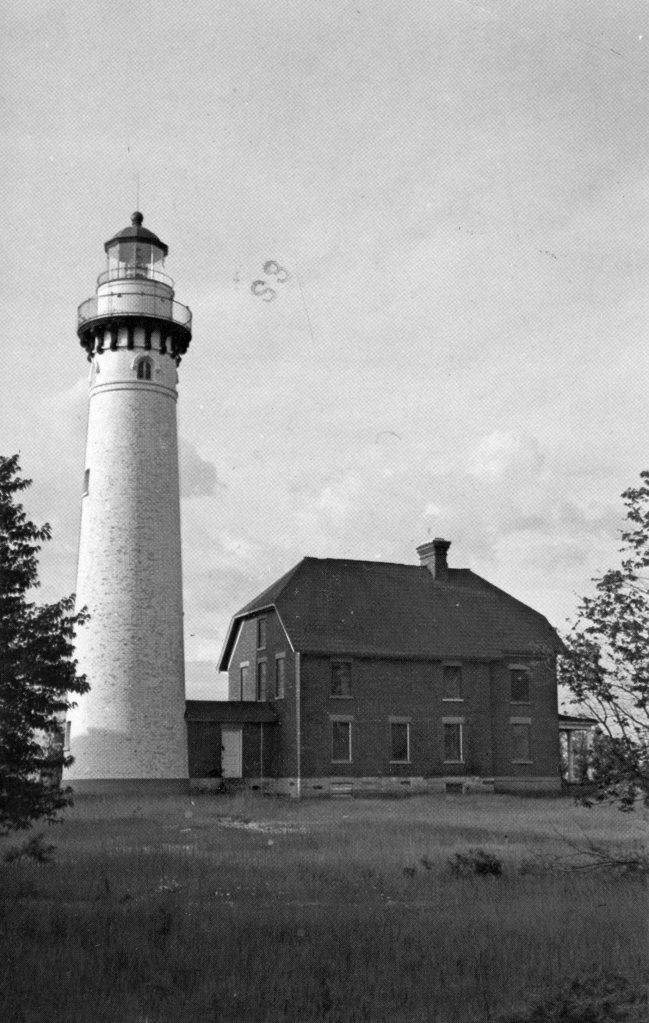
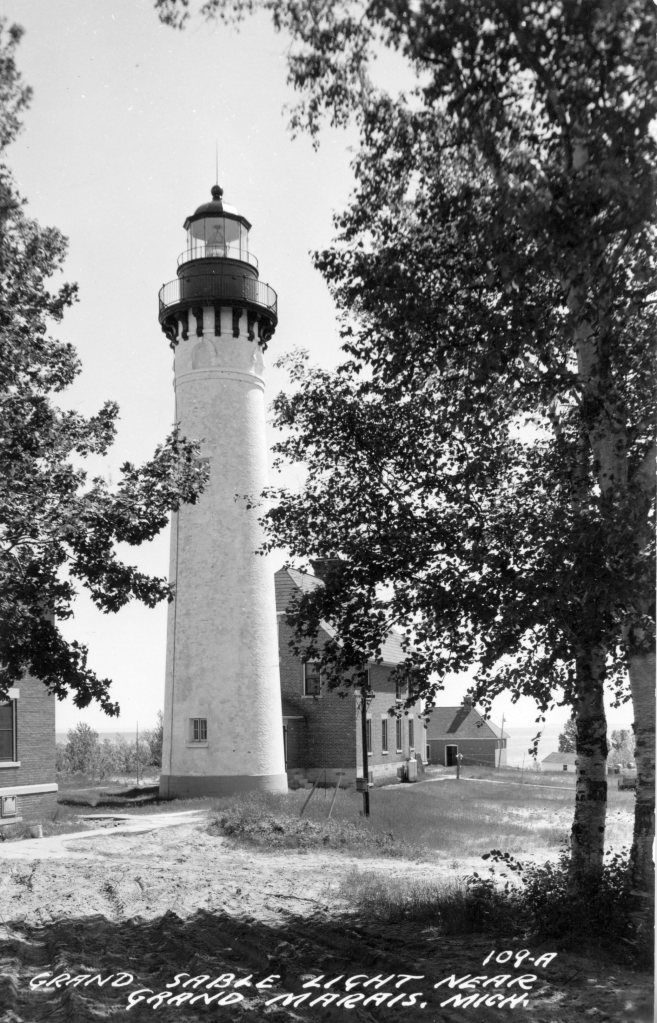
Up until 1910, when control of the country’s lighthouses passed from the Lighthouse Board to the Bureau of Lighthouses, the lighthouse was known as Big Sable Lighthouse, but for some reason, the Bureau of Lighthouses started using the name Au Sable Lighthouse. While some say this was to prevent confusion with Big Sable Lighthouse on Lake Michigan, the change to Au Sable Lighthouse gave the station the same name as another light on Lake Huron. The characteristic of the light was changed from fixed white to a group of two white flashes every fifteen seconds in 1944. Au Sable Lighthouse was automated in 1958, and its keepers were no longer needed.
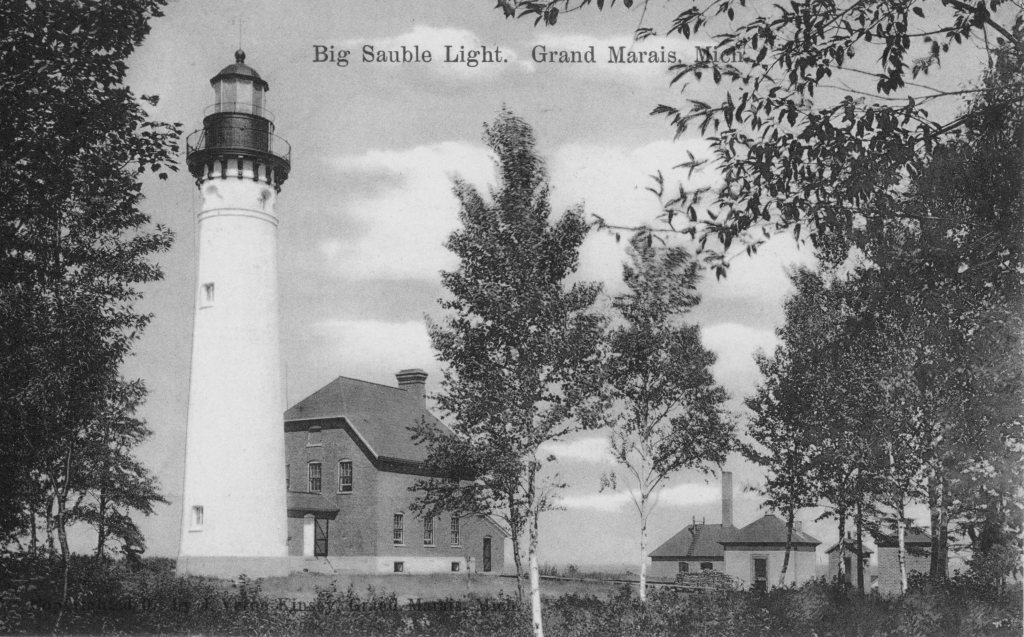
In 1968, Au Sable Light Station became part of the surrounding Pictured Rocks National Lakeshore, which had been created in 1966. When the station’s third-order lens was removed from the tower sometime after 1972, it was placed on display at the old Grand Marais Lifeboat Station, which doubled as a maritime museum and the lakeshore’s ranger station. After the lantern room was restored, the lens was returned to its rightful home atop Au Sable Lighthouse in 1996.
Top image take from the water side, circa 1920, courtesy of the National Archives, three other images authors vintage postcards. Images from the Arcadia Publishing book, ‘Lighthouses and Lifesaving on the Great Lakes’. Thank you to Lighthousefriends.com for their content and their love of all the lighthouses. On that ‘wee note’ till next month, Monday May 1, 2023.
Thank you for visiting and reading today. Please be sure to share with your friends, using the share button and if you haven’t already, please enter your email address in the subscription form below to receive my stories by mail.
 Linda Osborne Cynowa