Linda’s Monthly Monday Morning Moaning’s for March 4th, 2024
After steaming out of New York City on December 1, 1917, filled with a staggering three thousand tons of TNT, benzene and gun cotton, this munitions ship the Mont-Blanc found its way up the Atlantic coast, through waters filled with enemy u-boats. After colliding with another ship the Norwegian Imo, chartered to the Belgian Relief Commission, while approaching the ‘narrows’, where the smallest portion of the harbor sits in the port city of Halifax, the Mont-Blanc’s cargo erupted with the force of 2.9 kilotons of TNT. Not until the atomic bombs of Hiroshima and Nagasaki in the mid 1940’s would the world see such an explosion. The blast vaporized in one-fifteenth of a second the 3,121-ton hull of the Mont-Blanc. The blast cloud shot up more than two thousand feet in the air. Then the thirty-five foot tsunami, triggered by the explosion, swept along the water-front, washing victims out to sea and pushing ships in the harbor on to the shore. Here is the story of a remarkable survival for the people of Halifax, Nova Scotia, Canada.

At the top of the postcard above, is ‘the narrows’ where the harbor has narrowed greatly in this large port harbor, this card showing a portion of the harbor before the explosion. Halifax’s inner harbor had become a safe harbor for merchant convoys leaving for Britain or France during World War l, both Halifax and across the harbor in Dartmouth were usually filled with merchant traffic because of the war. Approximately 60 to 65 thousand people lived and worked in the Halifax Dartmouth area. Anti-submarine nets were pulled in place every evening and opened again every morning.
When the Mont-Blanc reached Halifax harbor, she arrived too late to make it into the harbor before the submarine nets had already been raised on December 5th. The Norwegian ship Imo, had been stuck inside the basin for the past few days and anxious to leave. When the nets were removed in the morning of the 6th, both ships in their haste, would ultimately collide, setting of a chain of events, previously unknown. At 8:45 in the morning the collision occurred. The damage to the Mont-Blanc was slight, but barrels of benzene on the deck fell over and opened, just waiting for a spark to set them off. Many of the ships in the harbor, not knowing what the cargo was on the Mont-Blanc, came to give assistance. All the while the ship was slowly moving closer to the pier.

With the lay out of the harbor many homes would face the water on streets that ran along the harbor on the rows of hills above it. People were on their way to work and children were on their way to school that early morning. But nothing could be more interesting than getting as close to the harbor as possible to see what they soon realize was a burning ship coming in close to the pier. Little realizing what was on the ship.
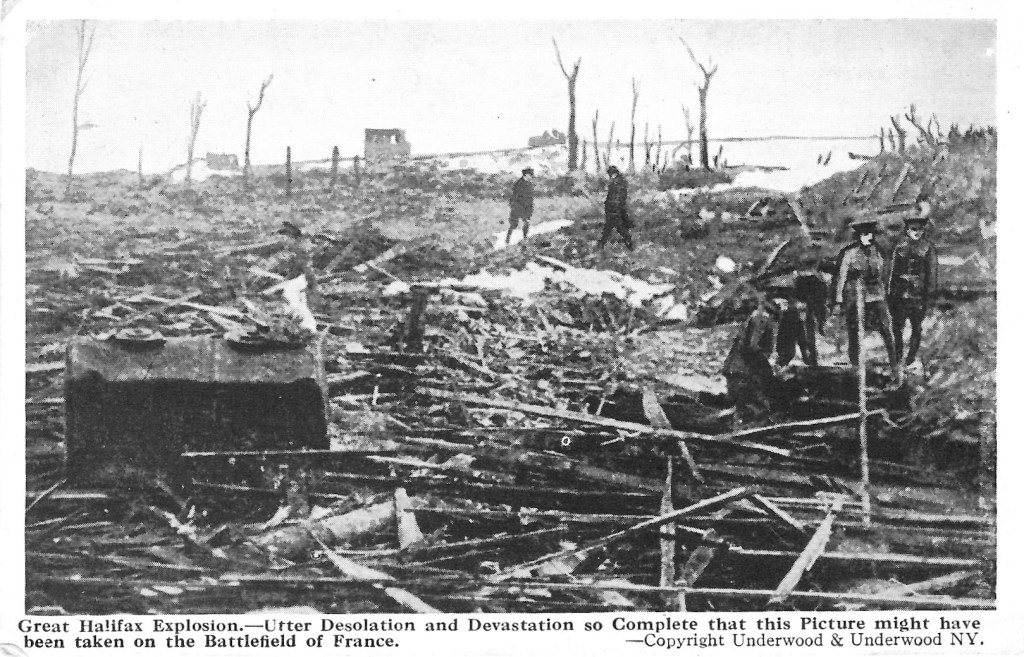
When the blast occurred, over 1,600 people were killed instantly, with 300 to perish shortly after and over 9000 people ultimately were injured. Every building within an almost 2 mile radius was destroyed. Hundreds of people watching the burning ship out the windows of their homes were blinded when the blast wave shattered windows they had been watching from. Stoves in homes that over turned created major fires throughout Halifax. It was believed had it not been for a railway dispatcher, Patrick Vincent Coleman operating near Pier 6 sent a telegraph message to the incoming train to stop where they were. “Hold up the train. Ammunition ship on fire in harbor, making for Pier 6 and will explode. Guess this will be my last message. Good by boys”. From there all incoming trains were halted coming into Halifax. Vince Colman died at his post while saving others.

Despite a raging snow storm that fell on the first night, relief efforts began immediately and hospitals filled up quickly. Soon recuse trains would arrive bringing help and supply’s from all over Canada and northeastern United States. Doctors and nurses from Boston, and especially eye doctors found their way to the where the help was needed most. Approximately 5,900 eye injuries were found, with many permanently debilitating, from the flying glass after the explosion, because of the thousands of people who stopped to watch the burning ship from both inside buildings and from outside.

Because of the help and monetary support that Boston’s Red Cross sent to Halifax, during Christmas 1918 the residents of Halifax sent to the City of Boston a Christmas tree. The official Boston Christmas tree that sits on Boston Commons is sent from the people of Halifax as an on going thank you. A portion of the Mont-Blanc anchor was found 2.5 miles from the harbor, today sits as a reminder of those devastating days in the winter of 1917. I came across this story when researching the books I have worked on, never having heard about this while in school, being that it took place in Canada and not part of our history. But I found it history worth noting. I was in Halifax, Nova Scotia in Canada in August 2022 and found a beautiful city, with no remains of the explosion obviously after all these years, but saw that there are many areas where the people of Halifax have remembered this dark days with memorials and especially with the sound of bells.
On that ‘wee note’ till next month, Monday April 1, 2024.
Research material curtesy of: ‘The Great Halifax Explosion’ by John U. Bacon, 2017 Harper Collins. ‘Curse of the Narrows’ by Laura M MacDonald, 2005, Walker Publishing Company. ‘Explosion in Halifax Harbor’ by David B Flemming, 2004 Formac Publishing Company. There is so much more to this story than I have been able to write about and these wonderful books give a complete story to this important disaster. Postcards are from authors collection.
Thank you for visiting and reading today. Please if you haven’t already, enter your email address in the subscription form below to receive my blog by email on the first Monday of each month. Thank you.
 Linda Osborne Cynowa