Linda’s Monthly Monday Morning Moaning’s for Monday 2, 2026
The Secret Hope of the Confederacy, the H.L. Hunley.
On 17 February 1864, after months of practice runs and weather delays, the Confederate submarine, under cover of darkness, silently approached USS Housatonic, a 16-gun, 1,240-ton sloop-of-war, on blockade duty four miles off the entrance to Charleston Harbor, South Carolina. Carrying a torpedo packed with explosive black powder bolted to a 16-foot spar, H. L. Hunley rammed Housatonic below the water line, detonating the torpedo, tearing a hole in the Union ship’s hull and sending her to the bottom along with five of her crew. The sub would signal to those on shore, that all was well and started for shore. Then the Hunley was not seen again for over a century.
The forty foot Hunley was designed to hold just eight men. There had been two other attempts to make this first under water attack work, but those previous subs had sunk with all hands. Captain George Dixon was in charge of this assignment to dispatch the USS Housatonic. There was a story that attached it’s self to Captain Dixon, in that he was shot on April 6 1962 while fighting a battle in Shiloh, were a twenty-dollar gold coin in his pocket, would stop a bullet from killing him. He would have it engraved with the date and area of when the shooting occurred and kept it on his person as a ‘good luck charm’.
While the H. L. Hunley began her preliminary testing, the news of the defeat at Gettysburg and loss of Vicksburg had reached Mobile. Times were increasingly desperate for the Confederacy. The Hunley was initially designed to dive completely below her target while towing behind a floating torpedo on a 200-foot tether. Once the submarine dove and passed under the keel of her target, the torpedo would impact its hull on the other side, in theory causing a devastating explosion that would sink the ship. To safely dive under a Union vessel, the Captain would need to carefully maneuver the five-foot tall submarine between the ocean bottom and the keel of the target ship.
The search for Hunley ended 131 years later when best-selling author Clive Cussler and his team from the National Underwater and Marine Agency (NUMA) discovered the submarine after a 14-year search. At the time of discovery, the team realized that they had found Hunley after exposing the forward hatch and the distinctive ventilator or snorkel box, used for refreshing the air inside. The submarine rested on its starboard side at about a 45-degree angle and was covered in an encrustation of ferrous oxide bonded with sand and shell particles. Probing revealed an approximate length of 34 feet with most, if not all, of the vessel preserved under the sediment.
Due to concerns that the historic vessel would be disturbed or damaged now that its location was known, the decision was made to raise the Hunley from its resting place. In the summer of 2000, a large team of professionals from the Naval History and Heritage Command’s Underwater Archaeology Branch, the National Park Service, excavated the site, measuring and documenting the hull prior to preparing it for removal. Once the on-site investigation was complete, customized slings were slipped underneath the sub one by one and attached to a truss designed by Oceaneering, International, Inc. The truss was then hoisted from the murky waters by crane from the jack-up barge Karlissa-B. On August 8 at 8:37 a.m., the sub broke the surface for the first time in over 136 years where it was greeted by a cheering crowd in the hundreds, on nearby watercraft.
Once safely on its transporting barge, Hunley finally completed its last voyage back to Charleston, passing by hundreds of spectators on the city’s shores and bridges. The recovery operation came to an end when the submarine was secured inside the Warren Lasch Conservation Center, now part of the Clemson University Restoration Institute, in a specially designed tank of fresh water to await conservation.
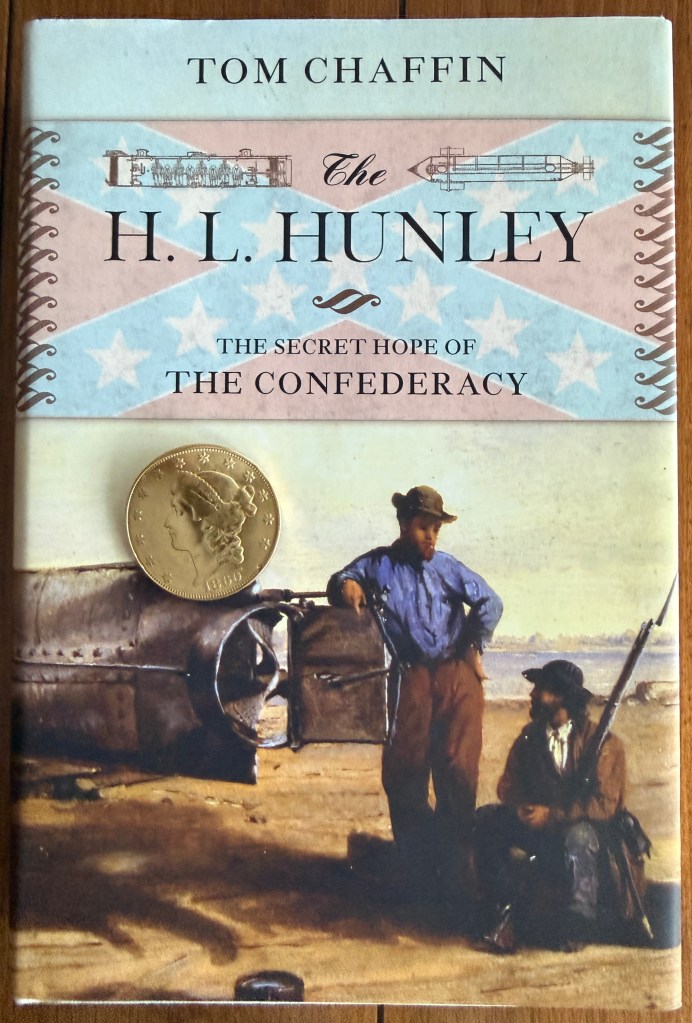
While the slow preservation would take many years, the eight remains of the crew were removed and given an honored burial in Charleston’s Magnolia Cemetery in 2004. Captain Dixon’s twenty dollar ‘good luck’ coin was found among his remains, still bent out of its normal shape giving credence to the long talked about rumor. A replica of that coin, can be seen on the book shown on the above left.
On that wee note till Monday April 6, 2026.
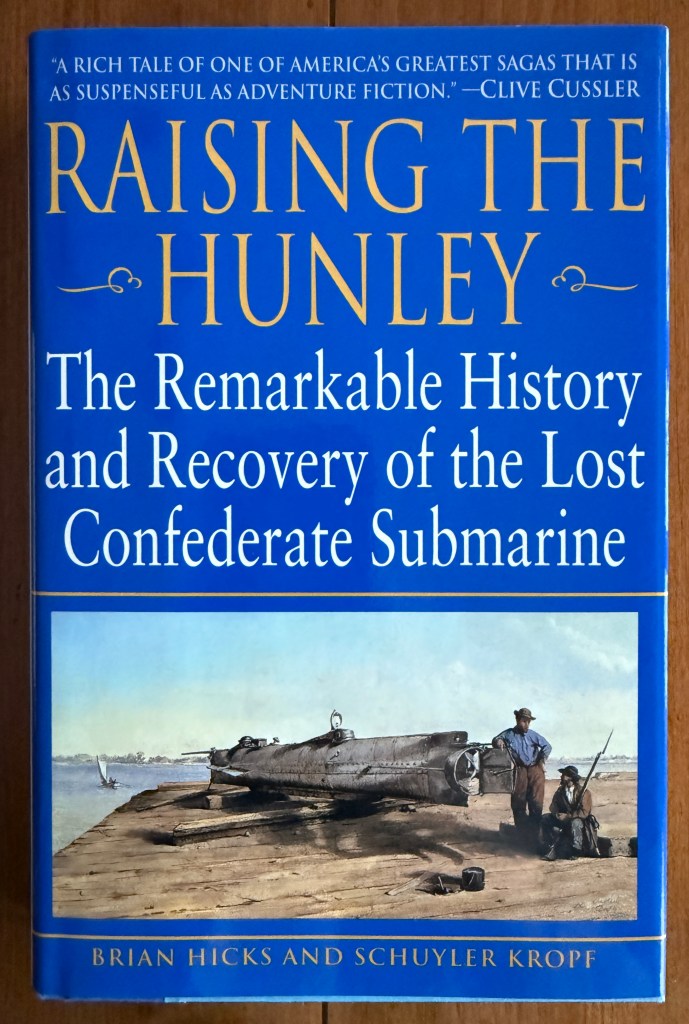
It is with great appreciation that I thank ‘The Friends of the Hunley’ at henley.org, and authors Brian Hicks for his ‘Sea of Darkness, and ‘Raising the Hunley’ with both Brian Hicks and Schuyler Kropf and also Tom Chaffin author of ‘H.L. Hunley’. These are great reads to further the information of the H.L. Hunley’s story.
The Hunley is located and in the care of the ‘Friends of the Hunley’ at: info@hunley.org
Warren Lasch Conservation Center
1250 Supply Street
(on the old Charleston Navy Base)
North Charleston, South Carolina 29405
Thank you for visiting and reading today. Please if you haven’t already, enter your email address in the subscription form below to receive my blog by email on the first Monday of each month.
 Linda Osborne Cynowa