The Lost Confederate Submarine

Linda’s Monthly Monday Morning Moaning’s for Monday 2, 2026

The Secret Hope of the Confederacy, the H.L. Hunley.

On 17 February 1864, after months of practice runs and weather delays, the Confederate submarine, under cover of darkness,  silently approached USS Housatonic, a 16-gun, 1,240-ton sloop-of-war, on blockade duty four miles off the entrance to Charleston Harbor, South Carolina. Carrying a torpedo packed with explosive black powder bolted to a 16-foot spar, H. L. Hunley rammed Housatonic below the water line, detonating the torpedo, tearing a hole in the Union ship’s hull and sending her to the bottom along with five of her crew. The sub would signal to those on shore, that all was well and started for shore. Then the  Hunley was not seen again for over a century.

The forty foot Hunley was designed to hold just eight men. There had been two other attempts to make this first under water attack work, but those previous subs had sunk with all hands. Captain George Dixon was in charge of this assignment to dispatch the USS Housatonic. There was a story that attached it’s self to Captain Dixon, in that he was shot on April 6 1962 while fighting a battle in Shiloh, were a twenty-dollar gold coin in his pocket, would stop a bullet from killing him. He would have it engraved with the date and area of when the shooting occurred and kept it on his person as a ‘good luck charm’.
While the H. L. Hunley began her preliminary testing, the news of the defeat at Gettysburg and loss of Vicksburg had reached Mobile. Times were increasingly desperate for the Confederacy. The Hunley was initially designed to dive completely below her target while towing behind a floating torpedo on a 200-foot tether. Once the submarine dove and passed under the keel of her target, the torpedo would impact its hull on the other side, in theory causing a devastating explosion that would sink the ship. To safely dive under a Union vessel, the Captain would need to carefully maneuver the five-foot tall submarine between the ocean bottom and the keel of the target ship.

The search for Hunley ended 131 years later when best-selling author Clive Cussler and his team from the National Underwater and Marine Agency (NUMA) discovered the submarine after a 14-year search. At the time of discovery, the team realized that they had found Hunley after exposing the forward hatch and the distinctive ventilator or snorkel box, used for refreshing the air inside. The submarine rested on its starboard side at about a 45-degree angle and was covered in an encrustation of ferrous oxide bonded with sand and shell particles. Probing revealed an approximate length of 34 feet with most, if not all, of the vessel preserved under the sediment.

Due to concerns that the historic vessel would be disturbed or damaged now that its location was known, the decision was made to raise the Hunley from its resting place. In the summer of 2000, a large team of professionals from the Naval History and Heritage Command’s Underwater Archaeology Branch, the National Park Service,  excavated the site, measuring and documenting the hull prior to preparing it for removal. Once the on-site investigation was complete, customized slings were slipped underneath the sub one by one and attached to a truss designed by Oceaneering, International, Inc. The truss was then hoisted from the murky waters by crane from the jack-up barge Karlissa-B. On August 8 at 8:37 a.m., the sub broke the surface for the first time in over 136 years where it was greeted by a cheering crowd in the hundreds, on nearby watercraft.

Once safely on its transporting barge, Hunley finally completed its last voyage back to Charleston, passing by hundreds of spectators on the city’s shores and bridges. The recovery operation came to an end when the submarine was secured inside the Warren Lasch Conservation Center, now part of the Clemson University Restoration Institute, in a specially designed tank of fresh water to await conservation.

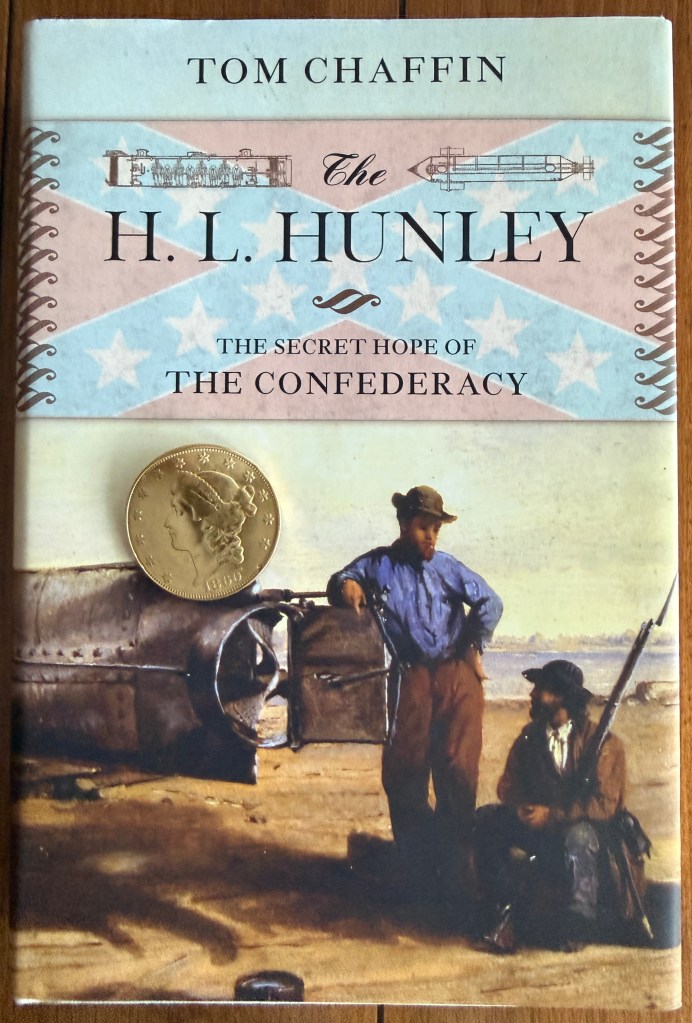
While the slow preservation would take many years, the eight remains of the crew were removed and given an honored burial in Charleston’s Magnolia Cemetery in 2004. Captain Dixon’s twenty dollar ‘good luck’ coin was found among his remains, still bent out of its normal shape giving credence to the long talked about rumor. A replica of that coin, can be seen on the book shown on the above left.

On that wee note till Monday April 6, 2026.


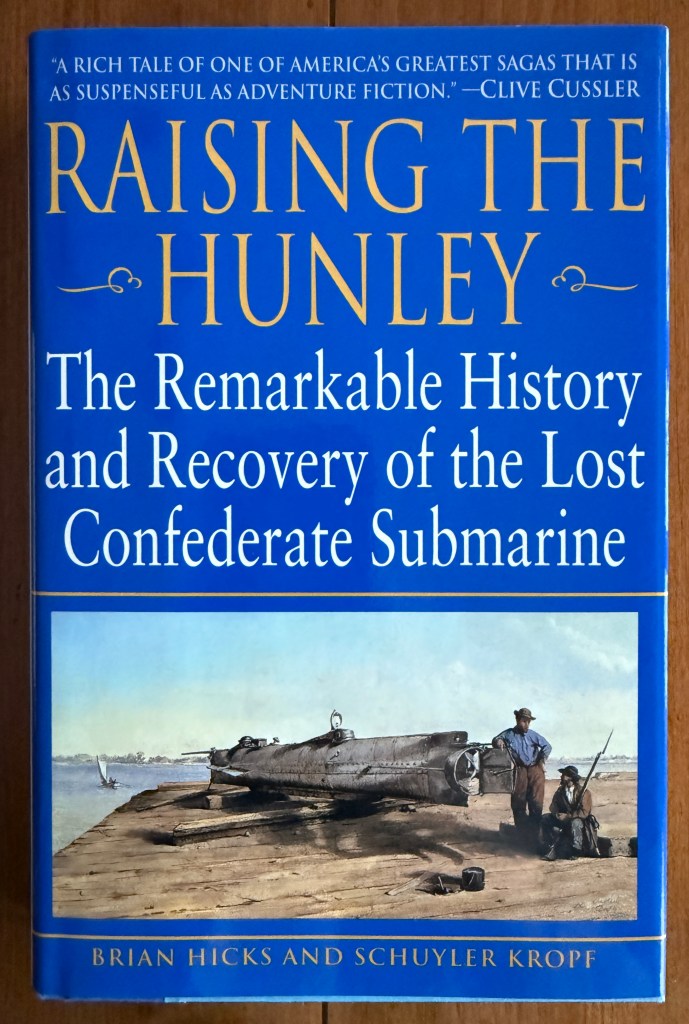
It is with great appreciation that I thank ‘The Friends of the Hunley’ at henley.org, and authors Brian Hicks for his ‘Sea of Darkness, and ‘Raising the Hunley’ with both Brian Hicks and Schuyler Kropf and also Tom Chaffin author of ‘H.L. Hunley’. These are great reads to further the information of the H.L. Hunley’s story.

The Hunley is located and in the care of the ‘Friends of the Hunley’ at: info@hunley.org
Warren Lasch Conservation Center
1250 Supply Street
(on the old Charleston Navy Base)
North Charleston, South Carolina 29405


Thank you for visiting and reading today. Please if you haven’t already, enter your email address in the subscription form below to receive my blog by email on the first Monday of each month.
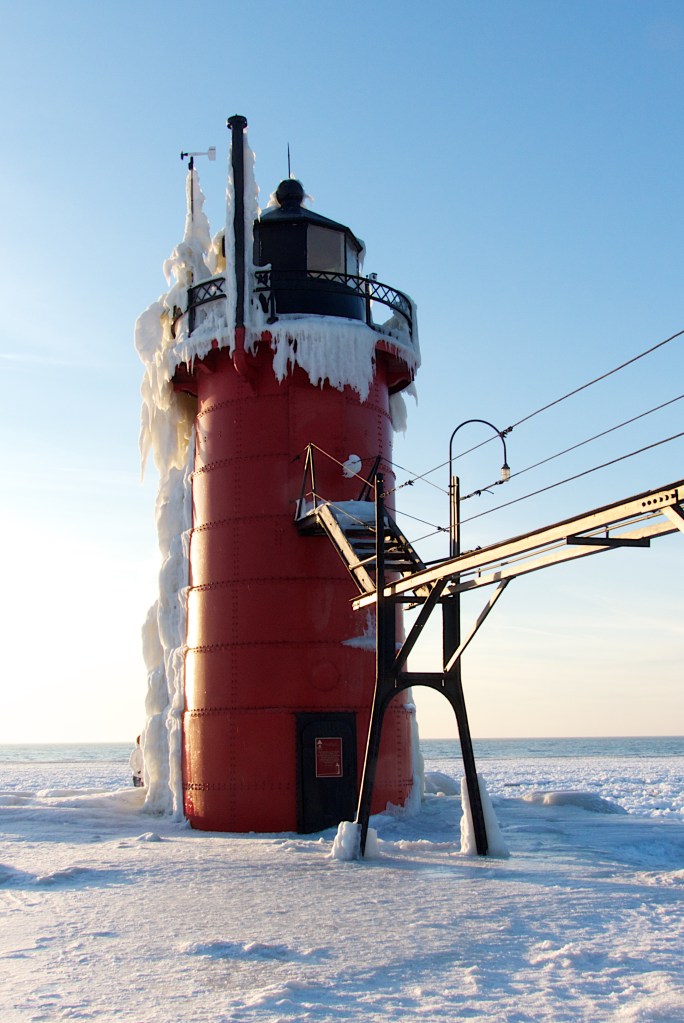
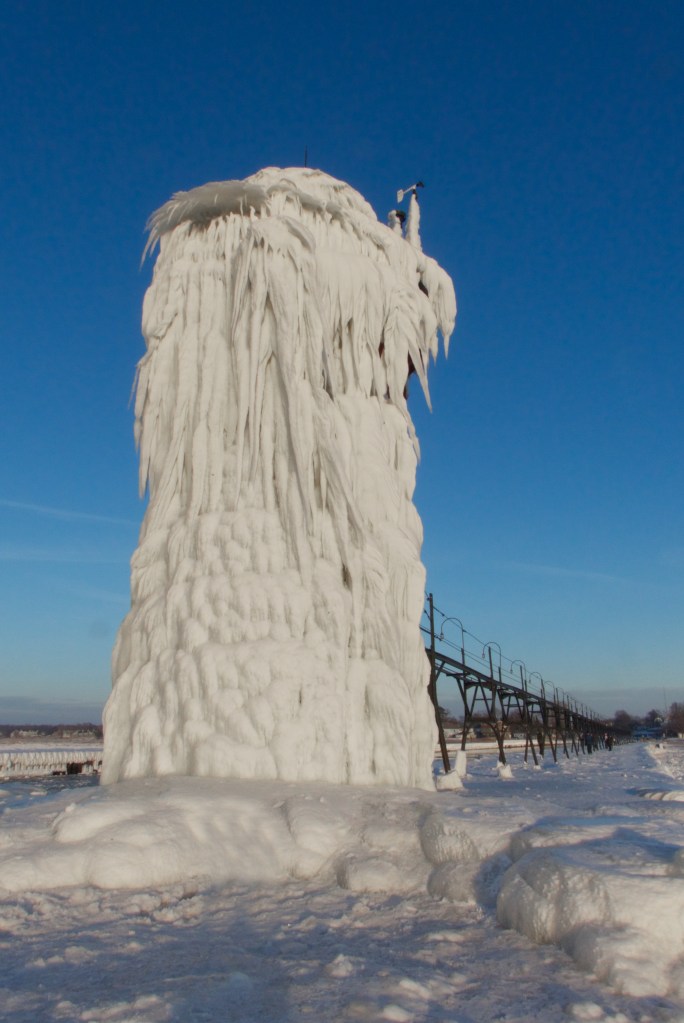
Lake Michigan’s Frozen Lights

Linda’s Monthly Monday Morning Moaning’s for February 2, 2016.

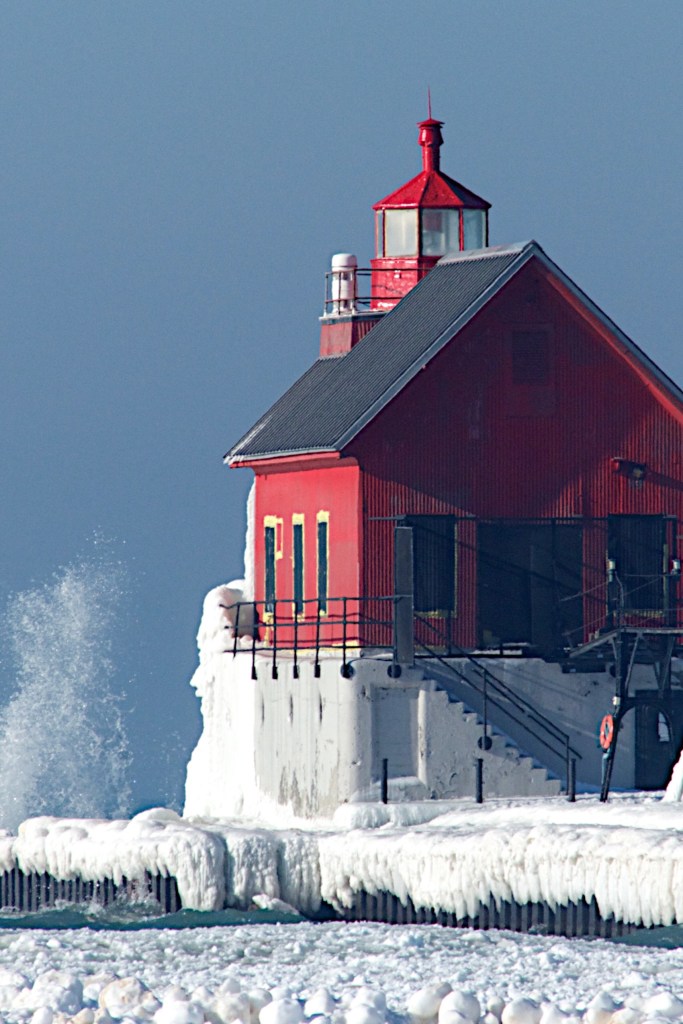
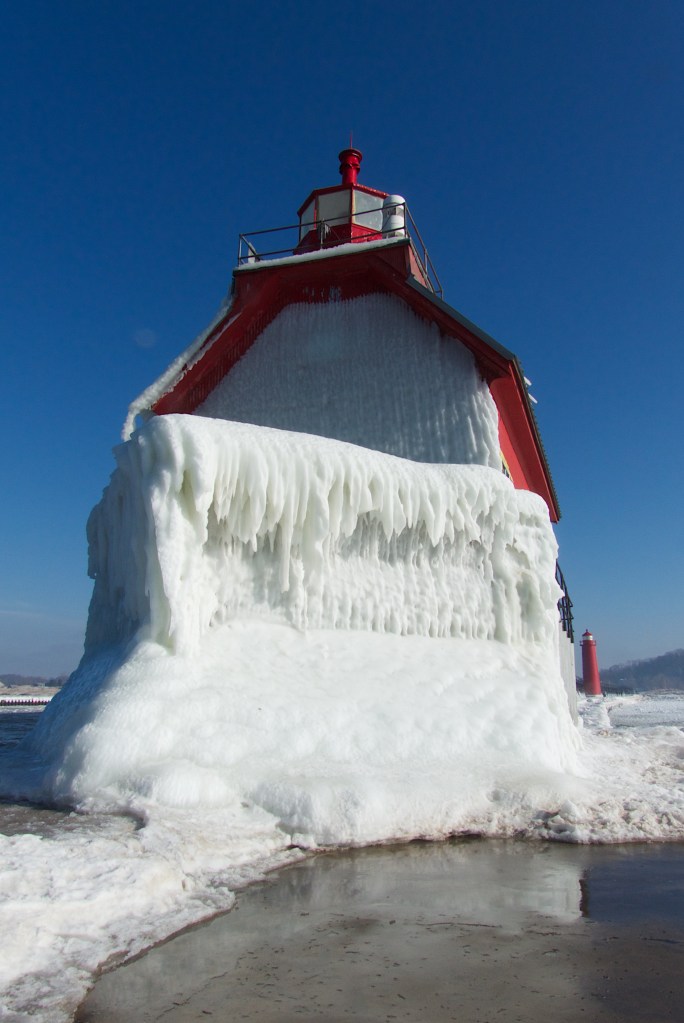
Frigid temperatures, strong winds, snow and freezing spray have created dramatic ice formations along Lake Michigan’s shoreline, with ice coverage on the lake reaching more than 35% earlier than normal this week. The severe conditions have coated iconic lighthouses in Grand Haven, South Haven and St. Joseph with thick layers of ice, with very impressive designs. Strong winds, crashing waves and long cold snaps can sculpt layers and ribbons of ice and icicles on the towers and catwalks, creating dramatic forms that often appear on the national news.

Ice-coated lighthouses do not appear every winter. The weather and lake conditions must align and this most often happens sometime between December and February. First, temperatures must drop and stay well below 32 degrees Fahrenheit. The colder it gets, the faster ice can build. Second, the wind must be strong and blowing from the southwest, west or northwest to create the most dramatic effect. Third, the water around the lighthouses must remain unfrozen so wind can drive waves high enough to crash against the pier and structures.

Both South Haven Lighthouse, above and Grand Haven Lighthouse below in 2013. (Author’s images)

When everything lines up, waves can reach 20 feet or higher. Spray from waves breaking against the pier and lighthouses can rise more than 80 feet in the air. During the course of a day, the structures can accumulate a significant amount of ice. While the thick ice formations look beautiful, they can cause structural stress over time. The weight and expansion of ice can put pressure on metal components, requiring regular maintenance for the lights. Whatever your photographic preference is, camera, mobile phone, protect them between shots to keep batteries and SIM cards warm, clean your lens often and stay aware of blowing freezing spray. You will be happier with the results.

Most important thing to remember, the ice never lasts long, but seeing it in person is something you will never forget, and most remember for years.

On this ‘wee note’ till Monday March 2, 2026.


Thank you for visiting and reading today. Please if you haven’t already, enter your email address in the subscription form below to receive my blog by email on the first Monday of each month.
History of the United States Lighthouses

Linda’s Monthly Monday Morning Moaning’s for Monday January 5, 2026

During the colonial period in America, individual colonies provided aids to navigation. In the 17th century they typically used beacons as aids, often lighted. For example, colonists built fires on Beavertail Point to guide vessels at night in Newport, Rhode Island, soon after it was founded in 1639. These warning beacons did not, guide ships through the islands and shoals of Boston Harbor. To mark the entrance to the harbor and thereby benefit trade, a group of merchants petitioned the legislature for a lighthouse in 1713. Little Brewster was chosen as the site, and in 1716 the construction of Boston Lighthouse was completed—the oldest lighthouse site in North America. Other colonies also needed guides to their ports. Subsequently, 11 additional lighthouses were built before 1789, including Sandy Hook, New Jersey, 1764 (still standing as the oldest lighthouse in the United States.

Scituate Lighthouse, MA

In one of its first acts after its formation in 1789, the United States government assumed control of all aids to navigation in the country. This included the 12 existing lighthouses at the time, as well as those under construction. The US government placed them under the Treasury Department. From 1789 to 1820, the number of lighthouses increased to 55, though apparently without any formal system. An 1838 survey by naval officers found that the condition of the lighthouses ranged from good to terrible—many were poorly placed, of faulty construction, and had poor quality lights. Nonetheless, Congress took no action. Congress again failed to act in 1845 on recommendations from navy officers.

in 1851, after years of protest from shippers, navigators, chambers of commerce, Congress appointed a special investigative board. After thorough study, this board recommended the establishment of a lighthouse board composed of navy officers, army engineers, and civilian scientists. Congress quickly complied and in 1852 created the US Lighthouse Board.

Cape Argo Light, Coos Bay, OR

In 1852, the newly established US Lighthouse Board took over operations of 331 lighthouses, 42 lightships, and other navigational aids, including numerous buoys. The board made many improvements, among them in the administration of lighthouses. The board divided the country into 12 lighthouse districts, the twelfth being the West Coast, where the board built their first lighthouses. Each district had its own inspector, usually a navy officer, and later also an army engineer. The board issued detailed written instructions to the keepers. With the help of the Civil Service Reform Acts of 1871 and 1883, they gradually changed the keepers from patronage appointments to professional civil servants.

The US Lighthouse Board also made many technological improvements, including the installation of Fresnel (pronounced Fruh-NEL) lenses. Frenchman August-Jean Fresnel developed the lens in the 1810s and they were installed in French lighthouses in the early 1820s. The lenses, composed of concentric circles of prisms, directed the light to a central bullseye which concentrated it. This resulted in a far brighter light than that from any other contemporary lens. By the Civil War, all US lighthouses had Fresnel lenses. Other technological improvements concerned lighthouse construction, lightships, buoys, and lamps. lighthouses were constructed of interlocking stones in wave-swept locations. Screwpile and sunken caisson foundations were also introduced in this period. Screwpile lighthouses replaced many lightships in Chesapeake Bay—by 1889 the total number of lightships dropped to 24. But with the development of iron steam-powered ships, the number again increased until there were 56 lightships in 1909.

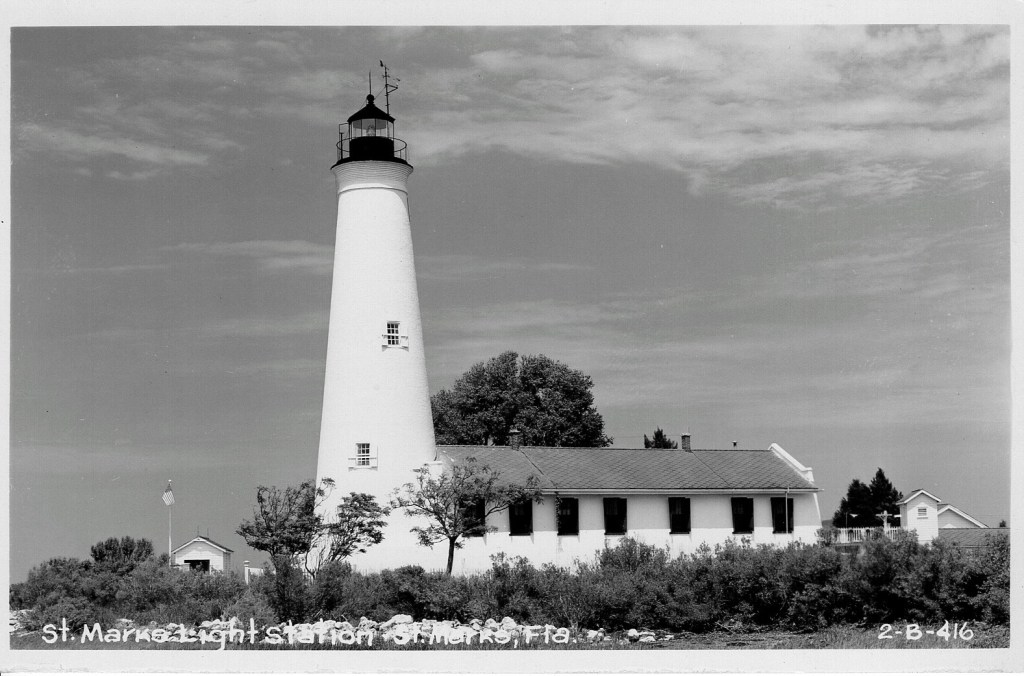
St Marks Island Lighthouse, FL

In 1939 the US Lighthouse Service was transferred to the US Coast Guard. Under the Coast Guard, automation proceeded, as the Lighthouse Automation and Modernization Program (LAMP) began in the mid-1960s. In the 1960s, lightships were replaced by structures similar to oil drilling platforms. By the 1970s, large navigational buoys (LNBs) replaced lightships as well. The last lightship (Nantucket I) was decommissioned in 1985. By 1990 all lighthouses in the country had been automated except Boston Light. After serving faithfully for 215 years, Boston Light was the last lighthouse in the country to be automated in 1998. Though electrified, Boston Light remained staffed due to an authorization by Congress in 1989.

Thank you to the United States National Park Service for keeping the lighthouse legacy, images owned by author. And on that ‘wee note’ till Monday February 2nd, 2026.


Thank you for visiting and reading today. Please if you haven’t already, enter your email address in the subscription form below to receive my blog by email on the first Monday of each month.
The Thorington School Update

Linda’s Monthly Monday Morning Moaning’s for December 1, 2025

For the last 18 years, the time frame I have lived in this area, I have traveled Mound Road at 31 Mile, sometime as much as a few days each week, and always pasted this sad bit of history sitting close to the road and abandoned. I wrote about the school in the ‘Washington Township’ book in 2019, always with the hope that something could be done to save this bit of Washington history. Every winter, I would have the thought, that one day I would drive past and she would be nothing but a pile of lumber. This past summer, our township Supervisor Sam Previti finally was able to close the deal for purchase, from the owners, and plans were put into place for the move to its new home. Just a look back on how this all started:

James M. Thorington was born on 26 January of 1837 in Washington Township the son of James and Sally Brown Thorington. His father would work the farm for 30 years being involved with agriculture and buying land. When he retired, he owned 700 acres in Washington. When James M married Mary Starkweather in 1857 and they raised 5 children on their 320 acre farm on Mound Road between 30 and 31 Mile Roads. James Thorington Sr. owned the 1/8 acre on which the school stands, with it being a part of his 158 acre farm. When the elder James Thorington died, his son James M. took over his farm and would continue to lease the school property. The school was in operation from the 1840’s untill it finally closed in 1955.

On Wednesday October 24, 2025, the day had come for her to be moved to the new area on 31 Mile that will be her new home. With the help of the Romeo High School, teachers, administrators, and students who have designed the new park area, and will be the hand ons workers bringing this bit of history back to it’s original form again.

Starting her move onto Mound Road
Having made the right turn onto 31 Mile and passing the Brabb Cemetery
Waiting to be backed over the new foundation, in the field that will become Thorington Park

I am not sure how many blogs I have written about this school, but the next and probably last one will be sometime in the future when all the work is completed and she becomes a learning tool for students to see what life was like 100 years ago when students of all ages where learning in the same one room school house. With the start of its new roof, and the original bell secured, it’s nice to know that history can still be saved from neglect and made new again.

Hoping your Holiday Season and the New Year coming is safe and happy. On that wee’ note till next month, Monday January 5, 2026.


I would like to thank the Detroit News Paper for use of their images, and the Washington Township station WBRW for spectacular video, that can be seen on Utube, of the moving process it took to get the school to it’s new home.


Thank you for visiting and reading today. Please if you haven’t already, enter your email address in the subscription form below to receive my blog by email on the first Monday of each month.

The Legend Lives On….

Linda’s Monthly Monday Morning Moaning’s for November 3, 2025.

At 8:30 a.m. on November 9, 1975, in Superior, Wisconsin, the loading began of taconite pellets on the Edmund Fitzgerald, and by 2:52 p.m. the ‘Fitz’ sailed past the Superior break wall and out into the vast expanse of Lake Superior, headed to Zug Island in Detroit. At 2:00 a.m. on November 10th, the National Weather Service upgrades an earlier gale warning to a storm warning.

At noon and through midday, with the Arthur Anderson freighter trailing the ‘Fitz’, the storm, with high winds turned into a blinding snowstorm, the ‘Fitz’ asked the Anderson to stay by her, when she radioed she had a ‘bad list’. The last contact with the Arthur Anderson was at 7:10 when they were told the ‘Fitz’ was “holding her own”. By 7:25, the Edmund Fitzgerald had disappeared from radar and from the visual sight of the Anderson, while in Canadian waters on Lake Superior.

“The legend lives on from the Chippewa on down, of the big lake they call Gitche Gumee. The lake, it is said, never gives up her dead, when the skies of November turn gloomy. With a load of iron ore, twenty six thousand tons more, than the Edmund Fitzgerald weighted empty. That good ship and true was a bone to be chewed, when the gales of November came early.”

One week from today, on Monday November 10, comes the fiftieth anniversary of the sinking of the Edmund Fitzgerald. Now the remains of the ‘Fitz’ lies in 530 feet of water in Lake Superior, just north of Whitefish Point, Michigan. The ship rests in two major sections, with the bow sitting upright with a partial burial in the lakebed, while the stern lies capsized at a steep angle 170 feet away. Between them, scattered debris includes hatch covers, hull plating, and taconite pellets from her final cargo.

“The ship was the pride of the American side, coming back from some mill in Wisconsin, As big freighters go, it was bigger than most with a crew and good captain well seasoned. Concluding some terms with a couple of steel firms, when they left fully loaded for Cleveland. And later that night when the ship’s bell rang, could it be the north wind they’d been feeling?”

The structure is still largely intact, though it shows signs of collapse from its decades underwater. The surveys taken have recorded a gradual deterioration of the deck plating and the openings in the hull, but the outline of the ship remains recognizable. The site is treated as gravesite and is legally protected by the Canadian government, so diving is restricted to observation only.

“Does any one know where the love of God goes, when the waves turn the minutes to hours? The searchers all say they’d have made Whitefish Bay if they’d put fifteen more mile behind her. They might have split up or they might have capsized, they might have broken deep and took water. All that remains is the faces and the names of the wives and the sons and the daughters.”

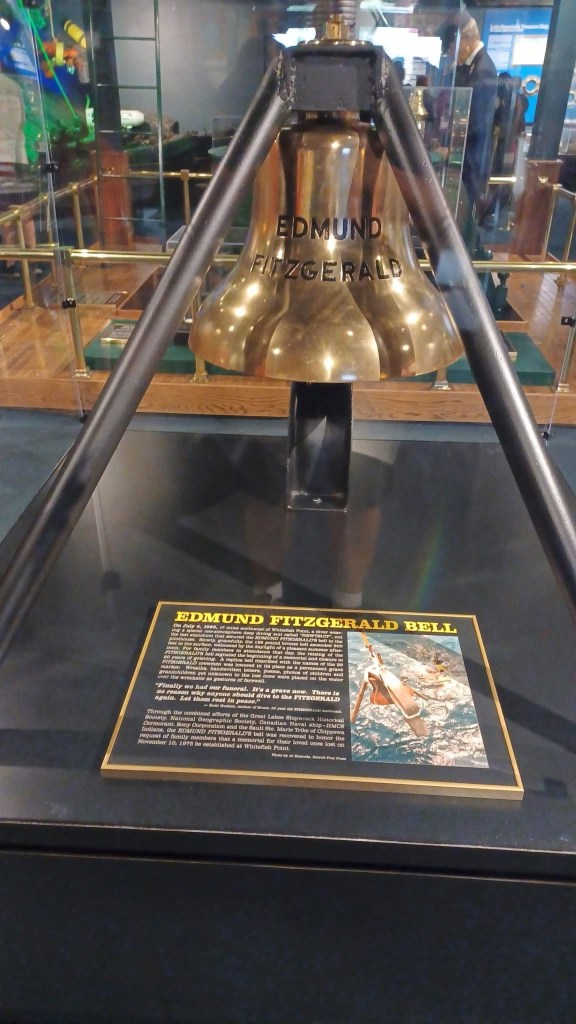
In 1995, the ship’s original bell was recovered and replaced with a replica bell. The recovered bell has been preserved and is displayed at the Great Lakes Shipwreck Museum at Whitefish Point, in Michigan along with the Whitefish Point Lighthouse, is a memorial to the 29 seamen who lost their lives.

“In a musty old hall in Detroit they prayed in the Maritime Sailors Cathedral. The church bell chimed till it rang twenty-nine times for each man on the Edmund Fitzgerald. The legend lives on from the Chippewa on down on the big lake they call Gitchee Gumee, Superior, they said, never gives up her dead, when the gales of November comes early.”

A gracious thank you to all the Mariners, who have sailed the Great Lakes and made this their life work. Thank you to John U. Bacon for his just published new book the ‘The Gales of November’, and Ella Andra-Warner for her book ‘Edmund Fitzgerald, The Legendary Great Lake Shipwreck’, and the estate of the late Gordon Lightfoot for partial use of ‘The Wreck of the Edmund Fitzgerald’, a most beautiful work for memorizing these very brave seamen, the ‘Lakers’ who travel our Great Lakes.

On this ‘wee note’ till Monday December 1, 2025.


Thank you for visiting and reading today. Please if you haven’t already, enter your email address in the subscription form below to receive my blog by email on the first Monday of each month.