Isaac Douglas Residence

This Greek Revival home of Isaac Douglas DDS sits today at 288 North Main Street, Romeo. The residence was built at two different time periods, with the south portion was built prior to 1859 and the north portion was constructed prior to 1868. In 1862 Dr and Mrs Isaac Douglas DDS, purchased the home in 1862 and lived on the south side until 1907. In 1905 Dr Douglas had renovations made to connect the two structures together as seen today.

That beard would have concerned me, if getting dental work done!

Isaac Douglas was born in Troy, Oakland County, Michigan on May 25, 1830. He was the third son of Nathan and Frances Douglas eight children. Isaac had an early life only with the advantages for an education common to the sons of Michigan pioneer farmers. When he turned 20 years he studied dentistry with his brother, who had settled in Romeo and continued to study with him until his brothers death in June 1852, then succeeded to his business. Isaac felt he also needed to study medicine for a wider scope in the health field, and started to read with Dr Wyker of Romeo. He would also start the study of homeopathy under the direction of Drs Ellis & Drake of Detroit. By 1858 he entered college in Cleveland, Ohio were he passed all his exams with the highest of honors and went on to be ranked amongst the highest in his class. Returning to Romeo in 1859 and began the practice of medicine together with dentistry. After 1865 he confined his practice to that of dentistry only.

As a dentist, Dr Douglas had been know for having put in 4394 fillings between January 1,1866 and January 1, 1872, with only 17 replacement fillings! Dr Douglas became one of the organizing members of the Michigan Dental Association. Dr Douglas married Elizabeth Clarke, a native of England, in 1852 and would go on to have three daughters and a son. The Douglas’s moved from the North Main Street address to Bailey Street in Romeo, where he passed away at age 79 years after a lengthy illness.

Isaac’s obituary from the Romeo Observer, October 20. 1909

After finding the obituaries for the many settlers that I researched, I always felt I needed to follow up and make a trip to the Romeo Cemetery on St Clair Street (32 Mile Road) to find their final resting place. Dr. Douglas was a very important part of early Romeo, for the continued help he gave to seeing other future dentists come along in their chosen field.

Romeo Cemetery, with the Romeo Middle School in the background

The home would see a number of new owners over the next 100 years. The ‘Canary Cottage Tea Room’ operated from the the building between the 1920’s and 1930’s. Oliver Stirling was the owner of the Romeo Marble and Granite, and operated his business from the barn behind the home, sometime around the 1935 according to the enumerated census taken. The business ran in that location till it was sold in 1998 to Raymond and Thelma Hug, who would restore the home to be used as commercial office space. Today the Romeo Chamber of Commerce has offices here.

The Douglas House toady, still serving the community of Romeo

On that ‘wee note’, till next week.


I want to thank the Community Archives of the Romeo Public Library, or better known as the Kezar Library on Church Street and Main, for the use of images and articles for this blog. And to thank them for the opportunity to do the research on these interesting pioneering settlers in the Romeo area while volunteering with the library. Please remember that with these stories, this is such a small part of the information that many times is available, and always keep the library in mind to further your interest in this.


Thank you for visiting and reading today. Be sure to share with your friends using the share button below. If you haven’t already please enter your email address in the form below to receive my stories by email.
Washington’s Octagon

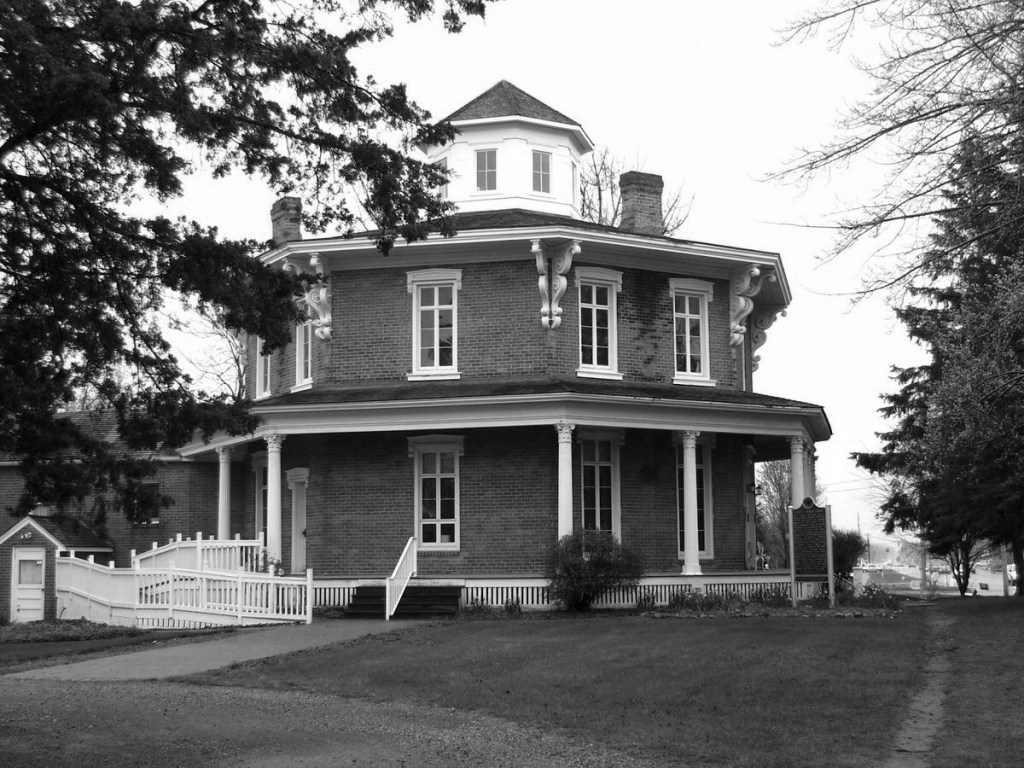
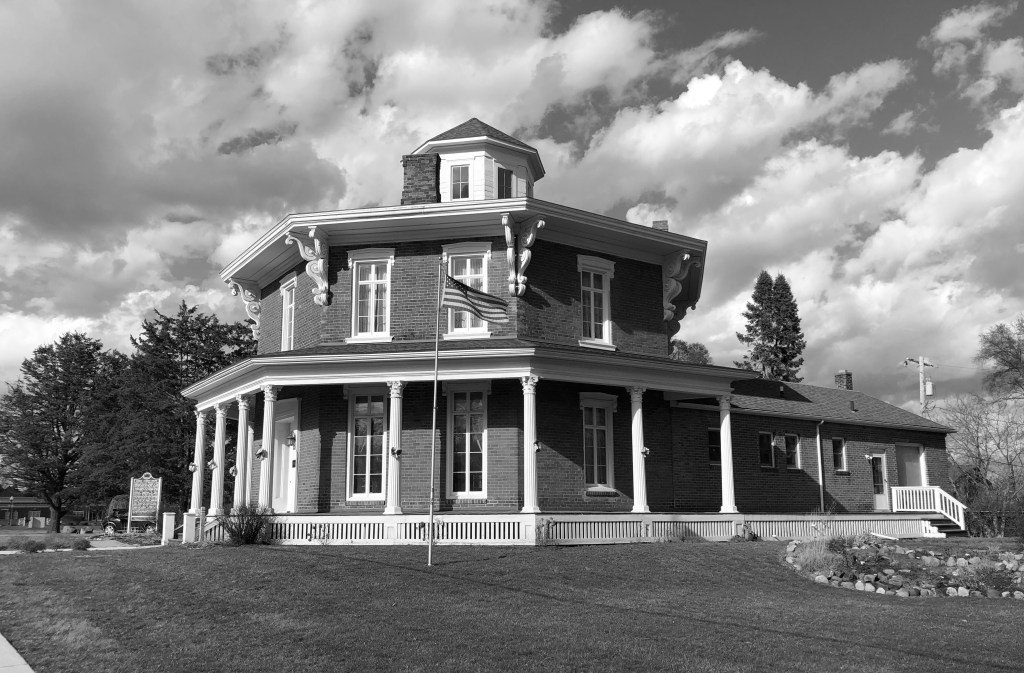
In 1858 Loren Andrus (1816-1901) with help of his brother in law David Stewart built, over a period of two years, his two story, eight sided home. The roof has extravagant Italianate supporting brackets and an octagonal cupola with weatherboard sheathing on top. A large porch supported by wooden Neo-Corinthian columns wraps around seven sides of the house. The family home has three-foot-thick brick walls in the basement and 15-inch-thick exterior walls.

Friends of the Octagon House image

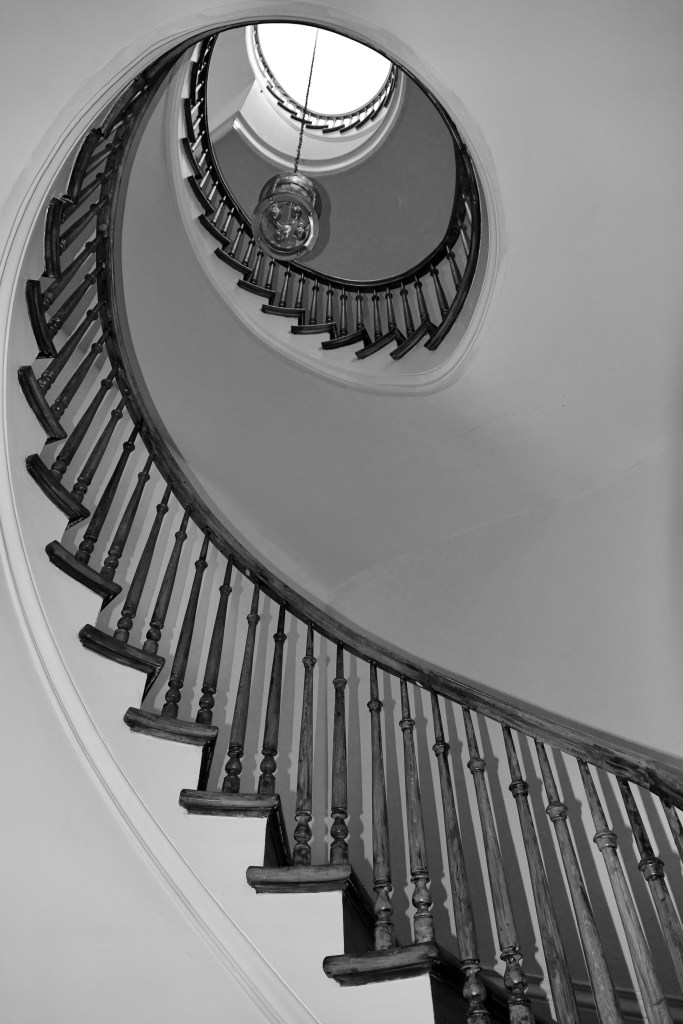
The interior of the house has four rooms on each level. In the center of the structure is a dramatic staircase that extends upward from the main floor all the way to the cupola. There are 12-foot ceilings and 8-foot windows throughout the first floor, with 11-foot ceilings with 6-foot windows on the second floor. The rooms were equipped with iron stoves for heating. Next to each room is a triangular alcove, making hallways unnecessary.

Authors image

Author’s image

With 16 rooms, it made up a total of 3,200 square feet of living space for Mr. Andrus and his family. Loren married Lucina Davis in 1841, and by 1849 he had received a land patent for 160 acres, just north of 26 Mile Road on Van Dyke where the Octagon House stands today. In 1854 Loren purchased an additional 80 acres fir $700.00, which is on the east part of the present day farm. Loren and Lucina went on to raise 8 children in the Octagon House.

Courtesy of Robert and Cheryl Allen

Loren’s brother-in-law, David Stewart, was a famous architect and carpenter, well known for his building skills. One home built by David Stewart is the brick home on Van Dyke and 30 Mile Road, now owned by the Huntington Bank also the Washington Union Church, also still standing in Washington.

While the Andrus family owned the home until 1894, there would over the years be numerous other owners who made this 8 sided home the place to reside. While many others also attempted to run businesses out of the house and farm, money difficulties made it necessary for something more permanent to take place. It wasn’t until the ‘Friends of the Octagon House’ purchased it in 1987 did the house’s security become apparent.

Author’s image

Many rumors and stories have followed the house through the years, most difficult to prove or disprove, but on fact stands on its own. If given a chance the house needs to be seen to truly understand the treasure Washington Township is gifted to have. Today, many talks and lectures are given (pre-pandemic) on many interesting topics by many local historians. I was honored to be able to give a book talk on Arcadia’s ‘Washington Township’ in 2019.

If you haven’t been out to visit the Octagon House recently, please add it to your ‘to do’ list, it’s well worth seeing and it helps support the care of this beautiful preserved home. The stories and tales go much farther than I have been able to talk about here.

I want to thank the Greater Washington Area Historical Society and Friends of the Octagon House for use of information used in this blog. The Octagon House, Diary of Phyllis Hamilton.

On the ‘wee note’ till next week.


Thank you for visiting and reading today. Besure to share with your friends using the share button below if you haven’t already please enter your email address in the form below to receive my stories by email.
What now……..?

I find that now with the ‘Farming in Northern Macomb County’ book having been sent to the publisher, my attention turns to “what now”! For many years I have been very interested in the great lakes lighthouses all around Michigan. I have tried to get too many of the lighthouses and photograph them for myself. A great many I managed to capture, but there was always ones I was unable to get too. Being that my thought process always seems to turn to anything of a vintage nature, I realized I would have to put aside my own images of the lights and work with older images, of which I had a some in the form of postcards.

Arcadia has another series of books, called ‘Postcards of America’ series. These books are very similar to the previous books, with the exception that Arcadia wants the majority of images coming from vintage postcards. Game on! Now, with a nod from Arcadia, I spend time searching out postcard images of the many lighthouses in the great lakes. Where the total scope of this book will be going is in the very early stages of thought, as what to be included and what not to include will take some time. Being able to put my love of lighthouse into book form is a very exciting venture that I am looking forward to.

Here are two vintage postcards, that will be a part of this venture;

Mission Point, in Grand Traverse County, on Lake Michigan, circa 1930’s
Point Betsie Light Station, Frankfort, on Lake Michigan

When seen in modern images of Point Betsie Light Station, these scruffy little bushes completely cover the front facade of this lighthouse, a photographic image of this angle is near impossible.

While I wait for the edits to come from Arcadia, were I will have to turn my focus back to Farming…. which they have now moved the publication time up to August from October. This interest of lighthouses is a subject that I am very excited about and will soon make my focus, I hope you will enjoy coming along on this ride, as I research these very valuable lights and how important they have been to the shipping industry in the great lakes.

On that ‘wee note’ till next week.


Thank you for visiting and reading today. Besure to share with your friends using the share button below. If you haven’t already please enter your email address in the form below to receive my stories by email.
The Romeo Middle School Time Capsule

September 4th of 1885 was a very proud day for the Village of Romeo and its surrounding school district. It was on that day that ceremonies were held dedicating the ‘new modern high school’.

In 1927 an addition was needed to house the many students attending the high school, seen in the news article below and a new more modern building was added and connected to the original victorian building from 1885. In the corner stone of the 1927 addition was placed a time capsule. By 1966, the original portion of the school, was in need of replacement, and the demolition soon started and the victorian building was torn down.

As time progressed, a new high school was built on 32 Mile Road and the now ‘old school’ was to become the middle school for the Romeo area. With the building of the new high school in 2019 on Powell Road in Washington, and the moving of the middle school into the now ‘old high school’ on 32 Mile, the 1927 school on Prospect Street was slated for complete destruction for a green space. But as fate would have it, the time capsule from the corner stone was found by one of the contractors, and opening it became a treasure for all those interested in history. The box was found to contain mostly documents, in pristine condition. The Romeo Community Schools Superintendent decided to donate the contents of the time capsule to the Romeo Community Archives at the Kezar Library. A copy of one of the oldest documents is shown below along with the man known to have signed the document.

Asahel Bailey arrived in Indian Village in January 1821. In July of that same year, he purchased 80 acres of government land on 26 Mile Road at Van Dyke. Bailey settled in Romeo early on. In 1858, he built his Greek Revival residence at 343 South Main Street (Van Dyke Road); this was his third home in the area. Years later the home was used as a parsonage for St Clements and as the Pontiac Nursery office. Bailey’s former home was moved and became a private home after it was moved to the Sisson Street area. Below, Asahel Bailey in his younger years.

It was known that Asahel was a pattern farmer of the settlement. HIs fields were always cleaned and finely cultivated, and everything in good repair. This might have been why the settlement asked him to be in charge of the schooling that was needed to educate the young students of the area. With the opening of the time capsule, the oldest article in the box, was the hand written application signed by Asahel Bailey quantifying a young lady to teach the settlement students on May 16, 1839.

This document and many others are available to be seen at the Community Archives. And for further information you can follow the Romeo Community Archives at the Kezar Library at https://romeocommunityarchives.blogspot.com.

A big thank you to Julie at the archives for allowing me access to the material to use in the blog today.

The Donley’s of Ballyporeen

In late spring of 1848 saw heavy rain, while early and midsummer experienced very hot temperatures, two conditions that spelled disaster for the autumn harvest. Realizing the severity of conditions, early in 1848 John Donley (1826-1885), the adventurous third son of John and Joanna, said goodbye to his parents and brothers and set out from their home in Ballyporeen, County Tipperary, on the thirty-five mile walk to Cork with £3 pounds (equal to about $15.00 or approximately 6 months wages) in his pockets. So, according to family lore, there were two ships sailing to North America that week from Cork, one bound for Halifax, Nova Scotia, and one for New York City. John asked who the president of Halifax was, and the ticket clerk informed him that Halifax was loyal to Queen Victoria, John quickly pulled out his 3 pounds on the table, saying, “I’ll take New York”, John a 22 year old  farm laborer, set sail from Cork, Ireland on the Bark Christianna for the port of New York.

After John Donley arrived in New York, he entered a lease-purchase agreement on a 160 acre farm in Lenox, Macomb County, Michigan. John’s brother Michael and his family came to the US and the two brothers set about clearing the land and building a log cabin for them to live in. In 1856 the Donley brothers jointly purchased for $465 the 160 acres farm on Irish Road (29 Mile Road) that would be the home for four generation of Donley’s. Soon brother Patrick joined Michael and John in Lenox. In December 1864 the 160 acre farm was divided into three equal parts, which were owned individually by each of the brothers.

John Donley married Mary Barry, and upon her death, he married Ellen Hickey, John would continue to work the farm until his death in 1885 and was buried in New Baltimore. Ellen passed away in 1899.

Thomas’, John and Mary’s son, had the natural ambition to be a farmer and a family man. He bought an 80 acre farm across the road from the Donely cabin, and the house he built cost $900. which is were he brought his bride, Catherine Sullivan in 1886. Catherine was from a neighboring farm also with Irish roots. Thomas and Catherine had three children, Mary born in 1892, who died in infancy, Hugh born in 1890 and a daughter Mary born in 1892. Major changes for the family occurred when Thomas was kicked by a horse and died from his injuries. His young son had just turned six. Catherine Sullivan Donley was a strong women and very determined, self sufficient widow. After Thomas death in 1896, she sought tenants to farm the eighty acres of land she and her late husband owned. She and her children moved to Richmond where the school was located, so the children could get a proper education. She rented a house and took in trade salesmen as boarders to help with the costs. When her son graduated from high school, she wanted him to qualify to be a school teacher. The nearest school was in New Baltimore, so the family moved there and she once again took in boarders to help pay for the schooling till he finished getting his teaching certificate.

During World War I, Mary moved to Detroit and once more became a landlady to defray the costs, but did ok, with the help of the farm income at times. Although farm prices declined in the 1920’s, she moved back to the farm and lived in the house until she died in 1930.

Hugh had inherited his grandfather’s John Donley’s farm, and after his mother’s death he inherited the family farm across the street from the cabin. He rented out the land while we was teaching. But in spite of his love of teaching the lure of the farm brought him back to farming around 1815 to 1920. Hugh married Frances Gavin, and they decided to move back to Detroit where he worked for the auto industry as a book keeper. But with the looming depression, pretty much everything would be lost and once again they made the move with their family back to the farm.

Hugh and Frances Garvin Donley, raised eight children, and it would be this generation that would start the important task of caring for the family cabin in the coming years. Ed was the oldest, with Frank (1923-1943), Hugh Jr. (1926-1989), Joseph (1928-1994), Thomas (1930-1931), Lawrence (1932- ), Mary Ann the only Donley daughter (1935- ) and Michael (1937- ). After moving back and enduring the loss of two of their children, to the farm house a cross from the cabin in Lenox, the troubles only continued when in 1940 a fire broke out and burn down the house, the family now had only the cabin (18 ft x 27 ft) to live in for the next few years. But to the children, they were left with irreproachable examples of two human beings, who when confronted with seemly endless disaster, always maintained their commitment to their principles.

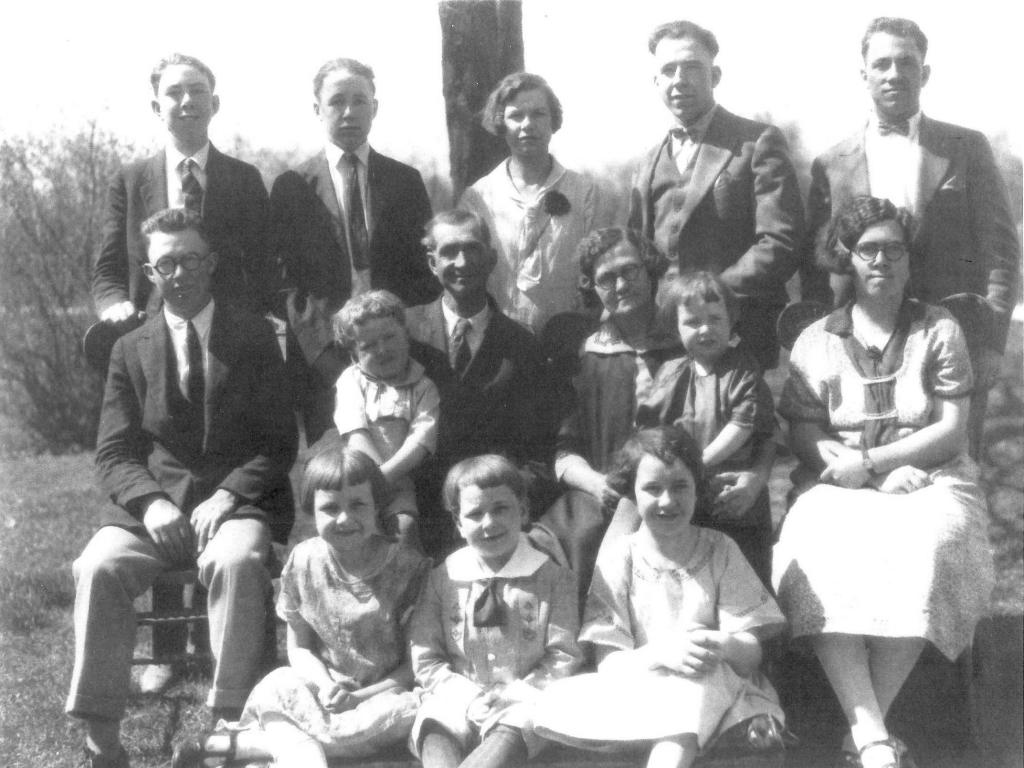
It is Hugh and Frances son Lawrence (Larry) that I need to continue on with in this story. In 1931, John’s grandson, Hugh Donley took on the task of preserving the cabin with a new foundation and new mortar between the logs. This was needed when the family moved back into the cabin after the fire at the farm house across the street. But as years moved on to the late 1960’s and into the 1970’s the cabin had been through a lot of of ‘life’ and from the first images above was in bad shape. Here is were Larry enters the picture of my story, as he decided that redoing the entire cabin was a project that needed to be started. In 1972 the great grand sons took the cabin apart, numbering each log and rebuilt using the old mortar mixed with new. See picture above after the restoration.

While the family did their best to keep an eye on the cabin, so did the vandals with nothing better to do than ruin the long loved family history of the Donley’s. It was only because of the fast response of the Lenox Township Fire Department that they were able to save the cabin from total destruction at the 29 Mile and Gratiot Road cabin. The Richmond Historical Society approached the family saying they would like to move the cabin to the little historical, village they were putting together at Bailey Park. After many hard discussions and thought, the Donely’s realized that probably the safest place and best place to preserve the cabin was to help the Historical Society with their venture. And so in 1998 the John Donley cabin was very carefully moved to Bailey Park. In 2017 the cabin was restored with some additional work were two logs were replaced, new roof beams and roof, windows and doors. Below, in 2019, the Donley family reunion, they try and hold every two years, now they gather in Richmond at Bailey Park.


You will find more stories like this in the Farming in Northern Macomb County, another ‘Images of America’ series book, due out in October 2021.

On that ‘wee note’, till next week.

Courtesy of Larry and John Donley and their book ‘The Donley Log Cabin An Oral History’

Thank you for visiting and reading today. Be sure to share with your friends using the share buttons below. If you haven’t already please enter your email address in the form below to receive my stories by email.