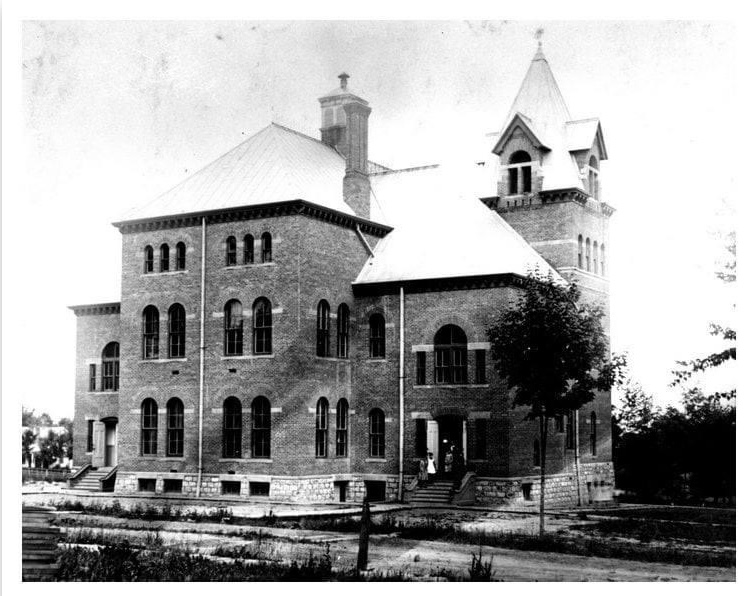
September 4th of 1885 was a very proud day for the Village of Romeo and its surrounding school district. It was on that day that ceremonies were held dedicating the ‘new modern high school’.
In 1927 an addition was needed to house the many students attending the high school, seen in the news article below and a new more modern building was added and connected to the original victorian building from 1885. In the corner stone of the 1927 addition was placed a time capsule. By 1966, the original portion of the school, was in need of replacement, and the demolition soon started and the victorian building was torn down.
As time progressed, a new high school was built on 32 Mile Road and the now ‘old school’ was to become the middle school for the Romeo area. With the building of the new high school in 2019 on Powell Road in Washington, and the moving of the middle school into the now ‘old high school’ on 32 Mile, the 1927 school on Prospect Street was slated for complete destruction for a green space. But as fate would have it, the time capsule from the corner stone was found by one of the contractors, and opening it became a treasure for all those interested in history. The box was found to contain mostly documents, in pristine condition. The Romeo Community Schools Superintendent decided to donate the contents of the time capsule to the Romeo Community Archives at the Kezar Library. A copy of one of the oldest documents is shown below along with the man known to have signed the document.
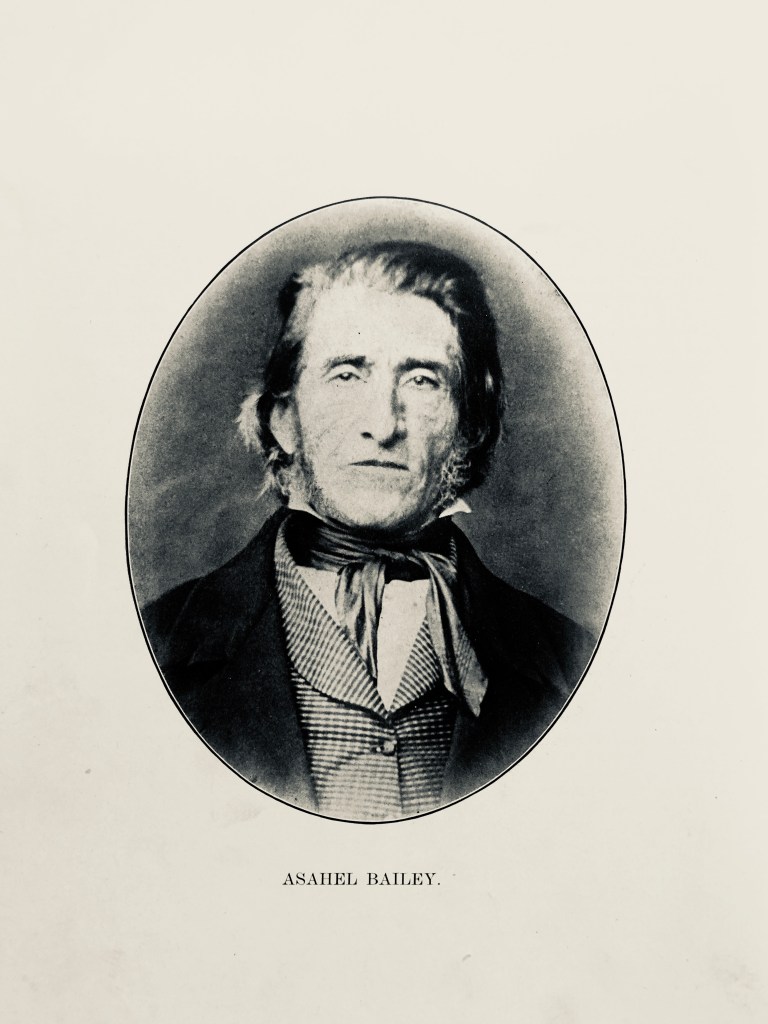
Asahel Bailey arrived in Indian Village in January 1821. In July of that same year, he purchased 80 acres of government land on 26 Mile Road at Van Dyke. Bailey settled in Romeo early on. In 1858, he built his Greek Revival residence at 343 South Main Street (Van Dyke Road); this was his third home in the area. Years later the home was used as a parsonage for St Clements and as the Pontiac Nursery office. Bailey’s former home was moved and became a private home after it was moved to the Sisson Street area. Below, Asahel Bailey in his younger years.
It was known that Asahel was a pattern farmer of the settlement. HIs fields were always cleaned and finely cultivated, and everything in good repair. This might have been why the settlement asked him to be in charge of the schooling that was needed to educate the young students of the area. With the opening of the time capsule, the oldest article in the box, was the hand written application signed by Asahel Bailey quantifying a young lady to teach the settlement students on May 16, 1839.
This document and many others are available to be seen at the Community Archives. And for further information you can follow the Romeo Community Archives at the Kezar Library at https://romeocommunityarchives.blogspot.com.
A big thank you to Julie at the archives for allowing me access to the material to use in the blog today.
In late spring of 1848 saw heavy rain, while early and midsummer experienced very hot temperatures, two conditions that spelled disaster for the autumn harvest. Realizing the severity of conditions, early in 1848 John Donley (1826-1885), the adventurous third son of John and Joanna, said goodbye to his parents and brothers and set out from their home in Ballyporeen, County Tipperary, on the thirty-five mile walk to Cork with £3 pounds (equal to about $15.00 or approximately 6 months wages) in his pockets. So, according to family lore, there were two ships sailing to North America that week from Cork, one bound for Halifax, Nova Scotia, and one for New York City. John asked who the president of Halifax was, and the ticket clerk informed him that Halifax was loyal to Queen Victoria, John quickly pulled out his 3 pounds on the table, saying, “I’ll take New York”, John a 22 year old farm laborer, set sail from Cork, Ireland on the Bark Christianna for the port of New York.
After John Donley arrived in New York, he entered a lease-purchase agreement on a 160 acre farm in Lenox, Macomb County, Michigan. John’s brother Michael and his family came to the US and the two brothers set about clearing the land and building a log cabin for them to live in. In 1856 the Donley brothers jointly purchased for $465 the 160 acres farm on Irish Road (29 Mile Road) that would be the home for four generation of Donley’s. Soon brother Patrick joined Michael and John in Lenox. In December 1864 the 160 acre farm was divided into three equal parts, which were owned individually by each of the brothers.
John Donley married Mary Barry, and upon her death, he married Ellen Hickey, John would continue to work the farm until his death in 1885 and was buried in New Baltimore. Ellen passed away in 1899.
Thomas’, John and Mary’s son, had the natural ambition to be a farmer and a family man. He bought an 80 acre farm across the road from the Donely cabin, and the house he built cost $900. which is were he brought his bride, Catherine Sullivan in 1886. Catherine was from a neighboring farm also with Irish roots. Thomas and Catherine had three children, Mary born in 1892, who died in infancy, Hugh born in 1890 and a daughter Mary born in 1892. Major changes for the family occurred when Thomas was kicked by a horse and died from his injuries. His young son had just turned six. Catherine Sullivan Donley was a strong women and very determined, self sufficient widow. After Thomas death in 1896, she sought tenants to farm the eighty acres of land she and her late husband owned. She and her children moved to Richmond where the school was located, so the children could get a proper education. She rented a house and took in trade salesmen as boarders to help with the costs. When her son graduated from high school, she wanted him to qualify to be a school teacher. The nearest school was in New Baltimore, so the family moved there and she once again took in boarders to help pay for the schooling till he finished getting his teaching certificate.
During World War I, Mary moved to Detroit and once more became a landlady to defray the costs, but did ok, with the help of the farm income at times. Although farm prices declined in the 1920’s, she moved back to the farm and lived in the house until she died in 1930.
Hugh had inherited his grandfather’s John Donley’s farm, and after his mother’s death he inherited the family farm across the street from the cabin. He rented out the land while we was teaching. But in spite of his love of teaching the lure of the farm brought him back to farming around 1815 to 1920. Hugh married Frances Gavin, and they decided to move back to Detroit where he worked for the auto industry as a book keeper. But with the looming depression, pretty much everything would be lost and once again they made the move with their family back to the farm.
Hugh and Frances Garvin Donley, raised eight children, and it would be this generation that would start the important task of caring for the family cabin in the coming years. Ed was the oldest, with Frank (1923-1943), Hugh Jr. (1926-1989), Joseph (1928-1994), Thomas (1930-1931), Lawrence (1932- ), Mary Ann the only Donley daughter (1935- ) and Michael (1937- ). After moving back and enduring the loss of two of their children, to the farm house a cross from the cabin in Lenox, the troubles only continued when in 1940 a fire broke out and burn down the house, the family now had only the cabin (18 ft x 27 ft) to live in for the next few years. But to the children, they were left with irreproachable examples of two human beings, who when confronted with seemly endless disaster, always maintained their commitment to their principles.
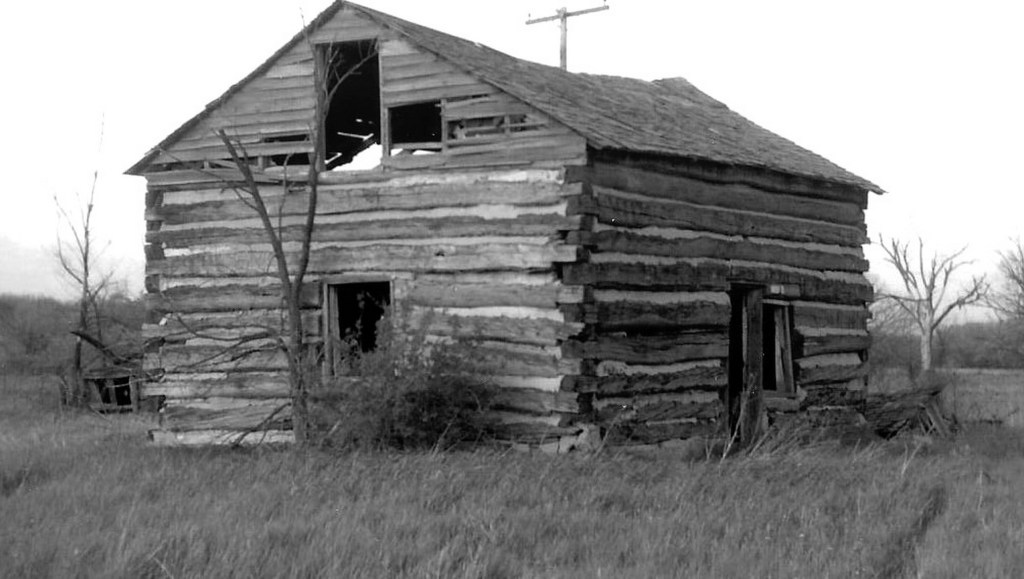
It is Hugh and Frances son Lawrence (Larry) that I need to continue on with in this story. In 1931, John’s grandson, Hugh Donley took on the task of preserving the cabin with a new foundation and new mortar between the logs. This was needed when the family moved back into the cabin after the fire at the farm house across the street. But as years moved on to the late 1960’s and into the 1970’s the cabin had been through a lot of of ‘life’ and from the first images above was in bad shape. Here is were Larry enters the picture of my story, as he decided that redoing the entire cabin was a project that needed to be started. In 1972 the great grand sons took the cabin apart, numbering each log and rebuilt using the old mortar mixed with new. See picture above after the restoration.
While the family did their best to keep an eye on the cabin, so did the vandals with nothing better to do than ruin the long loved family history of the Donley’s. It was only because of the fast response of the Lenox Township Fire Department that they were able to save the cabin from total destruction at the 29 Mile and Gratiot Road cabin. The Richmond Historical Society approached the family saying they would like to move the cabin to the little historical, village they were putting together at Bailey Park. After many hard discussions and thought, the Donely’s realized that probably the safest place and best place to preserve the cabin was to help the Historical Society with their venture. And so in 1998 the John Donley cabin was very carefully moved to Bailey Park. In 2017 the cabin was restored with some additional work were two logs were replaced, new roof beams and roof, windows and doors. Below, in 2019, the Donley family reunion, they try and hold every two years, now they gather in Richmond at Bailey Park.
You will find more stories like this in the Farming in Northern Macomb County, another ‘Images of America’ series book, due out in October 2021.
On that ‘wee note’, till next week.
Courtesy of Larry and John Donley and their book ‘The Donley Log Cabin An Oral History’
Thank you for visiting and reading today. Be sure to share with your friends using the share buttons below. If you haven’t already please enter your email address in the form below to receive my stories by email.
In December, I contracted with Arcadia Publications to write my third book for them. I was made aware that there were people, who had missed inclusion in the previous books I had written. Although many of the Northern Macomb County townships already had the ‘Images of America’ books highlighting them, there were at least four of these townships, Lenox, Ray, Bruce and Armada that didn’t. While the population, seems to move forward and going north that seems to be the direction for that growth. These townships population is considerably smaller that most of the others in this area. But large or small population, there are still stories to be told and to be documented.
I realized my best option, was to make a chapter for each of the nine townships. While the usual and past books have included information on the complete area, from schools, churches, governmental building, shoppes as well as the early settlers, I found researching the farming life of these areas fascinating, so that became my focus.
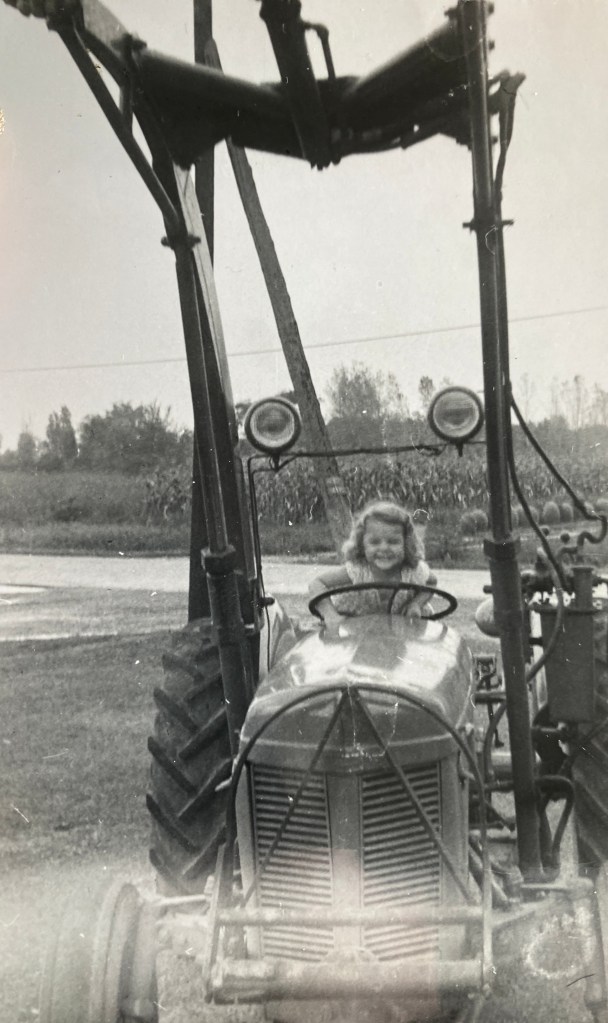
While I have been asked if I had grown up on a farm, I would reply that I was surely a “city girl”! Then I came across this image of me when my family was living in Canada during the mid to late 1950’s, and it looks like learning to drive a tractor was something I had already accomplished. After that, the closest I got to a farming life was as a 10 years old, using an old bunkbed ladder to climb a stockade fence and drop down on to a fifty gallon oil drum to visit my friend Jane. Were we would go in to her parents garden and pilfer their kohlrabi. Today when shopping for vegetables and I see the kohlrabi in season, I still remember those days. But when you realize how many kitchen ‘tools’ you need just to get passed the leaves and stocks and skin on kohlrabi just to make it edible, how did two young kids do it straight out of the garden?
As you do the research, you are always on the look out for the perfect image to use on the cover. Although Arcadia usually asked for as many as 10 images for them to find the best, that will fit the cover, and they like a human interest aspect to it. This time, I remembered this image from the ‘Macomb’ book, and talking to the gentleman who met me at the archives to see what he had for a submission into that book. That gentleman, is the little boy on the tractor.
I don’t think I could have found a better image to use than the one showing a father on his ‘brand new 1953 Ford tractor’ with his little son adding his ‘opinion’ to the situation.
I have been very lucky to be able to meet some really lovely farming families, and be taught all about this very hard working way of life, from planting techniques, to farm machinery and how its used. This is a way of life that should give everyone a deep pause when we put these fresh foods on our tables. It is with great excitement and pleasure that this week, this book goes off to my publisher. Looking for an early fall publication date 🙂
On that ‘wee note’, till next week
Thank you for visiting and reading today. Be sure to share with your friends using the share buttons below. If you haven’t already please enter your email address in the form below to receive my stories by email.
The earliest building in Romeo to serve as a community center was the Gray’s Block at 231 North Main Street. It was constructed in 1869 to house Gray’s Opera House. The $22,000. building was designed in the Italianate style by local architect Oscar S. Buell, and financed by brothers Hugh, James and Noah Gray. When finished, the three-story structure had stores on the ground floor, with offices, a ballroom and a Township Hall that seated 1,000 people on the upper levels. The building was at the time “the most costly and elegant building in Macomb County” according to the Romeo Observer- 1869.
At the turn of the twentieth century the Gray’s Opera House provided the spot for social activities, staging plays, vaudeville shows, and musicals. And for all its special entertainment, it was also known to have withstood five fires between 1876 and 1941. With varying degrees of damage necessitated rebuilding, and much repair and improving. The Masonic Temple would make a home there in later years, as did the Romeo Village town hall occupied space in the building in the 1950’s. But one of its more important meetings would soon come to light.
The Grays Block, Main Street, Romeo
A citizens meeting was held at Gray’s Opera House in Romeo on January 11, 1879. The object of this meeting was ‘merely to get matters in shape for raising of the $30,000 promised for the erection of a new county building, should the county seat be moved too Romeo’. ‘ The Honorable A.B. Maynard, being present, addressed the meeting briefly to explain the object and purposes to the citizens of Romeo in the matter under consideration’. ‘He stated that the proposal had nothing to do with any unrest felt with Mt. Clemens, but Romeo was simple exercising its undoubted and unquestioned right, in a business point of view. Mr. Maynard spoke for about 10 minutes and his remarks seemed to be well received, by the end of the meeting they had amassed $6000. though subsequently, other citizens followed the example and within a short time the entire $30,000 was raised. In todays money, these men raised $784,746.00!
Romeo Observer Wednesday January 15, 1879
A few years ago, when I first came across this story, I became aware there was a touch more to this story, and although Mt. Clemens was appreciative that Romeo was willing to burden themselves with becoming the county seat, (thank heavens they didn’t) their offer was declined, but the $30,000. raised, was kindly accepted to build the new jail, Mt Clemens very much needed at the time.
On that ‘wee note’ till next week.
Images and articles courtesy of the the Romeo Community Archives at the Kezar Library.
Thank you for visiting and reading today. Be sure to share with your friends using the share buttons below. If you haven’t already please enter your email address in the form below to receive my stories by email.
Otis W Cotton an expert with an ax, came to Chesterfield in 1832-33 and started a new life in Michigan when it was still a territory. Cotton purchased 128 acres on the new road about where today’s Cotton Road touches Gratiot. One of his neighbors was Martha Fairchild, the daughter of early Chesterfield pioneers. Though clearing the land was arduous work there was still time for romance. In 1833 Otis Cotton and Martha Fairchild married. A ew months later the newlyweds built a log cabin on the Fort Gratiot Turnpike.
It was a hard struggle to keep them clothed and fed until the growth of timber could be cut and the soil made productive. Because of the limited resources even the loss of a cow, was a heavy misfortune in this primitive wilderness. Wolves brought additional hardships, as at one point the Cottons lost and entire flock of sheep to a pack of wolves. With the family dependent on wool for clothing and bedding, this would make for a serious loss. They would persevered and ‘the conditions of pioneer life gave way to an advance civilization, and they would enjoy a comfortable living before passing away, Otis 1884 and Martha in 1887.
The Cottons were the parents of nine children. Their three sons all fought in the Civil War. Son Jay, seen here in this image below, enlisted, and later became and officer in the First Michigan Cavalry. He was present at the surrender of General Robert E Lee at Appomattox, Virginia in 1865. Jay was born with his patriotic spirit found at an early age. Jay would sit spellbound listening to eyewitness accounts by his grandmother, Ruth Fairchild. Her father Jacob Hall, wad a minuteman in the Revolutionary War.
Jay often heard the story of the Revolutionary Wars biggest scandal, the betrayal and treason of Benedict Arnold. His grandmothers sister watch the execution of Major John Andre. John Andre, a British officer, played a key role in Benedict Arnolds attempted plot to turn the fortress of West Point over to the British. Andre was captured and hung as a spy in 1780.
After the Civil War Jay Cotton left with a wagon train for Nebraska were he farmed and ran a hardware. In 1876 Jay was called upon to mourn the death of his first wife, Jennie Ensminger, leaving him with four children. In 1878 at the request of his father, he returned to Michigan. There he purchased the old homestead and continued the family tradition of farming. Jay married a second time to a widow named Maria Tucker. With her two children from her first marriage, Jay and Maria would have a daughter together. The Chesterfield farm would continue to thrive.
Maria Cotton would die on the 3 November 1924 with Jay following on 10 June 1929.
With that ‘wee note’, till next week.
Image courtesy of Mick Sullivan of Lenox Township
Thank you for visiting and reading today. Be sure to share with your friends using the share buttons below. If you haven’t already please enter your email address in the form below to receive my stories by email.






 Linda Osborne Cynowa