‘Lighthouses of the Southern Atlantic and Gulf States’

Linda’s Monthly Monday Morning Moaning’s for July 7, 2025

I have been very fortunate to have had six previous local history books published by Arcadia Publishing since 2019, and nothing compares to the feeling when the first package of finished books are delivered to my door. All the work, research, time, love, and aggravation in bringing this ‘new baby’ to life, Arcadia will then compensates you by giving you the first five copies that are printed, and don’t mistake my thoughts, this is what you wait for!

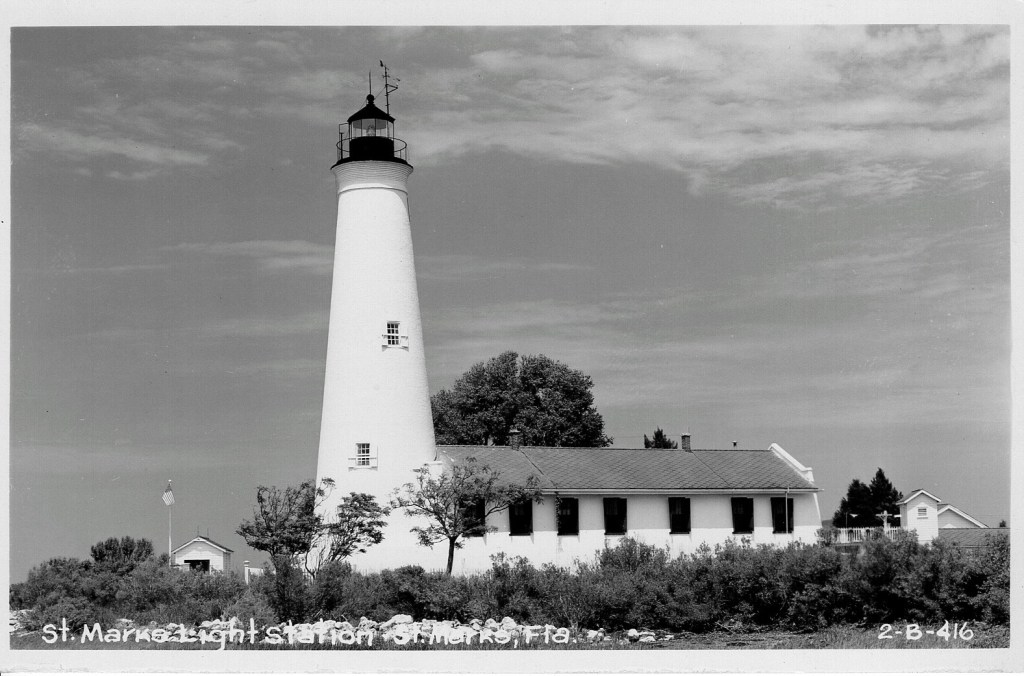
Working on these books, takes about 6 to 8 months of my time, when all your time is focused on getting the written work on the page and for me with the lighthouse books, making sure the right lighthouse goes with the correct postcard. And getting the written material correct! Then you wait for roughly 6 months, for Arcadia to go through your written work and give you a copy of a rough draft of what your book will look like. You then go through their draft, answer their questions as to why you might have done, such and such. You look for corrections and no matter how diligent you are in looking for mistakes, there is always some silly ones that need attention. After you have completed that portion, it is sent back to the publisher for another review, and when that is completed you are sent your last correct manuscript, and now it has to be as corrected as it is going to be, because it’s now going to print.

The publication date for ‘Lighthouses of the Southern Atlantic and Gulf States’ is the 29th of July. This is the last of the four lighthouse books I decided to bring to light. It covers as many lighthouses in vintage postcards for the different parts of the United States as has been possible to gather. The states covered in this book are Maryland, Virginia, North and South Carolina, Georgia, Florida, and the Gulf States (Alabama, Mississippi, Louisiana and Texas.)

The lighthouses on the Southern Atlantic coast are built and maintained with their sandy shores that create never ending continual erosion of the soil, and they have different difficulties, such as the years of the Civil War and the hurricanes than you would find on the Pacific coast lights with their high rocky cliffs and earthquakes. In Michigan, we have many pier lights in the water on the Great Lakes, as well as some on sandy beaches, where erosion also takes its toll. My hope is if you are able to get a chance to see with the different area books, how the landscape of the United States can change from coast to coast, and have an effect on the many lighthouses that have guarded the coastal waters in and around this country.

On this ‘wee note’ till next month Monday August 4, 2025.


Thank you for visiting and reading today. Please if you haven’t already, enter your email address in the subscription form below to receive my blog by email on the first Monday of each month.
Preserving a Legacy

Linda’s Monthly Monday Morning Moaning’s for June 2, 2025

Preserving a Legacy, The United States Lighthouse Society: For the past 40 years, the United States Lighthouse Society (USLHS) has been in the forefront of efforts to preserve this essential part of maritime heritage. The USLHS has built a comprehensive research library, both in the physical form and digital form. The library contains books, maps and documents that detail the history of lighthouses in America and around the world. The Society’s mission goes beyond simple restoration, but seeks to keep the stories of these remarkable structures alive, for future generations to understand the vital role that lighthouses played in the safety and development of coastal communities.

Part of the mission of the USLHS is to offer national grants specifically for lighthouse preservation. These grants have enabled the restoration of many lighthouses, many of which have been in danger of being lost forever.

Long before the invention of the compass or modern technologies, early seafarers went on voyages using the most primal of tools, the sun, stars, the wind and the sea tides. The North Star holds it position in the northern sky about the earths axis, in a fixed position. But even before the tools for sea faring voyages improved, navigation remained very dangerous. The sea was open to hidden reefs and shoals, the rocky coastlines, unpredictable weather, and treacherous currants. But because of these hazards to navigation, it is the reason lighthouses began to rise as the guardians of the coastlines.

Each lighthouse is positioned to warn mariners of these hazards, while also providing a point of reference that could mean the difference between life and death at sea. As the technology advanced the lighthouse evolved from simple bonfires to towering stone structures with powerful Fresnel lens, that had the ability to project their light across miles of open water. They would always be a symbol of hope to the seafaring mariners.

So why do lighthouses continue to capture the heart and minds of people all around the world? They are symbols of solitude and community, standing along on rocky cliffs or the sandy shores, yet always offering a guiding light for those in need. Through their work, the USLHS, whether through research, restoration or education, it ensures that the legacy of lighthouses remains an essential part of our nation history.


I want to give thanks and my great appreciation to the people at ‘The United States Lighthouse Society’, their 40th Anniversary edition of ‘The keepers Log’, Number Four, 2024, for the information as written here today. When ever visiting a lighthouse, and if from Michigan you can’t go very far in any direction with out running into one of them, in your thoughts, and remember this group when every you see a lighthouse still standing.

On this wee note, till next month Monday July 7, 2025.

Thank you for visiting and reading today. Please if you haven’t already, enter your email address in the subscription form below to receive my blog by email on the first Monday of each month.
A Michigan Mystery

Linda’s Monthly Monday Morning Moaning’s for May 5th, 2025

With my long love of history, I am always looking for that next great read and hopefully with some sort of an mystery attached. A few years ago I came across just the book I was looking for.

Northwest Orient Airlines, Flight 2501 was a DC-4 with operating service between New York City and Seattle, Washington, when it disappeared during the night of June 23, 1950. Flying from New York’s LaGuardia Airport to Minneapolis, Minnesota, and from there a new crew would take over and complete the flight to Spokane and Seattle. This flight had 55 passengers and 3 crew members that night. When the flight passed Battle Creek in Michigan at 11:51p.m. it was approaching the edge of a squall line, heading straight for Lake Michigan and sitting in the path the plane was heading for.

Northwest Airlines DC-4

When flight controllers last heard from the crew, at 12:13 a.m. near Benton Harbor, the crew had been asking for clearance to descend from 3,500 feet to 2,500 feet, because of a severe electrical storm, but request was denied due to what was thought, at the time to have been other air traffic at a lower altitude, in the vicinity. At 12:15 a.m. the Captain acknowledge the denial and signed out. Flight 2501 was never heard from again.

Some of the people lost that night

The day had been hot, and the evening brought little respite from the heat, and many lakefront residents were out near the lake taking in the breeze to cool off before bed, when at 12:20 a.m. an airplane could be heard over head, soon an unusual flash was seen several miles off shore. They did not realize they had witnessed what at the time would be the worst aviation accident in the country till that ime. When the flight did not arrive in Milwaukee, the Coast Guard was alerted and the search and rescue operation was begun.

Over the next days the US Coast Guard recovered fragments of the airplane, its cargo, and passengers. Area beaches were closed to spare people from encountering any remains not already recovered. After five days all recovery was stopped.

Members of the Michigan Shipwreck Research Association (MSRA), on the 53rd anniversary of the accident wrote a commemorative article on the subject of the flight and the piece was brought to the attention of Clive Cussler, and adventurer novelist, who has in the past used his book royalty’s to finance searches of sunken ships. A joint venture was proposed to see if wreckage from the down plane could still be found. By the end of 2013, 10 expeditions had been launched and 600 square miles were covered, with no sign of the wreckage, although not discouraged Clive Cussler believed that “A wreck will not be found until it wants to be found”. Over the passed few years, further side scan sonar attempts have been made when leads are discovered. Remains have been buried in Riverview Cemetery in St Joseph, Michigan and Lakeview Cemetery in South Haven, Michigan.

Valerie van Heest, is MSRA co-director and author of the book, shown above, ‘Fatal Crossing’, this is truly one of the most well written and interesting books I have read, and I can’t suggest it enough, if you like a good strong story that will hold your interest till the end. The book weaves a captivating portrait of the victims, and vividly recreates the last few hours of Flight 2501, such as after the dinner meal was served, the flight attendant passed out two cigarettes to each of the passengers that cared to have a smoke. This is a very deep dive into the past. I have written here but a very small taste of what this book is all about, I hope it will peak some interest in others, to see if my praise is correctly written about this very interesting book.


Thank you, with great appreciation to V.O. van Heest at http://www.in-depteditions.com published 2013, and ‘Lost Over Lake Michigan’ by V.O. van Heest for May-June 2014 edition of Michigan History Magazine.


On that ‘wee note’ till next month, Monday June 2nd, 2025.

Thank you for visiting and reading today. Please if you haven’t already, enter your email address in the subscription form below to receive my blog by email on the first Monday of each month.
The Thorington School Part 2

Linda’s Monthly Monday Morning Moaning’s for April 7, 2025

Back in early 2020, I wrote a blog about my frustration in seeing a Washington Township treasure, the 1840 Thorington primary school, sit at the side of the road, at Mound and 31 Mile and slowly deteriorate as time went on. Many people would comment on why this was allowed to happen, but nothing seemed to fix this issue. I realized that our township Supervisor Sebastian Sam Previti was also greatly bothered that this landmark for Washington was being ignored, and over the next four years he managed to come to an agreement with the owners of this small bit of property, 1/8th of an acre with the school sitting on it. Image below, from 2021.

Image below from 2023, now showing the large hole in the roof that that continues to weaken the structure further.

To further this, I will let Sam speak for himself: I am excited to announce the purchase of the historic 1840 Thorington School House!

I am proud to share that we have officially secured the purchase of the historic 1840 Thorington School House! This acquisition was approved by the Washington Township Board of Trustees with a 6-1 vote, marking a major step in preserving our community’s rich history. 

The Thorington School House, located on Mound Road just south of 31 Mile, was purchased for $125,000, including the original school bell. Right now, the building sits on just 1/8 of an acre, making it difficult to develop, maintain, and fully restore. That’s why I’m leading the effort to relocate it to a 10-acre township-owned parcel on 31 Mile Road between Mound and Campground. This move will allow us to properly restore, protect, and showcase this incredible piece of history for future generations.

The new location will become Thorington Park, a public green space that will feature: A pavilion, restrooms, playscape, pickleball courts & parking. The historic schoolhouse as the focal point, for a beautiful setting for student visits, proms, homecomings & photos and rental space for small private events. A fruit tree from each township orchard to honor our agricultural heritage will be planted on the site.

To restore and revitalize the Thorington School House, we are partnering with Craig Brant, Romeo Schools Building Trades teacher, whose students will gain hands-on experience in construction and restoration. Additionally, Romeo High School architecture students, led by Evva Dossin, played a major role in designing the park layout, creating a working mockup of the future Thorington Park. Finally we are having our planning consultant Spalding DeDecker work to explore grants and funding to help explore funding avenues of this project. Protecting our historical landmarks for future generations

Beyond my role as Supervisor, I also serve as President of the Greater Washington Area Historical Society and Museum, where I’ve helped raise critical funds to preserve the 1916 former High School that now serves as the Washington Township museum, including securing a much-needed roof replacement. My passion for history runs deep, and I am honored to lead this project for our township. The Romeo-Washington-Bruce Parks and Recreation Department will oversee the park’s maintenance, ensuring it remains a long-lasting community asset and follow a key part of our township’s master plan for new parks and green spaces. Sebastian Sam Previti.

Having been ‘cleaned up’, now waiting for its next move in July, a 1/4 mile east of its present location to a 10 acres parcel on 31 Mile Road and Campground.


Thank you Sam, for all the hard work, negotiations, and time you put into this project, in acquiring this little treasure for our community. There were many times I was fearful when passing the structure in the last few years that it would be laying as a pile of timber on the ground, each winter making the possibility of this, almost a sure thing. Thank you for taking the reins and seeing this project through, hopefully the hard part is finished. Above images courtesy of the author. Advertisement image courtesy of Anne Nicolazzo Photography. And thank you to ‘The Record’ newspaper.


Thank you for visiting and reading today. Please if you haven’t already, enter your email address in the subscription form below to receive my blog by email on the first Monday of each month. Thank you.

America’s Liner

Linda’s Monthly Monday Morning Moaning’s for March 3, 2025

Off she went….

On Wednesday, February 19, 2025, the SS United States, the liner often called ‘America’s Liner’, was towed from her berth at Pier 80 in Philadelphia, where she had been waiting for 30 some years. I have followed this ship for many years, with the ships manifest, memorabilia and photographic images, because it was on this ship my parents and I immigrated to this country from Great Britain in the mid 1950’s. A little girl below, who could easily have slipped into the ocean, (ok, Mum and Dad??) not knowing what was ahead with this big adventure she was on.

I had hoped that the ship builders granddaughter Susan Gibbs could save her grandfathers creation and bring it back to a useful entity once again. I had the pleasure of meeting this determined lady, and understood her passion. Sad to see that not to be.

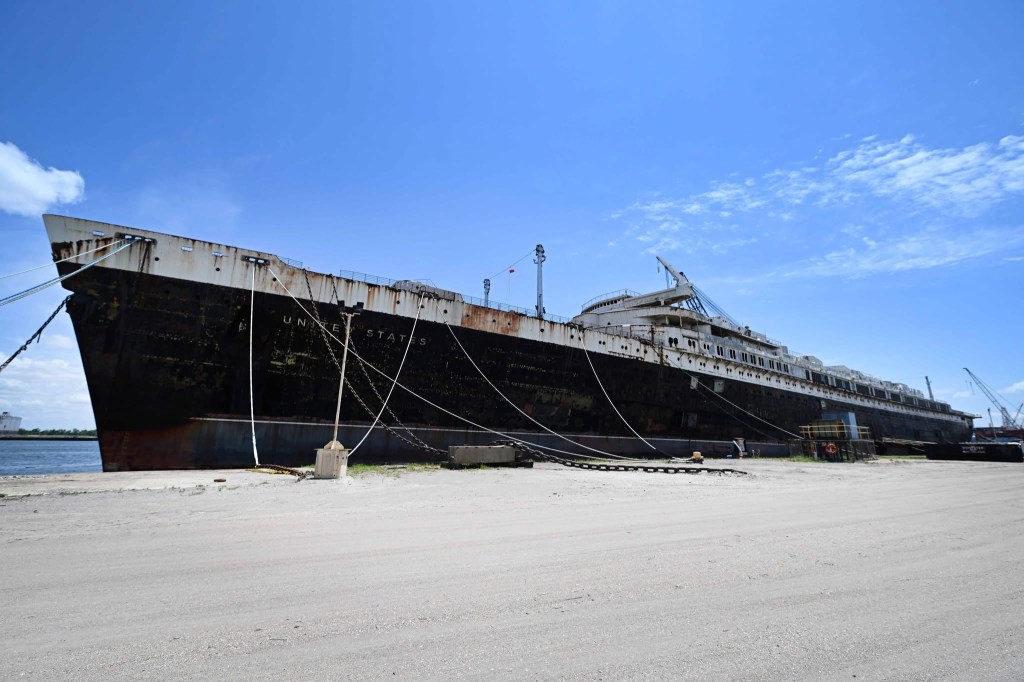
The ship was designed by American naval architect William Francis Gibbs and could have been converted into a troopship if required by the United States Navy in time of war. The ship served as an icon for the nation, transporting celebrities and immigrants throughout her career between 1952 and 1969. Her design included innovations in steam propulsion, hull form, fire safety, and damage control. Despite her record speed, passenger counts declined in the mid-1960s due to the rise in jet-propelled trans-Atlantic flights. Below, her at the height of her beauty, and below that, what 55 years of sitting and waiting will do……

First-class passengers were entitled to the best services and locations the ship had to offer, including the grand ballroom, the smoking room, first-class dining room and restaurants, observation lounge, main foyer, grand staircase, and promenades. Most of these facilities were located midship, distant from the vibrations and distractions of the engines and the outside.

The liner’s famous passengers favored first class due to its prestige, priority service, and spacious cabins. The Duck Suite, which was popularized by the Duke and Duchess of Windsor, was the ship’s best-known stateroom. It was created by combining three first-class staterooms into a single suite containing four beds, three bathrooms, two bedrooms, and a living room. Up to 14 similar suites could be created in a similar way, establishing a level of stateroom above that of a standard first-class ticket. Tickets for the two-bedroom suites started at $930 ($10,552 in today’s funds); these were aimed at the wealthiest passengers on board. Much like the Duck Suite, these rooms reflected a post-war American standard of living, lacking in intricate details and adorned with natural scenes.

Cabin class was aimed toward the American middle classes, striking a key balance between the affordability of tourist and the elegance of first class. Each cabin had four beds and a private bathroom, and were located primarily aft. While inferior to first class, passengers received service and had access to amenities that were historically reserved for the highest class on other ocean liners.The food, pool, and theater were shared with first-class passengers, making cabin class ideal for those who wanted the first-class experience without paying first-class rates.

Tourist class was aimed at those who were unable or unwilling to spend much on a ticket; it was often booked by migrants and students. Cheapest of all tickets, tourist-class cabins were located at the peripheries of the ship, where rocking and noise were most pronounced. These small cabins were shared among passengers, each room containing two bunk beds and simply furnished with little detail. Communal bathrooms were shared with all tourist-class passengers in the same passage. Service from the crew was lacking compared to the other classes, as tourist-class passengers received the lowest priority. While equivalent to the third-class on other vessels, these poorest conditions on United States were noticeably better than what was offered on other ships. I believe this was the way we sailed, based on images of a mother, her daughter and bunk beds!

Following the financial collapse of the United States Lines, the SS United States was withdrawn from service in a surprise announcement in 1969. All planned cruises were canceled, and the ship changed owners repeatedly for the next several decades. Every owner attempted to make the ship profitable, but she was aging and poorly maintained. In 1984, her interior furnishings were sold at auction, and the rest of her interiors were stripped to the bulkheads in 1994. In 1996, she was towed to Philadelphia, where she would remained.

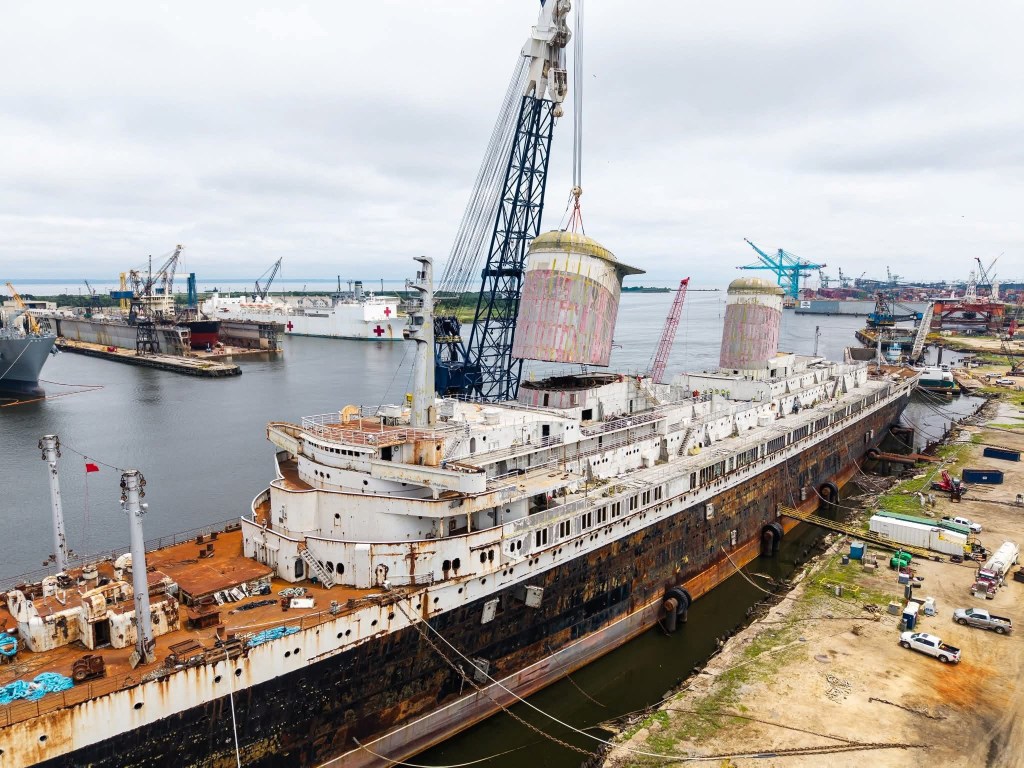
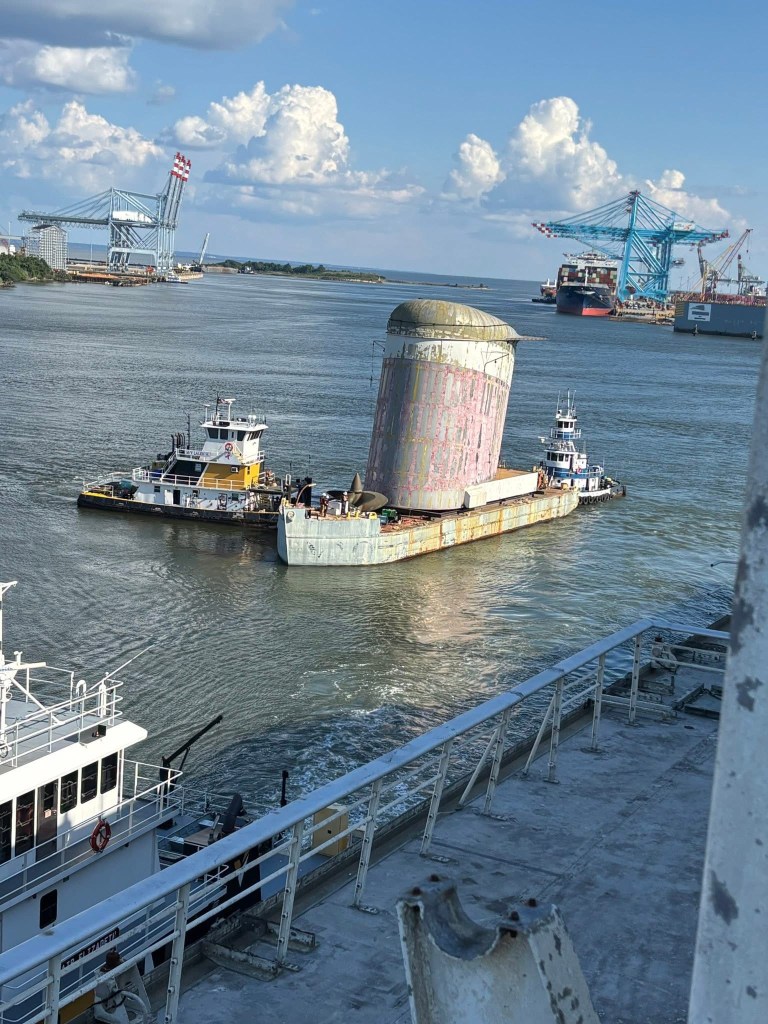
Since 2009, the ‘SS United States Conservancy’ has been raising funds in an attempt to save the ship from being scrapped. The group purchased her in 2011 and has created several unrealized plans to restore the ship. Due to a rent dispute, in 2024, the ship was evicted from her pier. Because no other locations for the ship could be found, America’s Flagship is on her way to Mobile, Alabama where she will be prepared as the World’s Largest Artificial Reef to be deployed off of Destin-Fort Walton Beach.

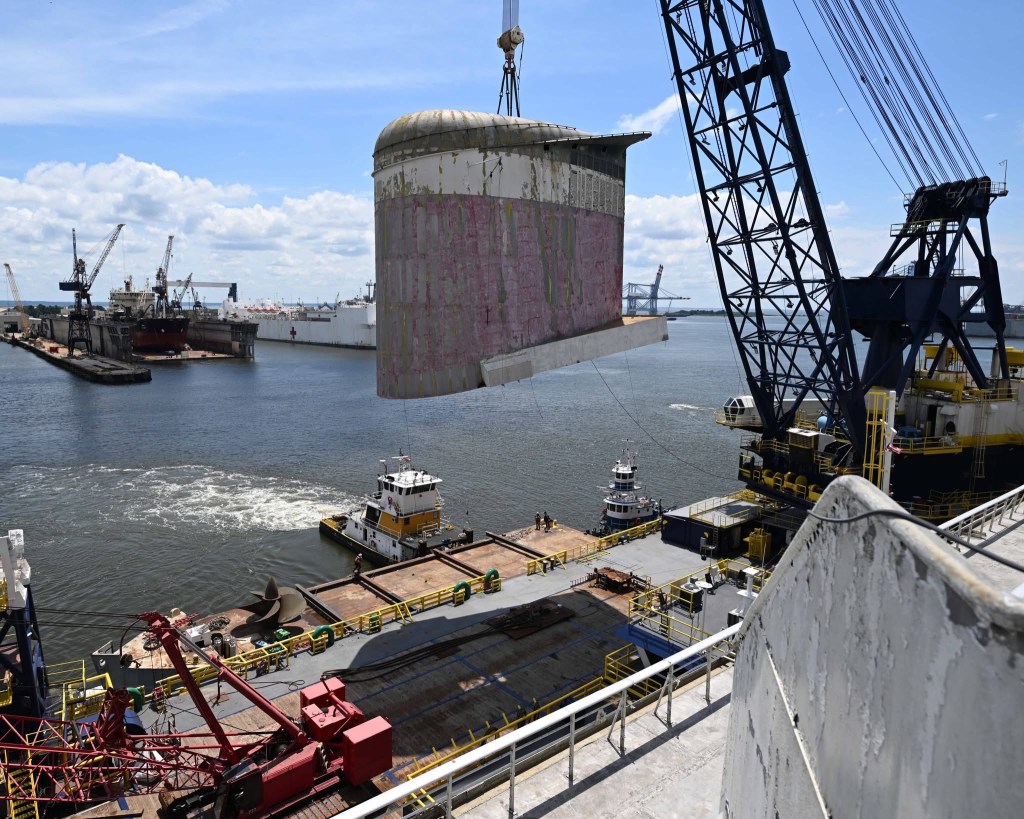
The ‘SSUS’ journey to Mobile, Alabama, is expected to take about two weeks. Upon arrival, the vessel will continue its rebirth into an artificial reef as contractors remove hazardous material, including nonmetal parts and fuel to ensure this deployment is clean and not harmful to the environment it aims to benefit. Modifications will also be made to ensure that when the vessel is deployed, it will land upright underwater. The preparation process will take about 12 months.

The exact location along the Gulf Coast for the vessel’s deployment has not been set but it is expected to be about 20 nautical miles south of the Destin-Fort Walton Beach area. As the World’s Largest Artificial Reef, the story of the ‘SSUS’ will be told to thousands of divers from around the world as they explore her unique design and features. She will also benefit her surrounding ecosystem and become home to countless marine species that will thrive from the presence of her structure.

Due to the size and the depth, this new artificial reef will provide bountiful fishing and diving opportunities for the local, visiting and charter industries. Okaloosa County will continue to partner with the SS United States Conservancy as it pivots to develop a land-based museum in Destin-Fort Walton Beach that will celebrate and commemorate the nation’s flagship. I will do another blog when she gets herself settled in her new home.

It might be time to learn how to dive?


Update: When she left her berth on February 19, she made her way down the Delaware River into the Atlantic, and followed the coast somewhat, till she rounded the Florida Keys into the Gulf of Mexico on Saturday, and looks for her to reach her destination in Mobile, sometime late today. Many were fortunate to see her travels when she was close enough to the shore line, and with the tugs far ahead by her pulling her along, she looked to be sailing once again. It is with great thanks to the SS United States Conservancy for all they did in keeping this ship in the hearts of so many, many people.


Thank you for visiting and reading today. Please if you haven’t already, enter your email address in the subscription form below to receive my blog by email on the first Monday of each month. Thank you.