The Scotch Cap Lighthouse, April Fool’s Day 1946

Linda’s Monthly Monday Morning Moaning’s for April 1st, 2024

On an April Fools Day, 78 years ago on Unimak Island, in the Aleutian Islands in Alaska the unthinkable would happen. At 1:30 am a 7.4-magnitude earthquake struck the North Pacific, at a location roughly 13,000 feet below the surface of the ocean. The earthquake created a tsunami that quickly traveled north to the Aleutian Islands and then south, where, five hours later, it would hit Hawaii. The Scotch Cap Lighthouse were a series of lighthouses on the southwest corner of Unimak Island.

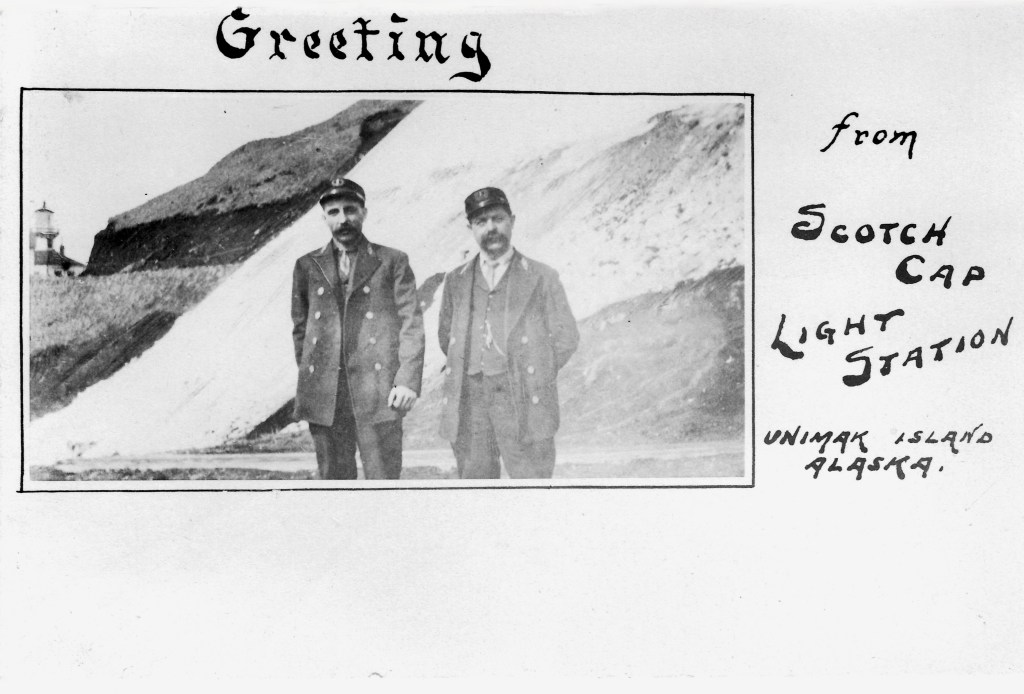
1903 light with keepers Michael Ludescher and Sigvart Olsen, circa 1910

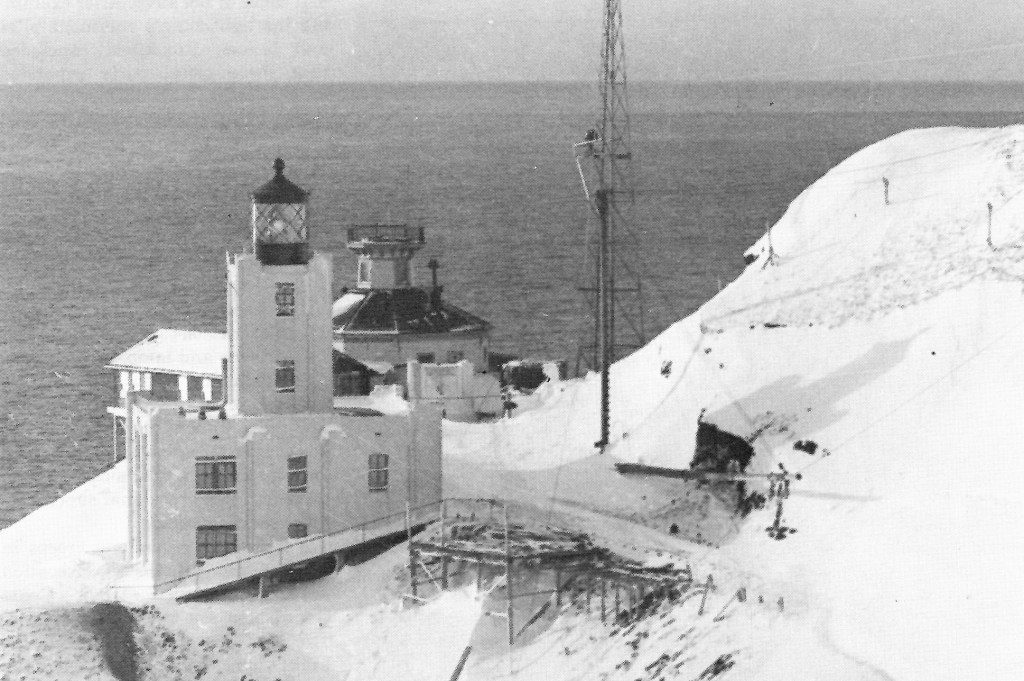
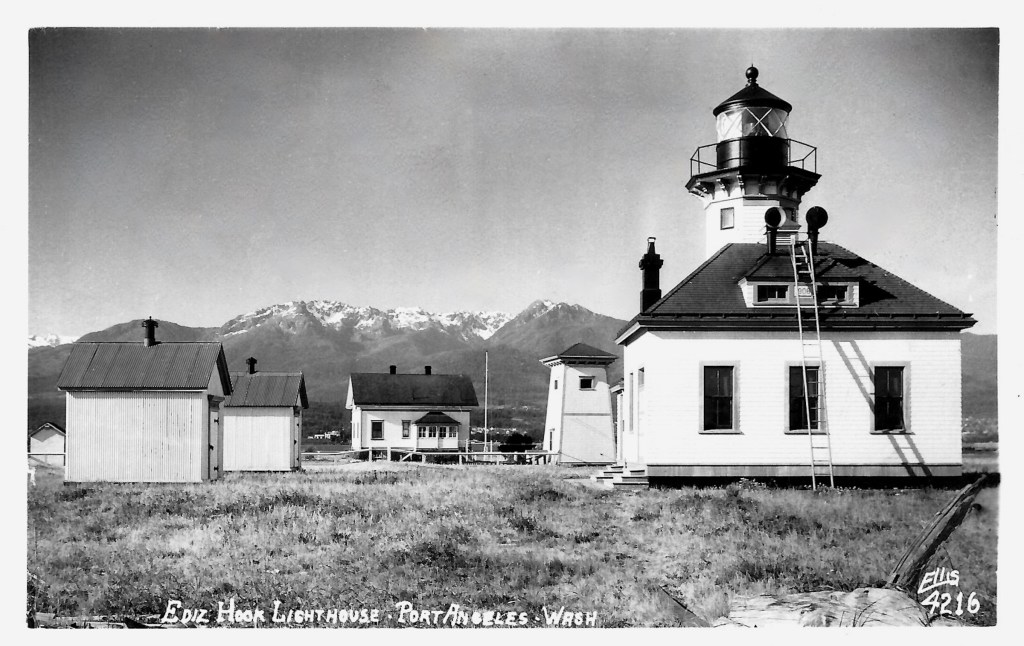
The original lighthouse built in 1903 was a 45-foot wood tower on an octagonal wooden building. The light and it’s keepers would see many ship wrecks over the next few years, as in 1909 when a supply ship and it’s 194 crew members were guests of the light station for two weeks after the their ship the Columbia was wrecked. It would be two weeks before they could be removed from the station. The 1903 original Scotch Cap light, seen below, would be replaced in 1940, by a concrete reinforced lighthouse and fog signal building, built next to this original light.

On that April Fool’s Day in 1946, the nervous watch keeper noted the event of the trembling, in the log book, and that it ‘lasted but a minute’. Keeping in contact with the watch man at the light at the foot of the headland, by radio telephone. But 70 miles out in the Pacific a massive segment of the wall of the Aleutian Trench collapsed and fell to the sea bottom, 20,000 feet below the surface. This would create a series of seismic waves or known as a tsunamis, racing across the Pacific.

Within minutes a second tremor, shorter but much sharper rocked the Scotch Cap light, and again no damage occurred. Twenty minutes later the first tsunami approached Scotch Cap. As the wave moved into shallow water near the shore, it formed into a near vertical wall of water estimated to be roughly 100 feet high. Millions of tons of water exploded as the water engulfed the headland, destroying everything in its path. The off watch crew station rushed out of their quarters, were they were ordered to get to higher ground, knowing there would be further waves coming in. As they rushed to leave the building, one looked toward the sea and cried out, “the light, the Scotch Cap Light! It’s gone out.”

Not only had the light gone out but the fog signal and radio beacon were quiet. All attempts to raise the station by radio failed. The commanding officer high on the cliffs looked over the edge and found nothing but blackness. When daylight appeared the Coast Guardsmen made their way to the cliff edge and peered down. All that they saw that morning was the concrete platform and some broken pieces of concrete, all that remained of the Scotch Cap Light Station.

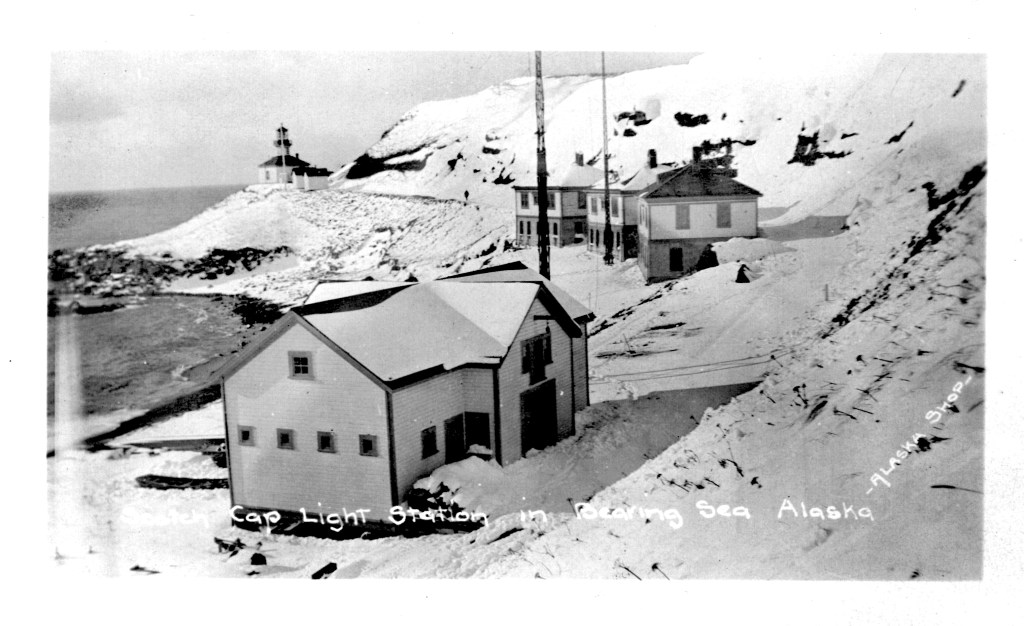
Scotch Cap Light and Coast Guard housing before the 1940 concrete light was added.

That morning the teletype machines sent out a message: “TIDAL WAVE PRECEDED BY EARTHQUAKE COMPLETELY DESTROYED SCOTCH CAP LIGHT STATION WITH LOSS OF ALL HANDS STOP TOP OF WAVE STRUCK THIS UNIT CAUSING EXTENSIVE DAMAGE BUT WITH NO LOSS OF LIFE STOP ENGINE ROOM FLOODED BUT EXPECT TO MAINTAIN EMERGENCY POWER IF NO FURTHER DAMAGE IS EXPERIENCED STOP WILL SEARCH FOR BODIES OF SCOTCH CAP PERSONNEL AS SOON AS POSSIBLE STOP REQUEST INSTRUCTIONS STOP”

The search for the five Coast Guard keepers found nothing, everything was gone. The five men would be found when the sea gave up their bodies five days later. The five men, Jack Colvin, Dewey Dykstra, Antony Pettit, Leonard Pickering and Paul Ness were identified only by dental records.

The wooden lighthouse and the concrete lighthouse.

Ghost stories are not unknown around lighthouses, and after the April Fool’s Day disaster Scotch Cap joined the ranks of the haunted lighthouses. One night, both the generators broke down. Without power, there was no light and the foghorn was silent. A ‘Notice to Mariners’ went out on Coast Guard radio alerting the ships and aircraft. A Coast Guard cutter cruising within sight of Scotch Cap, raised the station asking why had the station sent out the warning? The cutter reported the the light was in view and burning brightly. The people who knew Scotch Cap, those of the old timers, just exchanged knowing glances.

All postcards used are from the authors collection, with the exception of the last image showing the concrete and wooden lighthouses, were I give my great appreciation to the ‘Keepers Log’ Winter 1986 for their excellent information and account on the disaster that struck the Scotch Cap in 1946.

From Arcadia Publishing of ‘Lighthouses of the Pacific Coast’, due to be published in mid summer 2024.


Thank you for visiting and reading today. Please if you haven’t already, enter your email address in the subscription form below to receive my blog by email on the first Monday of each month. Thank you.

‘The Narrows’ Halifax 1917

Linda’s Monthly Monday Morning Moaning’s for March 4th, 2024

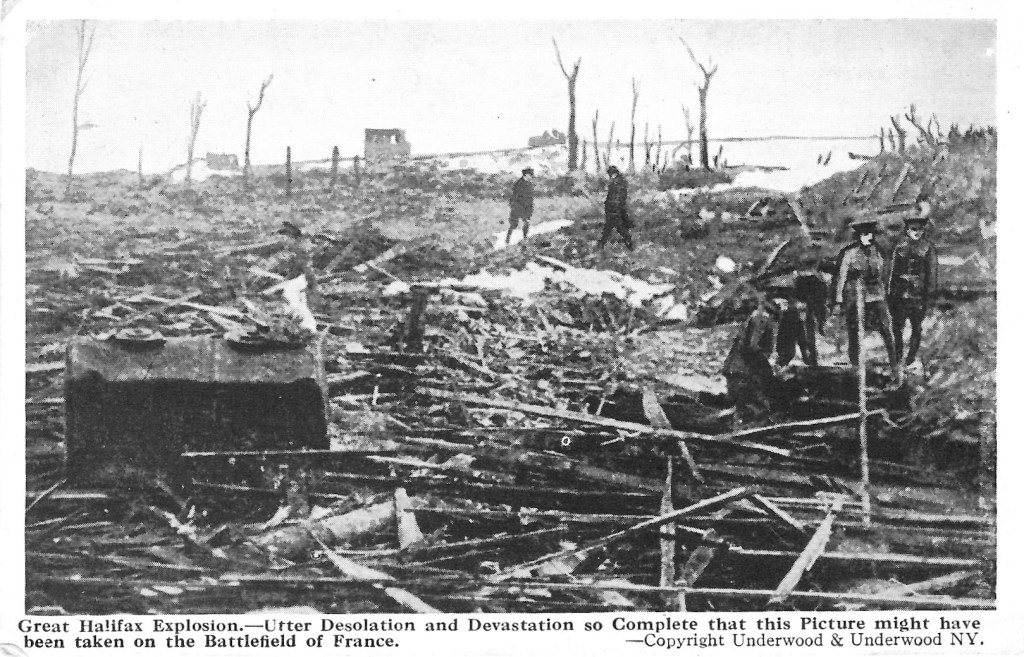
After steaming out of New York City on December 1, 1917, filled with a staggering three thousand tons of TNT, benzene and gun cotton, this munitions ship the Mont-Blanc found its way up the Atlantic coast, through waters filled with enemy u-boats. After colliding with another ship the Norwegian Imo, chartered to the Belgian Relief Commission, while approaching the ‘narrows’, where the smallest portion of the harbor sits in the port city of Halifax, the Mont-Blanc’s cargo erupted with the force of 2.9 kilotons of TNT. Not until the atomic bombs of Hiroshima and Nagasaki in the mid 1940’s would the world see such an explosion. The blast vaporized in one-fifteenth of a second the 3,121-ton hull of the Mont-Blanc. The blast cloud shot up more than two thousand feet in the air. Then the thirty-five foot tsunami, triggered by the explosion, swept along the water-front, washing victims out to sea and pushing ships in the harbor on to the shore. Here is the story of a remarkable survival for the people of Halifax, Nova Scotia, Canada.

At the top of the postcard above, is ‘the narrows’ where the harbor has narrowed greatly in this large port harbor, this card showing a portion of the harbor before the explosion. Halifax’s inner harbor had become a safe harbor for merchant convoys leaving for Britain or France during World War l, both Halifax and across the harbor in Dartmouth were usually filled with merchant traffic because of the war. Approximately 60 to 65 thousand people lived and worked in the Halifax Dartmouth area. Anti-submarine nets were pulled in place every evening and opened again every morning.

When the Mont-Blanc reached Halifax harbor, she arrived too late to make it into the harbor before the submarine nets had already been raised on December 5th. The Norwegian ship Imo, had been stuck inside the basin for the past few days and anxious to leave. When the nets were removed in the morning of the 6th, both ships in their haste, would ultimately collide, setting of a chain of events, previously unknown. At 8:45 in the morning the collision occurred. The damage to the Mont-Blanc was slight, but barrels of benzene on the deck fell over and opened, just waiting for a spark to set them off. Many of the ships in the harbor, not knowing what the cargo was on the Mont-Blanc, came to give assistance. All the while the ship was slowly moving closer to the pier.

With the lay out of the harbor many homes would face the water on streets that ran along the harbor on the rows of hills above it. People were on their way to work and children were on their way to school that early morning. But nothing could be more interesting than getting as close to the harbor as possible to see what they soon realize was a burning ship coming in close to the pier. Little realizing what was on the ship.

When the blast occurred, over 1,600 people were killed instantly, with 300 to perish shortly after and over 9000 people ultimately were injured. Every building within an almost 2 mile radius was destroyed. Hundreds of people watching the burning ship out the windows of their homes were blinded when the blast wave shattered windows they had been watching from. Stoves in homes that over turned created major fires throughout Halifax. It was believed had it not been for a railway dispatcher, Patrick Vincent Coleman operating near Pier 6 sent a telegraph message to the incoming train to stop where they were. “Hold up the train. Ammunition ship on fire in harbor, making for Pier 6 and will explode. Guess this will be my last message. Good by boys”. From there all incoming trains were halted coming into Halifax. Vince Colman died at his post while saving others.

Despite a raging snow storm that fell on the first night, relief efforts began immediately and hospitals filled up quickly. Soon recuse trains would arrive bringing help and supply’s from all over Canada and northeastern United States. Doctors and nurses from Boston, and especially eye doctors found their way to the where the help was needed most. Approximately 5,900 eye injuries were found, with many permanently debilitating, from the flying glass after the explosion, because of the thousands of people who stopped to watch the burning ship from both inside buildings and from outside.

Because of the help and monetary support that Boston’s Red Cross sent to Halifax, during Christmas 1918 the residents of Halifax sent to the City of Boston a Christmas tree. The official Boston Christmas tree that sits on Boston Commons is sent from the people of Halifax as an on going thank you. A portion of the Mont-Blanc anchor was found 2.5 miles from the harbor, today sits as a reminder of those devastating days in the winter of 1917. I came across this story when researching the books I have worked on, never having heard about this while in school, being that it took place in Canada and not part of our history. But I found it history worth noting. I was in Halifax, Nova Scotia in Canada in August 2022 and found a beautiful city, with no remains of the explosion obviously after all these years, but saw that there are many areas where the people of Halifax have remembered this dark days with memorials and especially with the sound of bells.

On that ‘wee note’ till next month, Monday April 1, 2024.


Research material curtesy of: ‘The Great Halifax Explosion’ by John U. Bacon, 2017 Harper Collins. ‘Curse of the Narrows’ by Laura M MacDonald, 2005, Walker Publishing Company. ‘Explosion in Halifax Harbor’ by David B Flemming, 2004 Formac Publishing Company. There is so much more to this story than I have been able to write about and these wonderful books give a complete story to this important disaster. Postcards are from authors collection.


Thank you for visiting and reading today. Please if you haven’t already, enter your email address in the subscription form below to receive my blog by email on the first Monday of each month. Thank you.

“Loneliness and Monotony”

Linda’s Monthly Monday Morning Moaning’s for February 5, 2024

The words most used by light keepers in their diaries and letters to describe the existence during their time at lighthouses are “loneliness” and “monotony”. A great deal of a keeper’s life centered on the mundane duties of keeping the station and its equipment clean. Lighthouses were by necessity placed in areas of danger and were in isolated regions. Solitude was part of position. Before the advent of electricity, the lighting device was a lamp. Fuel for illumination ranged from whale oil, lard oil, rapeseed oil, and petroleum products. The wick of the lamp had to be carefully trimmed to produce a strong light and watched constantly throughout the night. This constant attention to wicks led to lighthouse keepers earning the nickname “wickies.’

St George Reef Lighthouse, California

Just two examples of isolated lighthouses on the Pacific coast, would be the St George Lighthouse in California and Tillamook Lighthouse in Oregon. The foundation of St. George Reef Light is a pier in an irregular oval shape, 86 feet in diameter, faced with cut granite and filled with concrete. The tower is also constructed of granite with the smallest block weighing 17 tons. The light stands 144 feet above sea level and was first lit on October 20, 1892. In total, it took an incredible ten long years to successfully complete the project, yet after 97 years St. George Reef Light still stands today. Getting supplies and especially families, out to the light, when they wanted to come or visit was very dangerous. Some of the families lived back on the mainland and their spouses would work three weeks on and a full week off, as an example.

Tillamook Lighthouse, Oregon

It is noted that lighthouses going back to the 1800’s “at one time or another had female assistant keepers; and a surprising number had women as principal keepers.” This was not, because of an enlightened view on the part of the service. Rather, it was a means of saving money. It was not unusual to have a husband and wife team at a station. Both wives and children helped in running the light. For example, Mary Israel raised four children while assisting her husband at the Old Point
Lorna Light, near San Diego. Juliet Fish, keeper of the Angel Island station, in San Francisco Bay, once manually pounded a fog bell for twenty hours straight when the mechanical striker failed.

 Floating Lightships in the form of cutters were used extensively, keeping the men out at sea for extended periods of time. One such time, as in the case of the Golden Gate, the 110 foot cutter built in Seattle in 1896 and arriving in San Francisco on May 13, 1897. The Golden Cate performed law enforcement boardings, towing, helped fumigate vessels, and resupplying in the Bay area. One of her most unusual duties came during the great San Francisco earthquake of 1906. A great deal of the city’s destruction was caused by fires. The men  that served on the Golden Gate cutter served as firefighters and transporting officials and refugees. Then, in the middle of their work, the commanding officer of the cutter was given the added responsibility of taking on board the gold reserve from the Federal Bank in San Francisco. The cutter remained a floating bank until the fire danger was over. 

On that ‘wee note’ till next month, Monday March 4, 2024.

Courtesy of the United States Coast Guard in the Southwest Pacific, postcard images part of the authors collection.


Thank you for visiting and reading today. Please if you haven’t already, enter your email address in the subscription form below to receive my blog by email on the first Monday of each month. Thank you.

‘Lighthouses of the Pacific Coast’ Book Cover

Linda’s Monthly Monday Morning Moanings for January 1, 2024

HAPPY NEW YEAR 2024

This has been a great way to start the first day of the new year. Although, I have been talking about the latest book I have been working on, this is the first time I have had to highlight the new cover that Arcadia Publishing has designed for me. On the cover Yaquina Lighthouse in Oregon, or as it has been known, over the years, Cape Foulweather, due to the elements that created the need for this and the many other light houses on the Pacific Coast when maritime navigation depended on these lights and the brave keepers that manned them.

This is the third lighthouse book out of a series of four to be published on the lighthouses around the coast line of the United States, including the Great Lakes. I have tried to gather as many vintage postcards of the various lights as I have been able to find. Some come very easy, some not so much! Finding interesting postcards and unusual cards has been my goal, to show what all these lights looked like when they were used to guide maritime navigation through some of the most treacherous waters there are. I have found that in the different areas of our country where you are situated will have a great impact on what type of lighthouse you become familiar with. In Alaska, cement built Art Deco lighthouses where the fog signal building and tower are all in one, were the keepers residences are usually separate, are very common. You will see in Washington and Oregon the tall towers and separate keepers residences similar to the east coast lights. California has a variety of designs that have been used for their lighthouses. Many are a schoolhouse design with the light tower rising from the middle of the roof line. In Hawaii we are back to the concrete built lights, obviously to make them as indestructible as possible from the elements.

EPSON MFP image

Point Hueneme Lighthouse in California is an example of the lighthouse keepers residence and the light tower as used together, this a Victorian Italianate style. Because of its unusual character I have used this on the back cover of the Pacific Coast lights.

This edition will be published this summer of 2024 by Arcadia Publishing. So now it’s back to the research, writing and gathering the images needed for an early March handover to the publishers.

On that ‘wee note’, till next month Monday February 5, 2024.


Thank you for visiting and reading today. Please if you haven’t already, enter your email address in the subscription form below to receive my blog by email on the first Monday of each month. Thank you.

‘Romeo Observer Christmas’

Linda’s Monthly Monday Morning Moaning’s for December 4, 2023

This is a repeat of a blog from Christmas of 2020. I felt it was well worth posting the information yet again for any newer blog readers who might not have seen this article from that point in time.

With this being the Christmas season, my thoughts turned to a wonderful and surprising find from when I first started researching the many historical homes in the Village of Romeo. While looking through the Romeo Observer newspapers once again for an obituary or article I was needing, I was handling an unbound set of these fragile and delicate papers, when on this particular search, I saw a touch of bright color coming from down deep in the archival box that was holding these papers.

My curiosity was peaked, and when removing the top papers, this wonderful unfaded image was looking back at me, with a printing date of December 20, 1916! Color was extremely rare throughout these papers, so the beauty of this artwork was just remarkable. Edwin King seems to have been the artist, it is not known to me if he was a local artist in the Romeo area or not. But he did some lovely work, and it’s nice to know it will be preserved. These copies are so fragile even using gloves, lifting them up is a very delicate process when using them. The image below shows them sitting in the tissue padded archival box that is used to protect the unbound copies.

I have a copy of the image now in a frame, where it sits under a Christmas tree, filled with the Romeo Historic Homes ornaments that the Romeo Historical Society puts out each year since 1997. The tree sits in the den where I work on my books and is a constant reminder of the fortunate situation and opportunity I had with being able to research these lovely historic homes and these historic newspapers from the past.

Much to my disappointment I was never able to come across another image such as this one, and it was not from a lack of trying. Although there are many bound editions of the Observers held by the archives, there are many that are individual paper sections that have not been bound because of the quality of the paper used at the time years ago and are in a very precarious state, but being kept safe in the hands of the archivists at the library.

Courtesy of the Melvin E and Joan D Bleich Collection of the Romeo Observer Newspapers at the Romeo Community Archives, Romeo District Library.


Thank you for visiting and reading today. Be sure to tell your friends. If you haven’t already, please enter your email address in the form below to receive my stories by email.