
What is Unique about Washington Township, Michigan?
History of Washington
Washington Township, as it would soon be called, would be known for its rich and fertile soil and rolling hills, perfect for the many apple and peach orchards. James Thorington was the firsts settler of record on February 1819. Asahel Bailey bought the first government land in 1821. William Austin Burt settled here in the 1820’s and would be best remembered for his inventions of a type writing machine, a solar compass and an equatorial compass. President James Monroe would sign the deed for the government land bought by Elon Andrus in 1821. The number of farms in the township in 1850 was 116 and by 1874 twenty-four years later there would be 196 farms with land under cultivation. Over the years Washington Township has developed from a pioneering settlement into an upscale residential community that, remains true to its roots, and still boast several well known orchards. Michi-Gan, as the early Indians called it, meaning the ‘Great Lake”, was a land of blue waters, deep snow and forests stretching to the horizon. In the beginning it was a vast wilderness… The Chippewa’s, the Ottawa’s, the Huron’s, and the Potawatomi, would become the first Michiganders, and call this area home. In July of 1805, land that was gained from the Indians in a treaty would become the separate territory of Michigan. Macomb would be the third County on January 15, 1818 to be organized by proclamation by Governor Lewis Cass.
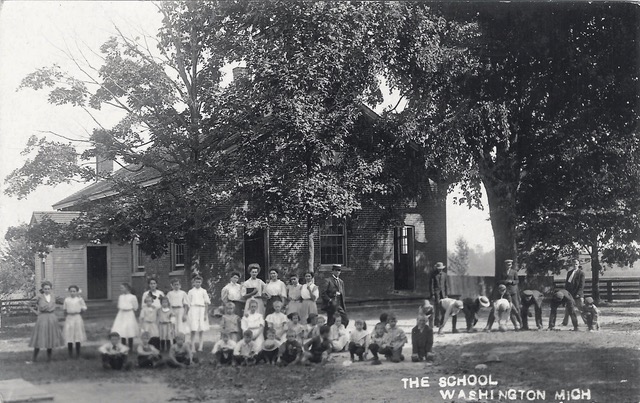
Sixteen miles northeast of Mt. Clemens and thirty miles north of Detroit, soon it would bring many New Yorker’s and New Englander’s to the area called the Village of Washington, so called, when the organization of the new township was being discussed in the home of Alvin Nye on April 12, 1827. Daniel Thurston one of a group of men at this meeting would say, “I move we name the town in honor of the father of our country”. The name was accepted enthusiastically, and would be confirmed by the act of organization. They would go on and create a township board, with Otis Lamb chosen as Clerk. In one of their firsts acts as a board, would decide to raise $25.00 for support for the poor. During this time the community had but 40 families. With that the area became Washington Township. Richard Jersey, the Brabb brothers, Isaac, George, and John, Elijah Thorington and son James, James Starkweather, Elon Andrus, would be some but not all of the many settlers to put down roots in the area. Asahel Bailey, who would make the first entry of land in the township on July 3, 1821. By 1837, in less than 17 years all the governmental land in the township of Washington would pass into the hands of private citizens. There would be one-hundred and eight six purchasers of land and of those, seven would be women, whose names are as followed: Ann Powell, Hannah Brabb, Dorcas Scott, Polly Graves, Mariah Millard, Joanna McDonald and Lydia Inman. William Austin Burt, one of the first settlers would be one of the first of many to become a member of the territorial council, serving from 1826 to 1827, William would move to the legislature in 1853 to 1854. He was known as a mechanical genius and would rank high as an inventor. His principal inventions were a typewriting machine, the solar compass and an equatorial sextant. Dr Dennis Cooley, also an early settler would become a renowned botanist of record, when published his “List of plants common within ten miles of Cooley’s Corners” would give him much publicity as well as his classification of plants collected under the U.S. Geological Survey in the Upper Peninsula in 1848. Dr. Cooley would become one of the most noted botanists of his day.
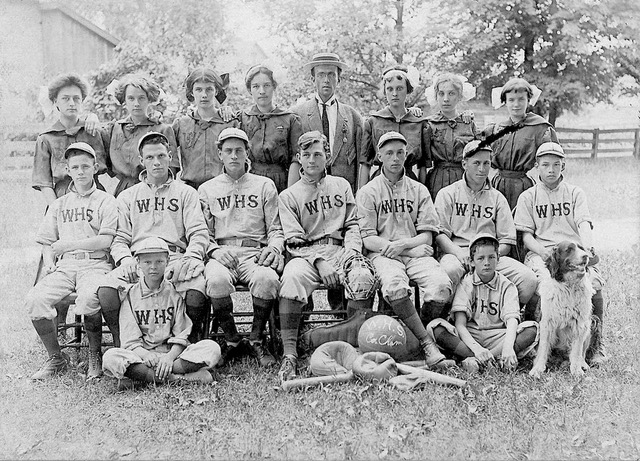
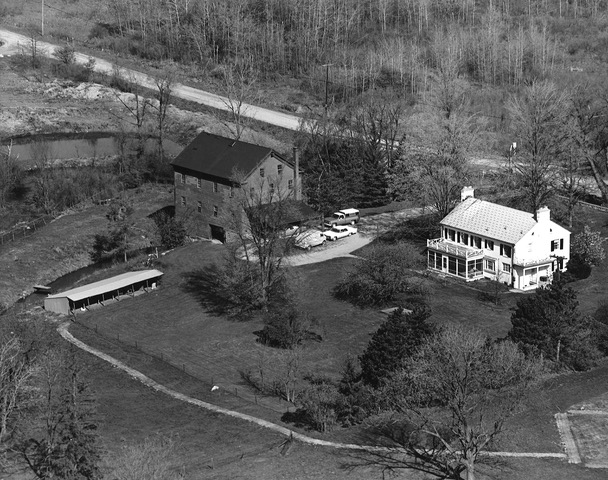
Washington would grow in the early years and become a thriving community with two churches, a well-organized school and hotel, stores and businesses with a general store run by Fred G Davis. Before long, being situated both on the Air Line Railroad and the Detroit and Romeo Electric Line, it would make doing business in the area all the more important to the farmers and orchard growers that were cultivating the rich soil so perfect for their crops. Historically, Washington Township has been a productive farming community, with a strong emphasis on their orchards. A significant part of the farming of the area is related to the beautiful orchards, still doing proud work here today. In the northeast part of the town, where the village of Romeo now in part is located, there was already a settlement forming. Several families of Indians lived there and only a couple of white families. The location was then known as “Indian Village” or “Hoxey’s Settlement”, where it is believed that Job Hoxey, soon after the surveys were made, moved there with his family in 1820. The Village of Romeo is situated at the southeast corner of Bruce Township, a neighboring community to the north and extends into part of Washington Township to the south. Romeo was first plated in 1830, and would receive its name at that time, by the wife of one of the village proprietors, who thought it “classic, musical, short and uncommon”. By 1836 log cabins were still predominant with only about thirty frame buildings in town. The prosperous farming region, which surrounded Romeo, brought wealth into the settlement and soon permitted the villagers to indulge in the tasteful and unpretentious architecture for which it is known. Clifton, which was a platted village, located near the intersection of 31 Mile Road and Mt Vernon Road would threaten to prove a dangerous rival to Romeo, and may have eclipsed the village had the railroad not decided to bypass Clifton and established a route through Romeo. Clifton was the site of ‘Grey’s mills’ which would eventually would become known as ‘Clifton mills’, would do a large business until about 1880 and help create a little settlement, with a church, school and a grave yard. The Grey family would remain owners for some years, but in the 1890’s the property would pass to new owners. New processes have been put into the mill and the valuable waterpower is still used for the operation of a successful country mill by present owners.
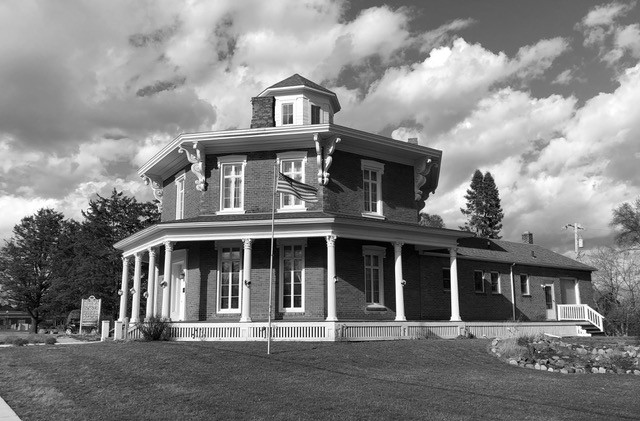
Mount Vernon would be a thriving village located in the southwest portion of Washington Township at Mt Vernon and 28 Mile Road. It would gather a number of businesses, such as a general store, a cooper shop, a gas station, a rag-rug weaving shop, buggy shop, several saw mills and a greenhouse, two churches and a blacksmith shop, a post office which would be considered one of the oldest post offices in the county. This community would be instantly associated with William Austin Burt, for making his home in this area. On January 14, 1833, he would receive an appointment to be the first postmaster of Mt Vernon, which had then just been established, with April of the same year, he would be appointed associate judge of this judicial area. William would also become one of the founding members of the Mt Vernon Baptist Church. The Crissman, Clifton, Sikes and Thorington schools were all wood frame, one-room schools houses, with Washington School being the first brick school in the Village of Washington its self. These schools would be built on land that was usually donated by the owner’s of the land or parents of the students.
There would eventually be seven cemeteries in the community of Washington Township, Mount Vernon, Powell, Brabb, Washington South, Cannon, Clifton, and Washington Center, where most of the founding pioneering men and women of this community would be laid to rest. Beginning in the 1950’s much of the farmland would be sold and converted to new home subdivisions, the one-room schoolhouses would make room for brick and mortar buildings and keeping the early history of the pioneering families alive would fall to the wonderful and knowledgable historians of the Historical and Archival Societies that now work to protect this area’s information.
Click on the graphic below to watch a presentation on Washington Township.

 Linda Osborne Cynowa