‘Lights of the Great Lakes’

Linda’s Monday Morning Moaning’s

Last week, I said I would be blogging the second part of the information on the Mount Vernon area, here in Washington. That will be furthered in next weeks blog instead of todays.

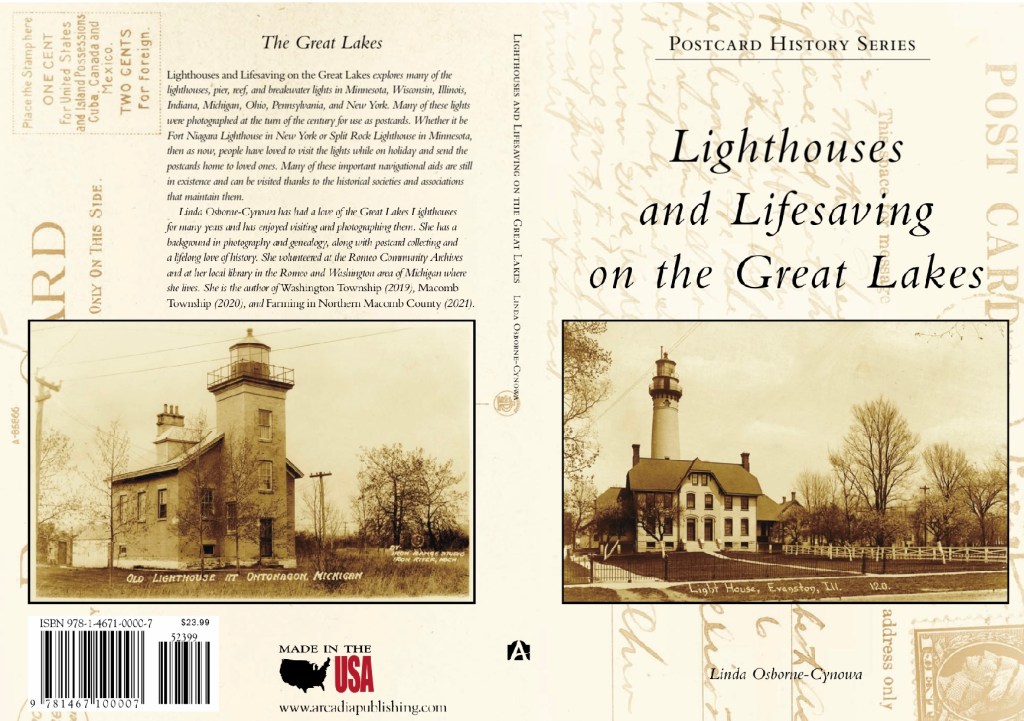
For the last couple of months I have been working on a new project while I was waiting for the farming book to be published in August. For many years I have had a strong attachment to the lighthouse of the area. I have on many occasions traveled to some of them just in the hope of photographing these beautiful structures that have been so important to the maritime shipping around the Great Lakes. After working on three previous books about the local area that I live in, I decided to expand my research area to cover approximately eight states in total, Minnesota, Wisconsin, Illinois, Indiana, Michigan, Ohio, Pennsylvania, and New York, all where the shores of these states touched the Great Lakes.

I submitted my proposal to Arcadia Publishing for their ‘Postcard History Series’ and have just received a commitment and my contract to further the project.

The title ‘Lights of the Great Lakes’ is still a working title. If all goes as planed, this edition will be published in time for ‘National Lighthouse Day’ on August 7th 2022.

EPSON MFP image

Although these scans are in their original color formats, Arcadia’s vintage history series are all black and white, images and postcards can be used when scanned in grey scale. Most real photo postcards (RPPC) are only produced in black and white which are the majority of vintage postcards available. This will be a look at the lighthouses, from the early days of their use, many no long exist or look nothing like their original look. So now I further the research for the ‘Lights of the Great Lakes’.

Next week, more on Mount Vernon, and on that ‘wee note’ till next week.


Thank you for visiting and reading today. Be sure to share with your friends using the share button below. If you haven’t already please enter your email address in the form below to receive my stories by email.

Mount Vernon, Washington

Linda’s Monday Morning Moaning’s

Patriotism ran strong among the early pioneering settlers to this area. They named the township and village after our first President (Washington) and a village after his Virginia estate (Mount Vernon). Since there were many of Scottish descent arriving new to the area, the name was easily approved.

The ruggedly hilly northwest corner of Macomb County was its most populated section in 1840 when the first Federal census for Michigan was conducted. The pioneer farmers and townspeople headed to the cool, well-drained hills of Washington, Shelby and Bruce Townships, avoiding the swampy flatlands for the more fertile and game abundant land. Although Mount Vernon has never been incorporated or officially organized, nor has it ever had specific boundaries, it was recognized as a village and had several business places and a United States Post Office. In Lesson’s ‘History of Macomb County, Michigan’ written in 1882, Mount Vernon is described as ‘a small post office village’ in Washington Township, Macomb County, seventeen miles northwest of Mount Clemens Court House and five miles northeast of Rochester, with two churches in the immediate area, Baptist and Methodist’.

The Mount Vernon General Store was a rather large wooden structure on the northeast corner of the main intersection. They carried a full line of groceries, yard goods, kerosene and farm supplies. Upstairs there were several rooms that were available for travelers. This store would burn down, due to a fire that started in the back the building were the kerosene was stored. A new smaller building was built, with living quarters in the back for the owners. The Fangboner Buggy Shop was also nearby during these years, a well used establishment in the community. I will travel further into Mount Vernon’s history in next weeks Monday Moaning’s.

On that ‘wee note’ til net week.


Thank you to ‘Historic Mount Vernon’ by Louise M. Pohly, 1997

Thank you for visiting and reading today. Be sure to share with your friends using the share button below. If you haven’t already please enter your email address in the form below to receive my stories by email.

911 Remembered, 20 Years Later

Linda’s Monday Morning Moaning’s

Saturday marked the twentieth time that September 11th has come round the calendar, saying anniversary usually denotes something worth celebrating this surely was not. September 11, 2001, like many other important dates that we remember in history, is a date that needs remembering by us that lived through it, and those not born at the time.

I was at Life Time Fitness, coming into the locker room to get my things and seeing on what at that time was an unusually large television screen showing what was happening at the Twin Towers in New York. I like everyone, that was soon gathering around this set, were in a saddened shock, for what we all realized was the terrible trauma that so many people in those towers surely where enduring. All I could think of was gong home and being with my family and realizing how lucky I was that I had them.

By the time of the fifth calendar year in 2006, I also had endured a loss for me of such magnitude, that my understanding and empathy was even stronger for the survivors, parents, husbands, wives and children whose lives had changed so horribly with their losses on that day.

As what was my usual response to most historical instances, I needed to know more, and over the years read many books and watched programs that would try and give me the best ability to understand and learn in some small way, WHY? I found over the years I would purchase the ‘911 Never Forget’ pins from a jeweler in Pennsylvania who was selling them at cost to help the Garden of Reflection in Shanksville as a memorial to Flight 93. They’re great work over these past twenty years has raised an enormous amount of money to help the many people effected by the 911 terror of that day and now the garden will be taken care of in perpetuity.

For the First Responders on 911 that survived the towers collapsing, but have suffered for these past twenty years from 911 with reoccurring health ailments that have plagued many of them and added to the amount of loss that was suffered that original day. These are people that gave so much thought those first days, and need the help from our government with medical, for the help they gave. Many are medically suffering greatly.

On that day, it was soon realized that clearing the sky’s of planes was paramount. Soon the United States Federal Aviation Administration, commonly known as the FAA, closed all US airspace, not knowing what might be coming in on other planes still in the air. As part of Operation Yellow Ribbon, Gander International Airport would need to divert 224 wide body airplanes that were past the ‘turn around point’ away from the US, and land them in small air ports in Canada near the eastern seaboard. They managed this in only 4 hours.

Gander, itself accepted 38 previously unscheduled planes. Most of these people, passengers and crews would be stranded there until the United States reopened airspace nearly a week later.

Gander had a population of about 10,000 people and now had 6,800 visitors. The book this comes from ‘The Day The World Came To Town, 911 in Gander Newfoundland’ by Jim Defoe, is a wonderful complete story of how the people of Gander opened up their homes and lives to help people from all over the world in a completely selfless way. After the tragedy of 911, this book brings the most heart warming story and what can bring people together at the most difficult times in their lives. If you are interested in a wonderful read, this is my suggestion, for the full story.

This week I close with a sadden heart, but with hope for our future.


Thank you for visiting and reading today. Be sure to share with your friends using the share button below. If you haven’t already please enter your email address in the form below to receive my stories by email.

The story of the ‘Free Public Library’

Linda’a Monday Morning Moaning’s

The ‘Romeo Free Public Library’, was a story, I found most interesting and wanted to share the research I had found about this great library.

Samuel and Nancy Kezar, from Turner, New York lived in a Queen Anne style home on Church Street in Romeo, that they built in 1894. Samuel passed away in Romeo in 1898. The Kezar home at 180 Church Street is where the Romeo Public Library, Romeo Book Club and the Romeo Monday Club would organize in 1900 and run through 1908. Nancy and her daughter Mary eventually moved to San Francisco, where Mrs. Kezar would come into an inheritance and remember their time in Romeo. They came up with a plan through their agent to give a library building to the village of Romeo.

‘The Romeo Free Library’ 1914

A local contractor Archibald H. Robertson, built the library according to a design by the well known architect Henry Whitfield of New York. Mr. Whitfield had been directed that the general appearance be ‘home like’ and imitate and ‘old English Inn’. Six directors were elected to the Board of Trustees for two year staggered terms. A lot was secured on the corner of Church Street and North Main. The deed contained a proviso that this gift would revert to the heirs of the Kezar’s if and when the property was no longer used for library purposes.

The ‘old English Inn’ today on the corner of Church and North Main

In 1911, the building was dedicated in a public ceremony, and the library received a gift of $1000. worth of books from Henry Glover Stephens, a Detroit collector, past Romeo resident and philanthropist to augment the 871 books already in its collection. The library would later become the ‘Romeo Free Public Library’. The library acquired its third name in 1969 when the Romeo District Library was formed by resolution of the Romeo village council and the Bruce and Washington Township Boards. Two addition Board members were appointed that summer to represent each of the three municipalities.

The need to expand the library collection and facilities was soon recognized and fund raising campaign to pay for an addition was started. The ground breaking ceremony for $154,000. addition which would triple the size of the library when held on March 21, 1970.

Roland Graubner served on the library Board from 1969 till 1999, he would help secure the federal grant for the addition to the Kezar Library and personally raise the money needed for the local share of the project. Later Roland and his wife Kathleen wold donate 6.7 acres of orchard land on Van Dyke Road between Romeo and Washington for construction of a new library building, to be called the Romeo District, Graubner Branch dedicated in 2001. The Community Archives would open to the public in the lower level of the Kezar Brach in 2017.

If you haven’t already paid a visit to the Romeo branch of the library, it is well worth the visit to see what Nancy and her daughter Mary envisioned all those years ago, where the same ‘home like’ feeling is still the major part of what makes this library such a hit for the community.

On that ‘wee note’, till next week.


Courtesy of the Romeo Community Archives, Romeo District Library.

Thank you for visiting and reading today. Be sure to share with your friends using the share button below. If you haven’t already please enter our email address in the form below to receive my stories by email.

A ‘Wee’ Sneak Peak

Linda’s Monday Morning Moaning’s

With in the next week or two the fall issue of ‘Macomb Now’ magazine should be out for public viewing. A few months ago, I was contact by the editor of the magazine to ask if I would be interested in making a submission to the portion of the magazine called ‘Macomb Then’, which is always the last page of the issue. Here they bring back long ago stories from Macomb’s past, as a closing to todays more modern Macomb County. I wrote two different stories and let them pick the one they thought would work best for this edition.

Washington’s First Brick School House

The school in Washington came into being as early as 1824 when a log schoolhouse was built. It would soon be the center of Washington’s community social life, for town meetings and dances where townspeople would gather. By 1839 the little log school was badly sagging, and with the work that was needed they decided to replace other than repair.

Soon there was Washington’s 1st School of Bricks…….

Cover of Arcadia Publishing’s Washington Township

In 1917 a new and larger building would replace Washington’s 1st brick schoolhouse. The new school would serve the community till 1972 and go on to become the home of the Washington Historical Museum.

Now used as the Washington Historical Museum

To learn more about the Washington’s school of bricks, pick up a copy of the fall edition of Macomb Now magazine. Next week the story of the article that didn’t make the cut…..

On that ‘wee note’ til next week.


Thank you to the Great Area Washington Township Historical Society for use of these images, and continual support.

Thank you for visiting and reading today. Be sure the share with your friends using the share buttons below, if you haven’t already please enter your email address in the form below to receive my stories by email.