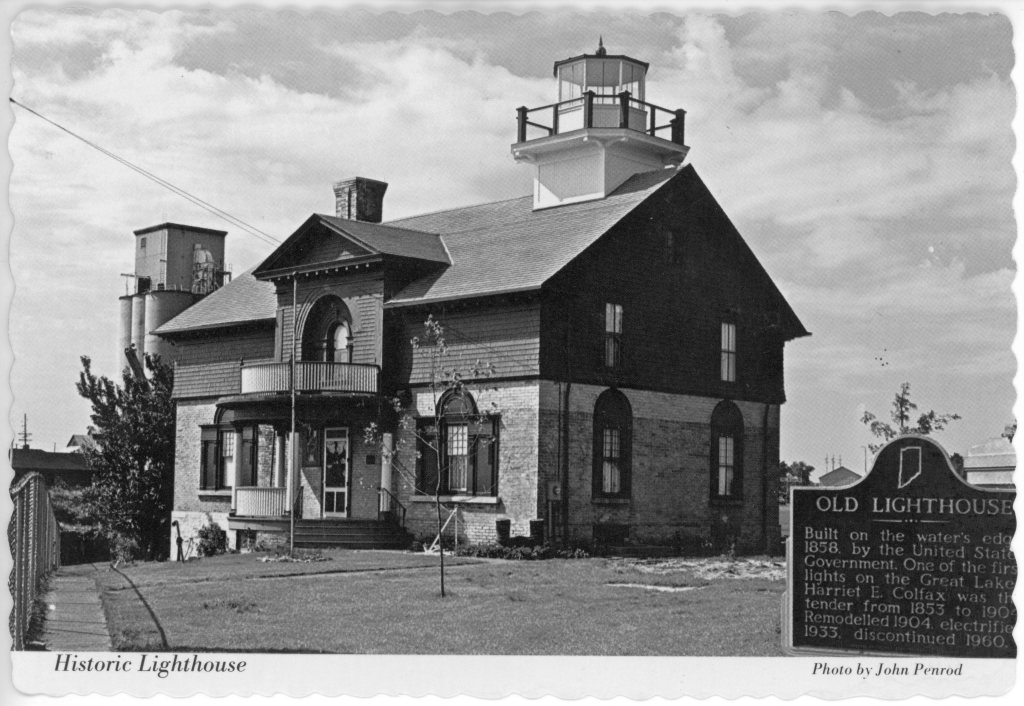
‘Lighthouse and Lifesaving on the Great Lakes’

Linda’ Monday Morning Moaning’s

The’Post Card History Series’ is another of the ‘Series’ books for Arcadia Publishing. This series has a different cover, then what I have been used to working with on my previous books for Arcadia. Late lat week I was sent the mock up of two versions of ‘Lighthouses and Lifesaving, etc’.

The images and written material for the front and back cover where not due until mid December, but I have found in the past, for advertising purposes and when approaching people whether for help or information, it is handy to have at least a cover image to add credibility to the research and project in general. I have been very fortunate in that I have been able to have a say in what images are used for the covers, etc. Normally they want 8 to 10 images and they pick what will be most suitable for the cover image, as to size where the image lays and how it should be placed to fit the cover area.

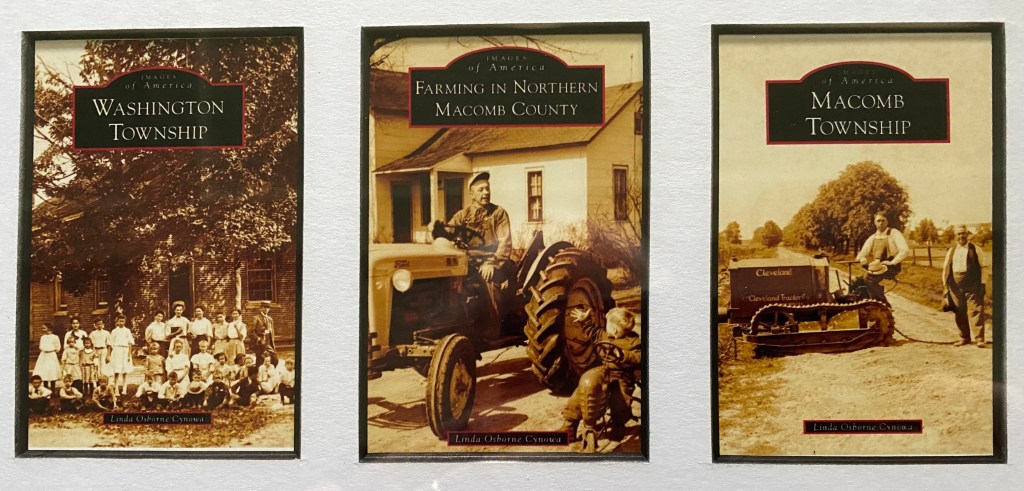
With my ‘Farming in Northern Macomb County’, there really was only one option, that would show what was involved in the farming life. That was using Louis Schoenherr on his new 1953 Golden Jubilee Ford tractor with his youngest son Pete, I was fortunate in the my editors agreed, as it couldn’t have been more perfect..

I gave my title editor four postcard images this time, two ‘linen postcards’ and two ‘RPPC or real photo postcards’. The “linen” postcards were not actually made from fabric but rather embossed stock, where as the RPPC image cards are a photograph as we know them today. What I didn’t realize was the difficult choice it would be when they sent me two mock ups for my approval!

Option One – Linen

Option Two – RPPC

Now to make that one choice. Choice one, Au Sable Lighthouse, Michigan on Lake Superior on front, with Selkirk Lighthouse, New York, Lake Ontario on back cover, both linen postcards. Or choice two, Grosse Point Lighthouse, Evanston, Illinois, Lake Michigan on front and Ontonagon Lighthouse, Upper Peninsula, Michigan, Lake Superior back image, both RPPC.

On that ‘wee note’s till next week.


Thank you for visiting and reading today. Be sure to share with your friends using the share button below. If you haven’t already please enter your email address in the form below to receive my stories by email.

Researching the Lights’ 2

Linda’s Monday Morning Moaning’s

In a lighthouse, the source of light is called the ‘lamp’, whether electric or fueled by oil, and the light is concentrated by the ‘lens’ or ‘optic’.

The introduction of electrification and automatic lamp changers began to make lighthouse keepers obsolete. They lighthouses still had keepers, because they could be used as a rescue service when necessary. Remaining modern lighthouse are usually illuminated by a single stationary flashing light that is powered by solar charged batteries mounted on a steel skeleton tower. In modern automated lighthouses, the system of rotating lenses is often replaced by high intensity light that emit brief omnidirectional flashes, while concentrating the light in time rather than direction. The lens were used to concentrate the light from a continuous source.

The lantern room is a glassed-in housing at the top of a light tower containing the lamp and lens. At the top of the lantern room is a storm proof ventilator designed to remove the smoke of the lamps and the heat that builds up in the glass enclosure. Beneath the lantern room is usually a supple room where the fuel and supples were kept and also where the keeper could prepare the lanterns for the nights use. On the lighthouse tower there is found a platform called the gallery, just outside the lantern room, this was used for cleaning the outside windows of the lantern room.

Lighthouses near to each other that have a similar shape are often painted in unique patterns so they can be easily recognized during the daylight, this being called a ‘daymark’. To be effective, the lamp must be high enough to be seen before danger is reached by a mariner. Whether a lighthouse was built tall or short, would depend on the location of where the light was located. If built on a hill, quite often the tower could be shorter, where as if on the land equal to the water, quite often the tower would need to be taller. There are times that lighthouses needed to be constructed in the water itself. In water too deep for a conventional structure, a lightship was used instead of a lighthouse itself. Most of those have now been replaced by fixed light platforms similar to offshore oil exploration.

Range lights, align two fixed points on land to provide a navigator with a line of position called a range. Ranges can be used to precisely align a vessel within a narrow channel as in a river. With landmarks of a range illuminated with a set of fixed lighthouses, night time navigation is possible. Hence, they are called range lights. The closer light is referred to as the beacon or front range, the further light is called the rear range. Most often the rear range is taller than the front range light. When the vessel is on the correct course, the two lights align vertically.

On that ‘wee note’ till next week.


Smithsonian National Museum of American History.

Thank you for visiting and reading today. Beside to share with your friends using the share buttons below. If you haven’t already please enter your email address in the form below to receive my stories by email.

Researching the ‘Lights’

Linda’s Monday Morning Moaning’s,

Let’s start with, “What is a lighthouse”? Very simply a tower, building or other type of structure designed to emit a light system of lamps and lenses and to serve as a beacon for navigational aid on the seas or inland waterways. Lighthouses helped mark the way around dangerous coastlines, shoals, reefs, and give safe passage into harbors. It was used to provide a mariner at sea with a find point of reference to aid in the ability to navigate in the dark when the shore or an offshore hazard can’t be seen directly.

Lighthouses have always had two principle functions, to warn of danger from a spot that sailors could see from a safe distance both night and day. They are used to guide ships into harbors and anchorages. Theses structures were often constructed under precarious circumstances by skilled builders and were maintained , often at great personal risk by very dedicated keepers.

The distance at which such a light can be seen depends on the height and intensity of the light. The brighter the light and the greater its height above the sea, the farther it can be seen. In 1822, the Frenchman Augustin-Jean Fresnel invented a lens that captured and focused a much larger fraction of the light emitted by the lamps than did the reflectors, previous used. These Fresnel lens were are quickly adopted in England, France and other European seafaring nations.

Fresnel lighthouse lenses are ranked by ‘order’, a measure of refracting power, with a first order lens being the largest, most powerful and expensive, with the sixth order lens being the smallest. The order is based on the focal length of the lens. the first order lens has the longest focal length, with the sixth being the shortest. Coastal lighthouses generally use first, second or third order lens, while harbor lights and beacons use fourth, fifth or sixth order lens.

On that ‘wee note’ till next week.


Smithsonian National Museum of American History.

Thank you for visiting and reading today. Be sure to share with your fiends using the share button below. If you haven’t already please enter your email address in the form below to receive my stories by email.
Mount Vernon, Part Two

Linda’s Monday Morning Moaning’s

Back to Mount Vernon, when Robert Eldredge wrote in ‘Past and Present of Macomb County’ in 1905, that “Mount Vernon, which is situated in section 19 and 30 of Washington Township is a thriving little village community, in which has gathered a number of business houses, two churches and a blacksmith shop and several residences, it was. It also has one of the oldest post offices in the county.

Old timers indicated that for years the post office was in a corner of the General Store, and names like Tobias Hoyle 1888, Frank Rogers 1893, Orlando Pike 1894, Levern Levanseler 1900, Rudolph Reed 1903 and Frederick Norton 1904 where all proprietors of the store so it can be assumed the post office was in the store at that time. In 1905 it was decreed that the Rochester post office would now handle Mount Vernon’s mail, and the local post office was closed marking the diffident end of an era. There was a structure that started out as a home built in 1830 which became the club house for the Mount Vernon Country Club. It was designed to look like George Washingtons Mount Vernon home. While the club drew members from all around and including the Detroit area, and the grounds were kept lush all summer, after World War II it would fall on hard times. It was later bought and restored by a family later on, but now the property is within the Stoney Creek Metro Park system.

Austin Burt’s Wagn Ship, circa 1905

Mount Vernon has changed from the thriving, yet quite farming community it once was. The school house was destroyed and damaged beyond repair during a windstorm in 1934. The Baptist Church closed. Stores went out of business. There was no more calls for buggies, wagons or windmills. Fields that once grew crops of hay and grains are covered over with asphalt. Large new homes are being built and automobiles make the area homeowners more mobile, where they can travel miles for shopping or entertainment. Food and fun are no longer homemade.

These changes might well have begun when Mount Vernon was bypassed by the railroad. The same as with many areas near by like Clifton Mills a ways down the road. Towns that railroads passed through grew and prospered while others became only a collection of homes. Now all that remains of the past are a few “old” homes, the Methodist Church (although that has recently been sold to soon become Greek Orthodox), and the Mount Vernon Cemetery.

Memories of Mount Vernon’s glory days are fading as most of the ‘old timers” are also gone, those hard working people who knew the importance of building their village. The present and future generations need to remember the past and the people who worked hard to shape it.


Thank you to Louise M. Pohly for her work on ‘Historic Mount Vernon, 1997

Thank you for visiting and reading today. Be sure to share with your friends using the share button below. If you haven’t already please enter your email address in the form below to receive my stories by email.

A Quick Trip for Research

Linda’s Monday Morning Moaning’

If you are researching lighthouses, the place to go is the Great Lakes Lighthouse Keepers Association, also known as ‘GLLKA’ in Mackinaw City, Michigan. For those that might not be familiar to this part of Michigan, it’s were the very tip of the mitten, connects to a five mile long bridge that open’s the door to Michigan’s Upper Peninsular. It’s just one of many beautiful places in the State of Michigan.

‘GLLKA’ is a great group of people who work very hard at keeping anything to do with the lighthouses a part of their important work. I was visiting the Association’s headquarters this past weekend for a much needed introduction to let them know of the contract to do the book for Arcadia Publishing on the Great Lakes Lights, with the hope they might be able to help with my research and quest for some vintage postcards, I am having a difficult time a acquiring.

Some years ago on a road trip to Mackinaw City with the intent of taking one of the Shepplers boat tours, we found that ‘GLLKA’ organizes these trips with Shepplers to see the different lighthouses in the Straits of Mackinac. The gentleman that was the host and speaker was Terry Pepper. His knowledge was complete when it came to these lights through out the Great Lakes.

We were offered this weekend to see his research room at ‘GLLKA’ offices and look through his files and collection. His research where he had gathered huge amount of information, pictures, article, and lots of books on all the lighthouse of the Great Lakes was to say the least overwhelming. Getting to search through his life time of work was a special treat for us to be allowed to see. With the files I am compiling, for my research, I can only hope these files can be, but small addition to his work at some point in the future.

The reason I mentioned ‘he had’ is because Mr. Pepper sadly passed away in 2019. Much to the loss of his family and friends, and a great loss to the lighthouses, shipping and navigation in general, not to speak of what he brought with his knowledge to the Association its self. His research done over many years, will be a wonderful source for the many researchers and lovers of the lighthouse lore, well into the future.

And I did manage to find a few vintage postcards, and with ‘GLLKA’s help, may be able to use them for the book. The Star Ferry Line, located right next to our hotel, had a beautiful huge fireworks display the same night, not sure what the occasion was, but could they heard about a new ‘lighthouse book’ in the works?? Ummmm, Arcadia would be pleased, building the excitement.

On that ‘wee note’ till next week.


Thank you for visiting today. Be sure to share with your friends using the share button below. If you haven’t already, please enter your email address in the form below to receive my stories by email.