The Eastland Disaster

The SS Eastland was a passenger ship based in Chicago. She was owned by the St Joseph-Chicago Steamship Company and made money ferrying people from Chicago to picnic sites on the shores of Lake Michigan. The Eastland was launched in 1903, it was designed to carry 650 passengers, but major construction and refitting in 1913 supposedly allowed the boat to carry 2,500 people. The same year, a naval architect told officials that the boat needed work to change structural defects to remedy and prevent listing, there could be a serious accident.

On July 24th, 1915 employees of Western Electric Company were heading to an annual picnic. The Eastland and four other Great Lakes passengers steamers, the Theodore Roosevelt, Petoskey, Racine and Rochester where chartered to take employees to Michigan City, Indiana for the picnic.

7,300 people arrived at 6 a.m. at the dock between LaSalle and Clark Streets, while much of the crowd boarded the Eastland, with even more people than the allowed number of 2,500. Many gathered on the port side of the boat to pose for a photographer, creating an imbalance on the boat.

A pre-1907 postcard of the Eastland coming into the South Haven Harbor, the area on right is left for writing a message

The crew attempted to stabilize the ship by admitting water into her ballot tanks, but within the next 15 minutes by 7:28 am the Eastland lurched sharply to port and rolled completely onto her port side, now resting on the river bottom, in 20 feet of water. With many passengers having moved to the lower decks to warm themselves on what was a cool and damp morning, it would leave many trapped. Although there was a quick response by nearby vessels a total of 844 passengers and four crew members died in the disaster. It would be found out that twenty-two entire families would be wiped out by this tragedy.

The Eastland was pulled up from the river, renamed the Willimette and converted into a naval vessel, and would be scrapped following World War ll. All lawsuits against the owners of the Eastland were thrown out by a court of appeals and the exact cause of the tipping and subsequent disaster has never really been determined.

The often overlooked importance of the lifesaving stations was realized with the Chicago Lifesaving Station, on Lake Michigan, when built in 1875, it is reported that a lifeboat detachment was indicated in the area as early as 1878. The worst marine disaster within the scope of operations of this station was the capsizing of the steamer ‘Eastland’ on 24 July 1915, with 2500 passengers on board. 280 were rescued by the Old Chicago crew and 400 bodies were recovered. It was estimated that this station was involved in saving at least 6000 lives through 1935.

‘This Day in History’, hundreds-drown-in-eastland-disaster.

On that ‘wee note’ till next month, Monday April 4, 2022


Thank you for visiting and reading today. Be sure to share with your friends using the share button below if you haven’t already, please enter your email address in the form below to receive my stories by email.

‘Lighthouses and Lifesaving on the Great Lakes’ Part 2

Linda’s Monthly Monday Morning Moaning’s:

Arcadia’s ‘Postcard History Series’ was a step in a different direction for me after the previous three books, I have written. But I found it was a direction I really enjoyed going toward. My interest in postcards, especially vintage cards, does not go back as far as my interest in history or photography does, but it blends the two interests very nicely. It gave me an opportunity to learn more about the subject of collecting postcards, which it turns out has a very immense following.

The Postal Act of May 19, 1898, provided for the extensive private production of postcards to measure 3.25 by 5.5 inches in size. Messages could only be written on the portion set aside on the front where the images were located. The back was reserved “exclusively for the address”. After March 1, 1907, the law specified that messages could be written on the back of cards. Cards of the new style were called ‘divided back’ because of the vertical line, to the left of which a message could be written, and with the address on the right. ‘Undivided back’ cards remained in the inventories of shops for many years, and now they are very collectable.

The most difficult part of working on this book, was coming to the realization that there were lighthouses, very important lighthouses that did not seem to have any postcards printed of them. Today, you would find cards printed of probably every light you could imagine, vintage lights seemed to be a different matter altogether. There were diffidently some that did not have postcards to use, hence the use of some vintage photographic images would be necessary to include these important lights in the book.


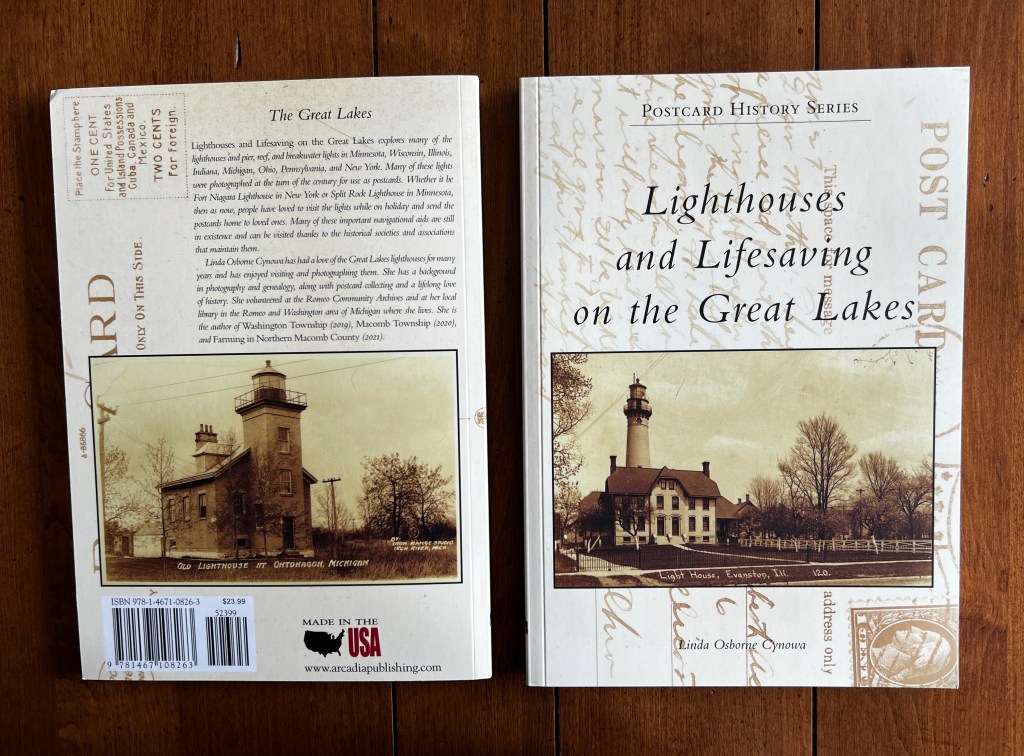
Ontonagon Lighthouse, Lake Superior, Michigan and Grosse Point Lighthouse, Lake Michigan, Illinois

If this book cover seems different, it is! I found that as the book was nearing completion I was not comfortable with the images that we had decided on for the front and back cover, when the decision had been made early on in the process. My concern came in with a Michigan image on the front cover. It seemed not quite as ‘inclusive’ as maybe putting a Michigan postcard on the back and using a postcard from one of the other states to highlight the front. I requested we change the images, and find this set up much more appealing and fitting. This book covers lighthouses in eight states, Wisconsin, Minnesota, Illinois, Michigan, Indiana, Ohio, Pennsylvania and New York.

So now, the postcards have been collected (many, many postcards), the research has been done (lighthouses have such a huge abundance of material about them), the writing is completed (after removing 3000 words over my limit) and the numbering of 227 images is finally correct and in order (thank heavens), now it’s time for Arcadia Publishing to works it’s magic and put my work and idea into book form, with the expectation of an early August publication date.

Sadly, just a couple of months before this book was finished my editor Angel who had been with me through all three previous books, moved on to a new job, and while I can’t thank her enough for her remarkable way of working with new authors, it was her guidance and help that made this a really great experience and help to make these books something I could be very proud of. I thank her and wish her all the success and good luck she well deserves to come her way.

Over the next few months, I would like to write about some of the stories I found during my research. About the lighthouse keepers and families and the life they lived while tending these lonely, isolated lights.

On that ‘wee note’ till next month, Monday March 7th.


Thank you to Q. David Bowers and Mary L. Martin for ‘A Guide Book of Collecting Postcards’.

Thank your visiting and reading today. Be sure to share with your friends using the share button below. If you haven’t already please enter your email address in the form below to receive my stories by email.

Harriet Colfax, part 2

Linda’s Monthly Monday Morning Moaning’s

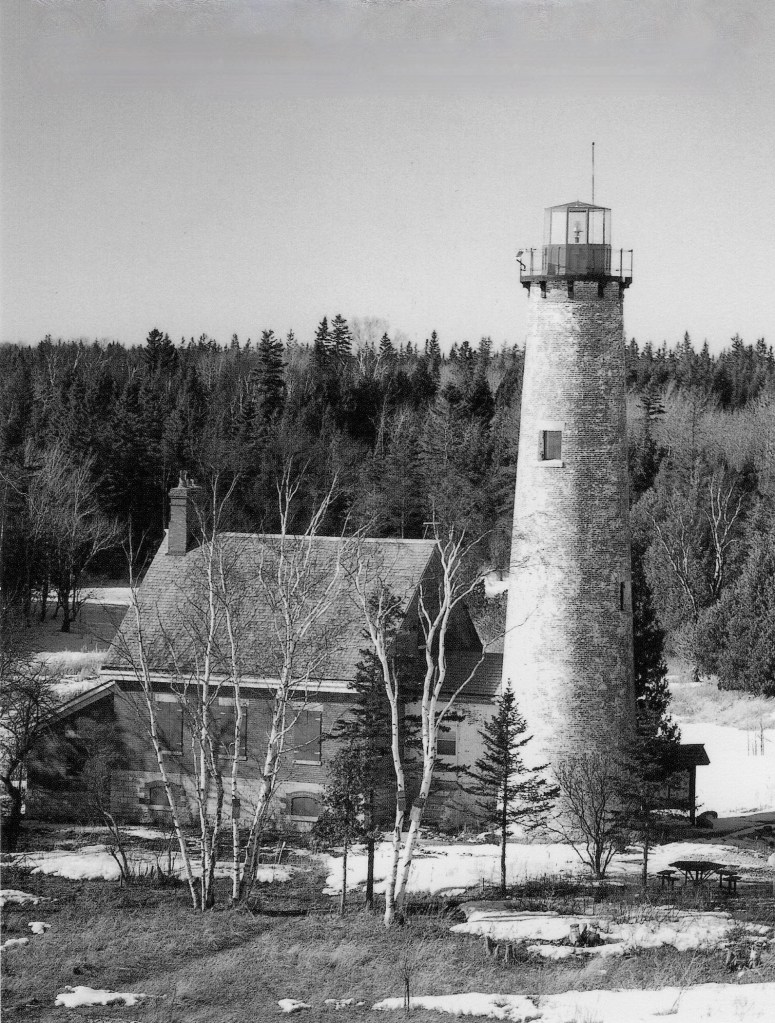
Harriett Colfax served as the keeper of the Michigan City Lighthouse for 43 years from her appointment in 1861 until her retirement at age 80 in 1904. The oldest, stanchest and most reliable lighthouse keeper in the United States is a women. A little, fragile, pretty maid of more than 80 years broke the records of all the lighthouse keepers in the country in length of service, in age, and above all in the fact that her light never failed, never went out between the hours of sunset and sunrise during the forty-three years that she tended it.

Her cousin, Schuyler Colfax, United States Representative and former Vice-President of the United States, suggested the lighthouse of the little port in which she lived as a way of earning her living. She assumed control of the lighthouse and the old harbor beacon in the spring of 1861. At eventide each day during the navigational season for forty-three years she would replaced the warning lamp with a fresh one; at dawn for forty-three years she had quenched the beacon and realized that the unfailing light brought safety to many ships and small boats in the rough waters of Lake Michigan.

Miss Colfax on left, Miss Hartwell on right

Miss Harriett Colfax was a native of Ogdensburg, New York where she had been a teacher of voice and piano. She moved to Michigan City in the 1850’s with her brother who had founded a local political newspaper. Miss Colfax worked as a typesetter on the paper as well as a music teacher. Her brother sold the newspaper and moved from the area but Miss Colfax remained in Michigan City with her companion Miss Ann Hartwell, also a teacher and native of Ogdensburg, New York.

At age 37 Miss Colfax took up the position of lighthouse keeper. Harriett Colfax and Ann Hartwell who were known to their friends as ‘Ann and Tat’, spent the rest of their lives together, primarily in the Michigan City Lighthouse. In the late 1800’s after twenty-five years of teaching, Ann Hartwell ran a newsstand and bookstore in downtown Michigan City. Her bookstore had Michigan City’s first circulating library. Miss Hartwell was a founding director of the Michigan City Branch of the Needlework Guild of America, an organization providing clothing to those in need. Miss Colfax and Miss Hartwell were supporter of the Library Association and construction of the Michigan City library which opened to the public on October 9, 1897. Confidants and companions for seventy years when, Harriett Colfax died on April 16, 1905, it was shortly after the death of Ann Hartwell on January 22, 1905. Taken from an article written after the deaths of the two friends.

On that ‘wee note’ see you next month, February 7, 2022


Courtesy to the Michigan City Old Lighthouse Museum.

Thank you for visiting and reading today. Beside to share with your friends using the share button below. If you haven’t already please enter your email address in the form below to receive my stories by email.

Harriet Colfax, Lighthouse Keeper

Linda’s Monthly, Monday Morning Moaning’s, not quite as catchy, but will have to do.

I am going to step a wee bit away from the ‘local history stories’ I usually try to write, but this is in keeping with the research I am doing, which differently takes me away from local history anyway.

The slow moving, bowed old women is proud of her record. The harbor light is in a glass cupola on the apex of the old house in which she lives, so that she can attend to her work in all kinds of weather without going outdoors. It was different in the ‘old days’ when the beacon stood at the end of a government pier, half a mile from her house, only accessible by a narrow walk with a single rail to hold on to.

As she would remember, the waves crashed over and against the pilings and woodwork of the pier till the timbers groaned and the frail women scarcely keep her footing. She fought her way along, made the stairway and the shelter of the tower, proceeded to fill the great lamp and light it. Then she came down, drenched to the skin, and chilled to the bone. The tornado had increased in fury, the tower wavered and the noise of the wind and water was deafening. She had hardly gotten to the mainland when there was a grinding crash. She looked back in terror to see the great beacon, whirl in an arc through the livid night and fall hissing into the lake. All night she watched the tower above her house praying that no ships would venture into the harbor. In the morning when daylight came, and she went down to the pier to see the ruins that the storm had brought. The beacon tower was gone, as was half the pier, and the shore was covered in wreckage of a structure that had withstood the storms for fifteen years.

That was eighteen years ago, and since Miss Colfax has had only the regular light to look after. She lives in the lighthouse, a strong, square, homelike house, built for the harbor service in 1858. Only the lantern like cupola on the roof distinguishes it from any other cozy country home.

Harriet Colfax served as the keeper of the Michigan City Indiana Lighthouse for 43 year, from her appointment in 1861 until her retirement at age 80 in 1904. Next month, part two, and I will tell the story of Harriet’s life as a lighthouse keeper and how she started in what was usually a man’s occupation.

On that ‘wee note’ till next month on January 3, 2022. Have a wonderful Christmas and a great New Year.


Thank you to the Old Michigan City Museum in Michigan City, Indiana for this story.

Thank you for visiting and reading today. Beside to share with your friends using the share button below. If you haven’t already, please enter your email address in the form below to receive my stories by email.
Changes to the Weekly Blog

Linda’s First Monday Monthly Moaning’s

I will be making a change from here on as far as the weekly, Linda’s Monday Morning Moaning’s blog. I am finding that with the research time and writing time, I am spending on this latest book, it is making it harder to spend the time needed to gather the images and information I need to make an ‘interesting’ story for the blog each week. My book presentations after this week will be done for the year, but with the holidays coming faster than most are ready for, I will be spending my time at a couple of Octagon House ‘teas’ they re hosting for the holiday season. Hopefully to give the public a chance to see and maybe purchase the three local books already published, as great inexpensive Christmas gifts.

From here on I will be putting out my stories on the first Monday of each month, and be able to keep everyone up on the progress I am making in my search for some of the lighthouses, that are proving to be very difficult to find in the vintage postcards images I am needing. There is an abundance of vintage postcards available on many of the lights around Michigan, while others are very elusive. there has been no problem with finding postcards for all the other states involved, but Michigan is proving to be difficult. I don’t feel I am able to not include these elusive lighthouses, as they are very impotent to the navigational and maritime history of the Great Lakes. So the hunt will go on….

So I hope you will be able to continue, if you have been a reader, or want to join if it’s the first time you are seeing my blogs. I hope to be able to continue to bring you local stories that will be of interest.

On the ‘wee note’ till next month, on the 6th of December.


Thank you for visiting and reading today. Be sure to share with your friends friends using the share button below. If you haven’t already please enter your email address in the form below to receive my stories by email.