Dr. Dennis Cooley

This morning I would like to talk about a very interesting gentleman from Washington’s early start, called Dr. Dennis Cooley, he will be my point of interest in todays Monday Morning Moaning’s. Let me explain why.

Dennis was born in Deerfield, Massachusetts on February 18,1789; he received his primary and preparatory education in the schools near his home town. Soon he completed his studies at the Medical College of Berkshire, Massachusetts, from where he graduated in 1822. He would travel south to pursue his career for some years and return to his home town, before deciding in 1827 that the area of Macomb County, MI, and namely Washington might hold his future.

Only known image of Dr Dennis Cooley

Dennis married Elizabeth Anderson of Deerfield, Massachusetts on May 16, 1830. Dennis and Elizabeth had two children Etta, born 1831 and died June, 1834, Belle, born 1834 and she died January,1844. Loss had still not finished with Dr. Cooley when his wife Elizabeth died in November, 1834. In May of 1836 he married again to the daughter of Elon Andrus a prominent Washington resident. Clara was born in Genesee County, New York in 1812, and came to Washington with her family in 1822. They adopted a son named George, birth date unknown, so where not much else is known about the young man, other than he passed away in 1856.

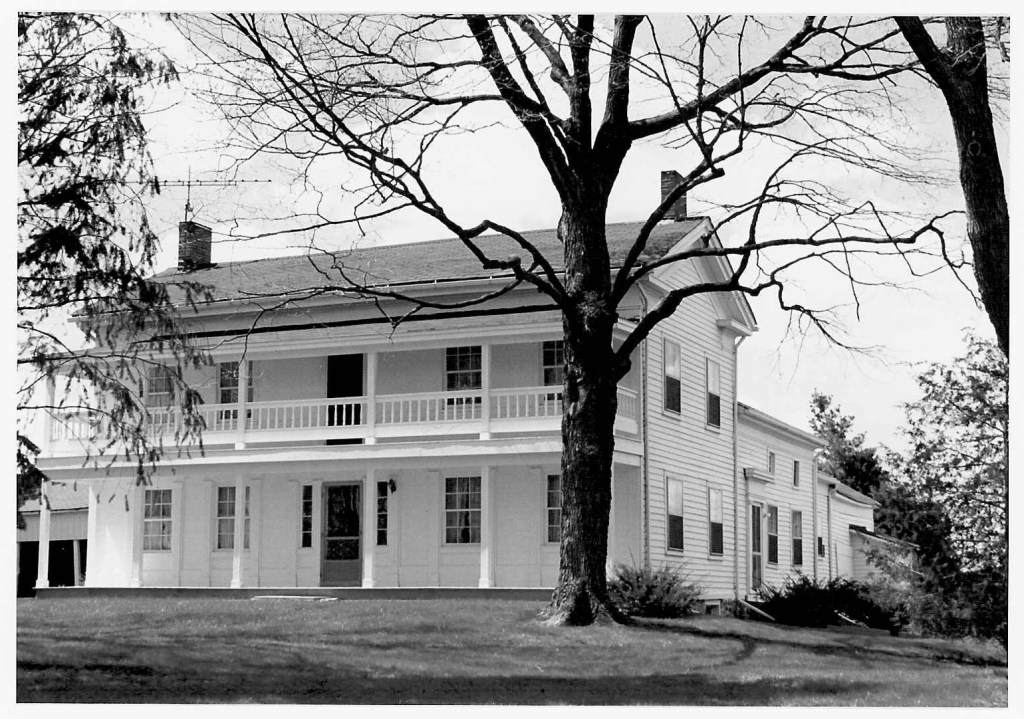
Dr. Cooley’s house on Main St and West St

Dr. Cooley was described as ” a man of fine form, with a good mind and eccentric with his habits”. He was among the few early physicians in the area, and his patients would come to the crossroads of West and Van Dyke Road, which became known as Cooley Corners. Dr. Cooley was well known for his special interest in botany and went on to publish a “List of Plants Common Within Ten Miles of Cooley Corners”.

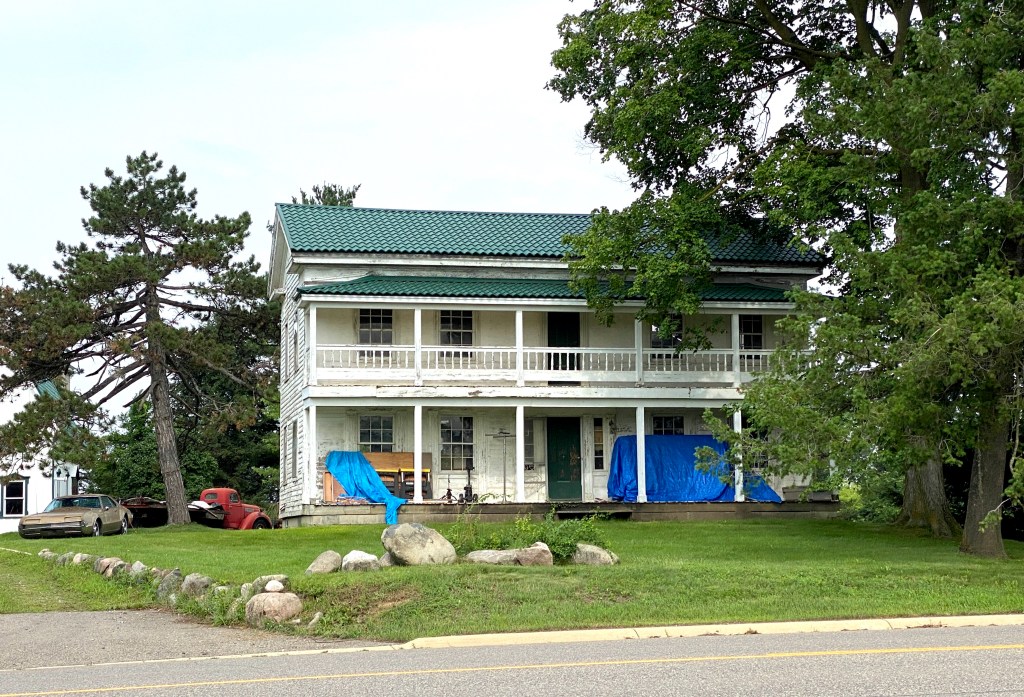
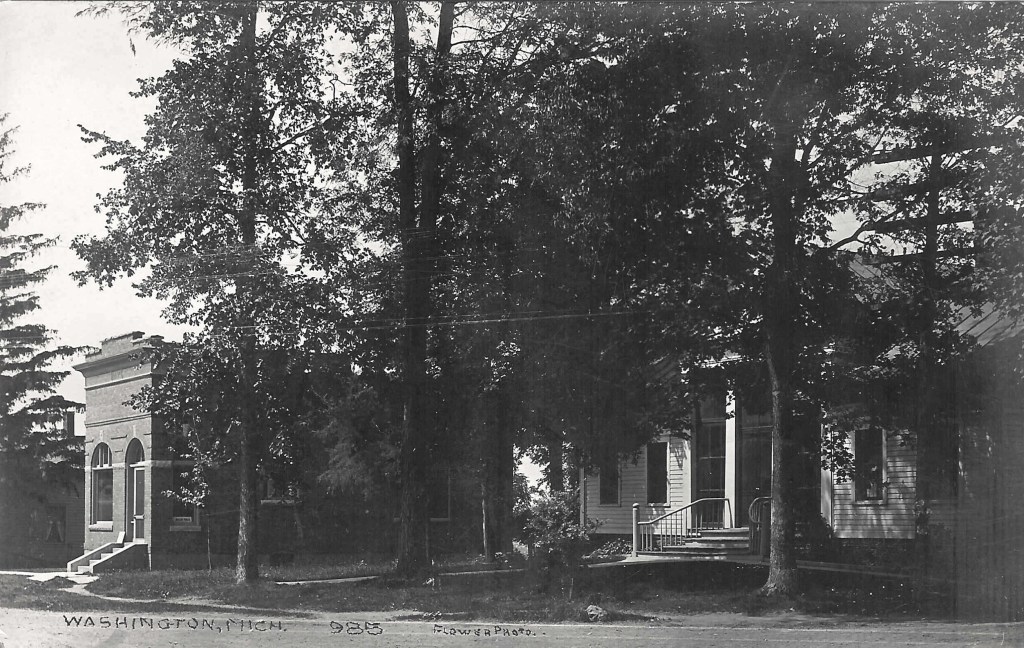
This is a small area, and this images shows it’s relation to the Washington Bank, now Bank of Antiques

Dr. Cooley was given the appointment of post master for Washington after the first post master Otis Lamb, so the mail was carried by stagecoach from Royal Oak for the next 23 years, where Dr. Cooley attended to both the mail as well as to the sick from around the area, at his home. He continued to practice medicine until 1856, when he ceased due to his own illness. Dr. Dennis Cooley passed away on September 8, 1860 at his home in the Village of Washington.

Years later after the home was demolished, there was a small gas station on the corner, and eventually a new construction business would built its showroom on this busy corner. Dr. Cooley should be remembered as a great lover of science, a skilled botanist, and had collected a fine and large cabinet of natural scientific objects.

On that ‘wee note’ till next week.


My thanks to the Great Washington Township Area Historical Society for the use of the images, and Cheri Allen for always having a better memory than I have. And least but not last, Find -A-Grave Memorial pages.

Thank you for visiting and reading today. Be sure to share with your friends using the share button below, if you haven’t already, please enter your email address in the form below to receive my stories by email.

Mr. McCullough

Linda’s Monday Morning Moaning’s will be a bit off subject this morning, but wanted to make this author part of history blogs, probably because this man influenced me and my love of history, and is my favorite historical author.

David McCullough, a great American Historian, just had a birthday this past week, and turned 88 years old. Readers and fans of his have called him a ‘National Treasure’, and with that I certainly agree. Many, many years ago he wrote a book on one of my favorite and often misunderstood Presidents, John Adams, and much was also written about his brilliant wife Abigail Adams. Her quotes, when writing her husband, who was often for great lengths of time, away from his wife and family while helping bring forth a new country, have been listed in many of his books. Each of the books I have written has a quote of Abigail Adams along with the dedication.

‘In the cold colorless light of a New England winter, two men on horseback traveled the coast road below Boston heading north. A foot or more of snow covered the landscape, the remnants of a Christmas storm that had blanketed Massachusetts from one end of the province to the other. Beneath the snow, after weeks of severe cold, the grounds frozen solid to a depth of two feet. Packed ice in the road, ruts as hard as iron, made the going hazardous, and the rider, mindful of the horse, kept to a walk’. Chapter 1 of John Adams, by David McCullough.

Beyond writing, he is a first rate narrator and speaker and over the years I have listened to his wonderful voice narrate PBS American Experience, and many other historical shows, and can still be found on C-Span where there is so much to learn by his programs and presentations.

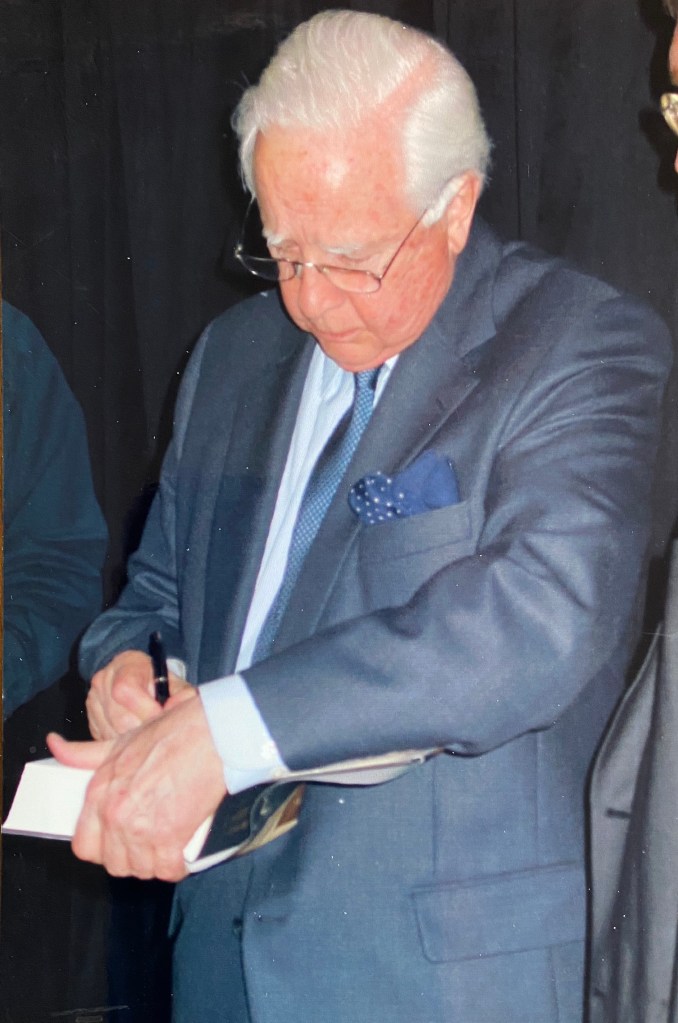
Many years ago in the early 2000’s, I heard he was coming too Meadowbrook, in Rochester Hills, to do a book presentation. I HAD TO ATTEND! At that time I owned four of his books, all big and heavy and wanted to get them signed. My husband David, was kind enough to carry this awkward pile of books in order for me to see if signing was an option. And being that photography was another hobby of mine, my camera and equipment had to also accompany us! What a thrill, for me it was like seeing the ‘rock stars’ we all want to see in person, but for me it was David McCullough, author.

Although it had been stated that Mr. McCullough would not be able to sign books that night, someone did thrust a book at him to sign anyway, and this polite man signed their copy. (It was not me, though). As the years went on I made sure I obtained a copy of all his books, and found his writing to be magnificent, and I would eagerly await for each new book. Sadly, he retired from writing, just before the pandemic , as he wanted to spend more time with his family and friends. So sadly, we won’t be seeing any new writing from this very talented man, nor have the luxury of probably hearing the velvety voice in public again talking about the history he so loves.

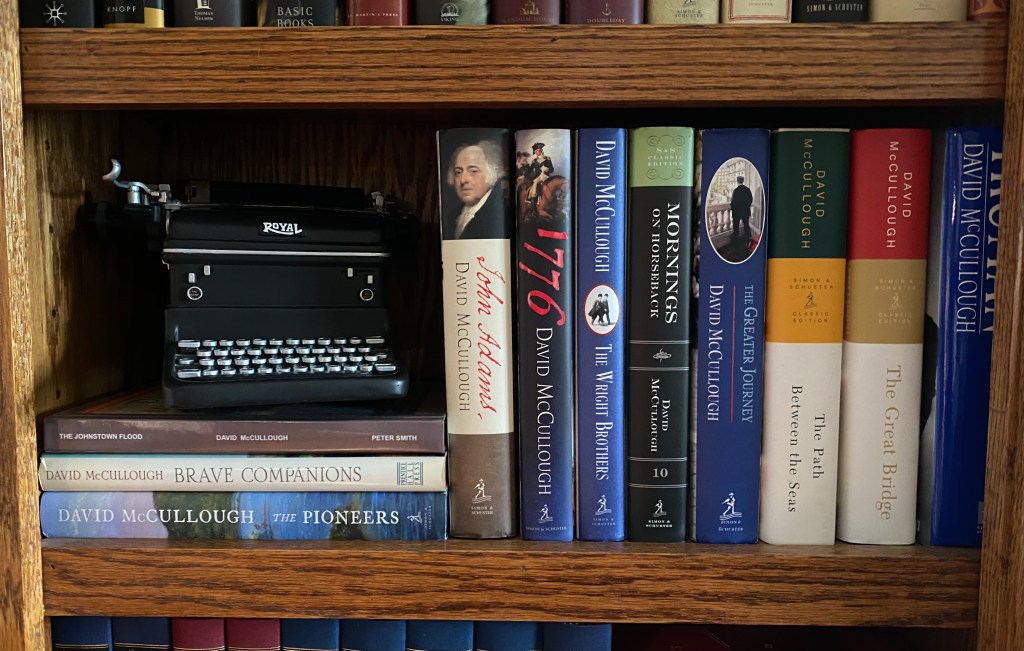
My McCullough book shelf and miniature Royal typewriter

Mr. McCullough always typed out his books on a late 1940’s Royal typewriter, no computers for him. Many years ago a company made a replica of his typewriter to use as a bookend, and of course I had to add one of them to my many books he had written. He wrote his books in a tiny cabin in his ‘backyard’ because of the peace and quiet around him. He would speak before Congress and won many awards, along with 2 Pulitzer Prizes for literature. He will always be a hard act to follow, and he set a high bar and encouraged many writers and documentarians to push forward on their work. Some months ago, while reading his Facebook page and people were talking of his books and showing their collections, I also listed the image above as I am very proud of my shelf of McCullough books, and I was contacted by the administrator of his site to ask if they could use my image as their mast head! Needless to say, what a thrill for me.

His writing will be missed. I will always treasure his writing and the books I have been fortunate to own. The stories he wrote were always written to understand and be very interesting. One of his last books was on the Wright brothers, and my first thoughts were, ok? But as usually I was over taken, what a great story and his take on their lives and what these brothers brought to us. I guess there is a small bit of hero worship in my blog this week. Happy Birthday Mr McCullough, and many happy returns of the day.

On that’ wee note’ till next week.


Thank you for visiting and reading today. Beside to share with your friends using the share button below. If you haven’t already please enter your email address in the form below to receive my. stories by email.

Little Sable Point Light Station

This week’s Monday Morning Moaning’s is going to open up the research I have been doing on this new venture I have begun on the Great Lakes Lights.

In 1867 lumbering was the main business in Golden Township on Lake Michigan where Little Sable Point Light is located. With very little roads at the time, most of the lumber and supplies were shipped in by boat. Shipwrecks in the area put out a call for a lighthouse to ease the navigational problems. Since ships had very limited navigational equipment , lighthouses were a very important contribution to safety on the lakes. Plans were drawn up by the Major of Engineers, O.M.Poe, and building began in April of 1873, were the crew and supplies would again come in by boat.

Circa 1915 Light Station via vintage postcard

Construction of the 115′ tower and 2 1/2 story brick dwelling was completed in the spring of 1879 and be the first time the light would shine. The was produced by a lamp with three concentric wicks which initially burned lard oil, but later burned kerosene. A lens made of hand-ground glass prisms intensified the light so it could be seen for 19 miles out into the lake. In order to make the tower more visible as a day mark, the tower was painted white in May, 1899. 1910 brought a change in name to the lighthouse, being that the original name of the lighthouse was Petite Point au Sable, French for Little Point of Sand. It would go on to be known as Little Sable Point Light Station. In 1911 the house was enlarged to better accommodate the keepers growing families, were dormers on the north and south sides and windows in the Attica were added. In 1915 the light was changed to an incandescent oil vapor lamp, which produced a brighter light.

President Franklin Roosevelt abolished the U.S. Lighthouse Service in 1939 and jurisdiction for all the lighthouses was transferred to the U.S Coast Guard. A land exchange between the U.S. Federal Government and the State of Michigan was approved in 1973, and the State received the deed to the lighthouse and land in 1974. To reduce the maintenance the Coast Guard removed the white paint from the tower in 1976.

There were 14 keepers at Little Sable. The last last keeper was Henry ‘Hank’ Vavrina, who transferred to Big Sable Lighthouse when Little Sable was automated. No date information is known, as to when the keepers house was removed.

On that ‘wee note’, till next week.


I wish to thank the Sable Points Lighthouse Keepers Association in Ludington, Michigan, you can check out http://www.splka.org for even more information.

Macomb Townships, Waldenburg

Last week in Linda’s Monday Morning Moaning’s, I talked about the ‘Cobbler of Waldenburg’ and felt that a further look into Waldenburg was of interest. I hope you agree.

Waldenburg, is a small town in Macomb Township, settled in 1831. The area was known as a German settlement of immigrants from mainly Prussia, in the north, from the Mecklenburg area. Waldenburg would get it’s name from the hometown of early settler August Posner. The immigrants liked the idea of settling where there was water available as in the middle branch of the Clinton River. This river was given the name of ‘the crick’ to the many town folk that lived there. The ground proved to be level and have a fertile sandy loam which would produce for them.

Early Waldenburg

There would be post office set up at Macomb Corners, at 25 mile and Romeo Plank in 1830, but would later be moved to Waldenburg at 22 Mile road, because of the businesses that helped with the growing of the community. In Waldenburg began a school for the Germain immigrants and a church in Immanuel Evangelical Germain Lutheran. In the beginning German was the language used, because of where the people were most comfortable. The post office went by the wayside in the first part of the 1900’s as did the blacksmith with the coming of the automobiles.

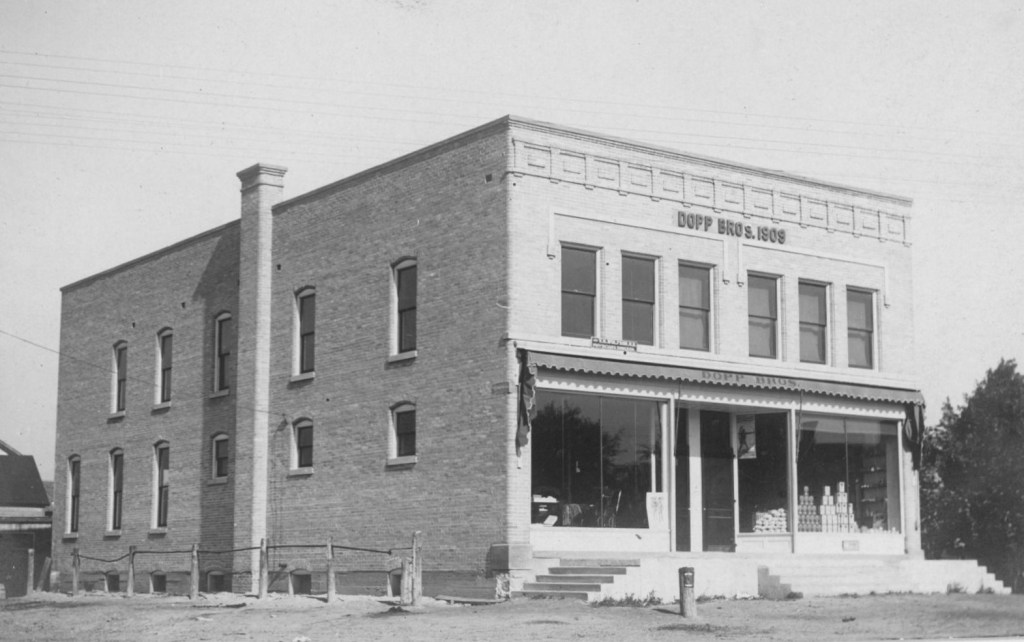
A blacksmith shop, the post office, a feed store, later on becoming a hardware store, the Dopp building that would house many different business opportunities over the years. When the auto came there would be two gas stations. The Stiers were farmers and some were in the hardware business. The Stades eventually ran the grocery store and the feed store-gas station. Rohrbecks ran the 2nd gas station-grocery-butcher shop. By the 1950’s there came 2 beauty shops, a shoe repair.

22 Mile and Romeo Plank Road, Waldenburg

Cemeteries were established in the same area as the church, which began its services in the Reh barn on Romeo Plank 1/2 mile south of 21 Mile. Names such as Klockow, Dopp, Schwark, Stark, Sahr, Kuechenmeister, Pringnitz, Gastmeier, Oehmke, Falkenhagen, Miller, Penzien and Schoof to name but a few, are families that would leave their mark on the growth of this community.

Waldenburg has always been known for it’s beer drinking and the playing of Euchre. Reunions were a yearly event for the many family members who moved on from Waldenburg in Macomb Township, when coming home to the farms of their grandparents made seeing long time friendship continue to last. The children played in the ‘crick’, swimming, fishing, ice skating and trapping. The cows drank in it and bathed in it, now its just a trickle, as progress has allowed its use is mainly watering the golf courses.

Now the Dopp building still stands, as does a gas station, the Waldenburg Tavern still meets the needs of the community, the Steir Hardware that stood for so many years is no more due to progress. Soon major work will be done to hopefully lessen the traffic congestion on that 22 Mile and Romeo Plank intersection where home building would have made the original settlers stand and scratch their heads in disbelief.

On that ‘wee note’ till next week.

A thank you to Shelley Steir Henshaw for her help when working on the ‘Macomb Township’ book and all her insights into the area of Waldenburg which sits so close to her heart.

Thank you for visiting and reading today. Be sure to share with your friends using the share button below. If you haven’t already please enter your email address in the form below to receive my stories by email.

The ‘Cobbler of Waldenburg’

Todays Monday Morning Moaning’s comes from an article in the Mt. Clemens Monitor, from Friday April 4, 1930, called “Cobbler of Waldenburg Celebrates 90th Birthday”.

Born March 30, 1840 in Austrian Silesia, now Czechoslovakia, Ambrose Leyer was “just another mouth to feed” at the time when his parents were scarcely able to keep the family they already had. Ambrose’s, uncle lived just across the line in Prussian Silesia offered to take the boy and raised him, his parents agreed. Although the boys parents were devout Catholics, they insisted he be raised in their Catholic religion, although permitted his foster parents to educate him in a Lutheran school. Little did they know that the coincidence would be an underlaying cause of his removal to America.

Time honor customs, being what they are, Ambrose was apprenticed to a trade. He selected the art of the cobbler. A diligent worker and being exempt from military service due to his small stature, he became a master at his craft, when he was sent to a fort near his home to keep the soldiers well shod. When he come to America he would find himself in the middle of of a nation torn apart by civil strife after his native land had but recently been torn by its own revolution of 1848.

Ambrose’s uncle, August Posner, packed up his goods and came to America, leaving his young nephew in the care of August’s mother. August Posner came to Waldenburg, with characteristic German foresight and ambition, he established a brickyard and potash factory. Being a devout Lutheran, Uncle August joined the congregation of the Waldenburg Lutheran church and was grieved to find that the congregation lacked any sort of a musical instrument with which to enliven its service. He was over joyed when after letters from home made him aware that the the trombone band which had been the pride of his home land church had recently discarded its old slide trombone and replaced it. Mr. Posner saw an opportunity before him. He wrote a letter in reply that the Waldenburg congregation would be glad to purchase the discarded trombone, for the right price.

August Posner was very please to hear that they would send the trombone to them free of charge, but they also had another instrument which was said to be able to play any tones that one’s heart could desire, for which a charge of $35 was to be made. To his surprise and all the residents of Waldenburg, when it was found out the ‘new instrument’ was none other than his nephew, Ambrose Leyer, and the $35 had been for his passage to bring with him the trombone.

It took six weeks in crossing the ocean on his first sailing, but upon his arrival he ‘took up’ 10 acres of land near the north end of Waldenburg and established his home and cobbler’s shop in an abandoned toll gate of the Romeo Plank Road Company.

Leyer home on Romeo Plank Road

The cobbler of Waldenburg married and reared a family of nine children. While Mrs. Leyer died about 30 years ago, it’s to the loving care of one daughter Mr. Leyer attributes his long life span. In addition to her personal care to her father, she also performs the many household tasks needed, while her brother farms the 10 acres for his father along with his own farming. The other children, married and grown up, are no less devoted although their own responsibilities prevent them from being ay his side.

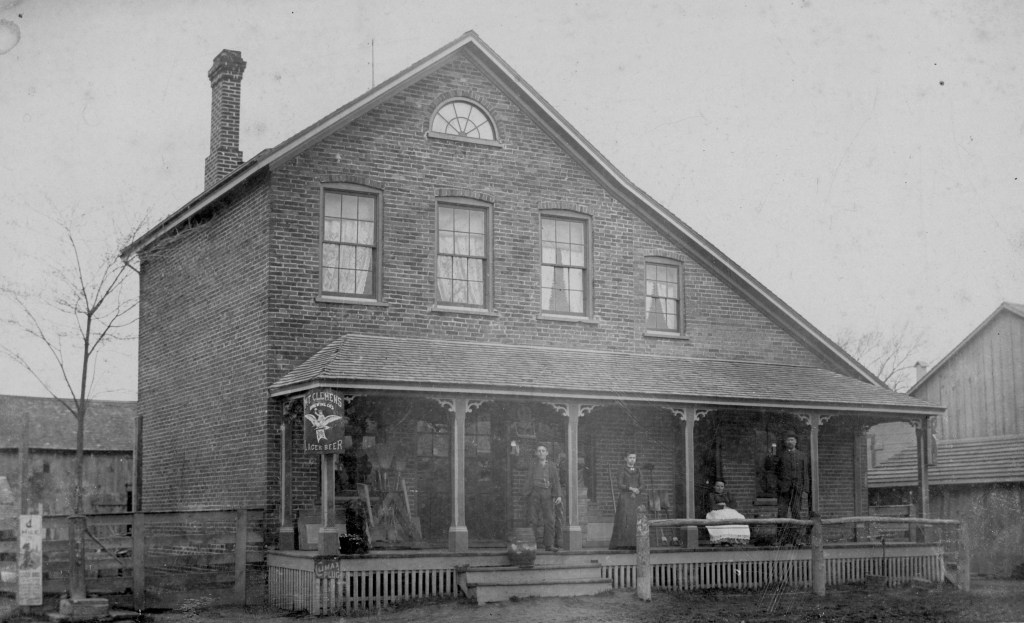
They bring him good things to eat and sometimes smuggle in a few bottle of beer, although as Mr. Leyer says regretfully, the beer in prohibition is by no means as good as the beer in which he accustomed himself while living in Germany or in Waldenburg when, Jasmund, the village brewer, produced his own beer in his general store.

The old man’s recipe for longevity is plenty of plain food, regular hours, steady work, beer, but not too much of it and schnapps when one wants one. Whiskey he declares, is just like medicine, if use properly. And don’t forget a good cigar. Although he has his “bad spells” when he does not feel overly well, for the most part he can be found seated by his window watching the passing traffic on the Romeo Plank road which runs in front of his house, waving to his friends who pass.

The ‘Cobbler of Waldenburg’, Ambrose Leyer passed away on November 5, 1933 at 93 years and 7 months.

On that ‘wee note’, till next week.


Thank you for visiting and reading today. Be sure to share with your friends using the share button below. If you haven’t already please enter your email address in the form below to receive my stories by email.