‘Princess May’s’ Grounding

Linda’s Monthly Monday Mornings Moaning’s for June 5, 20023

Built in England by the Hawthorn, Leslie & Co. in 1888, the ship was originally named Cass, where in 1901 after thirteen years serving along the Chinese coast, the Canadian Pacific Railway Coastal Service purchased and renamed the Cass, the ‘Princess May’, after Mary of Teck, who was known as ‘May’ and would in 1910 become Queen of England.

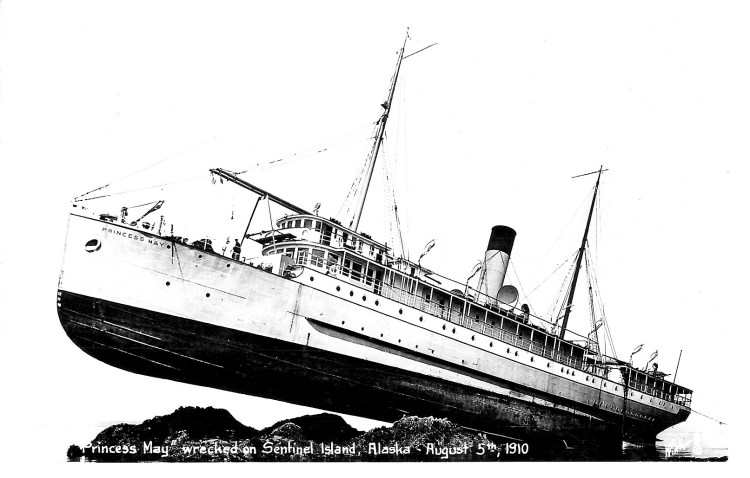
On 5 August 1910, the Princess May departed Skagway, Alaska, with 80 passengers and 68 crew and a shipment of gold. The ship was steaming down the Lynn Canal at 12 knots under heavy fog in the command of Captain John McLeo, when it stuck the rocks near the north end of Sentinel Island early in the morning. It was high tide and the momentum of the ship forced it well up onto the rocks, with the bow jutting upward at an angle of 23 degrees.

The hull was breached, through which water began to pour in and flooded the engine room, cutting off electrical power to the ship’s instruments, including its wireless set. The wireless operator, W.R. Keller, ran to the engine room and rigged an improvised electrical connection with the engine room telegraph battery, and using this was able to send out a wireless distress call before the engine room was completely flooded. The close proximity of Sentinel Island helped prevent a major disaster. The passengers and crew were able to safely evacuate to the island, and the gold shipment was also secured. Later the passengers and crew were picked up by Princess Ena and other rescue ships and taken to Juneau.

Over a 120 plates were damaged on the hull, and the largest hole was approximately 50 feet long and two foot wide. Many attempts were made to remove the ship from the rocks, and with a cost in 1910 finances of $115,000. it was salvaged. The grounding left the ship jutting completely out of the water, where it would go on to become the subject of a very famous ship wreck photograph.

The ‘Princess May’ at low tide
Sentinel Island Lighthouse 1910

Sentinel Island Lighthouse is located in Alaska just adjacent to the Lynn Canal, between the main land and the Lincoln and Shelter Islands by Juneau City. Another famous image from the islands history shows the ‘Princess May’ on the rocks from in front of the lighthouse itself. I unfortunately have not been able to acquire a postcards of that image. Postcard images are from the authors collection.

On that ‘wee note’ till next month, Monday July 3, 2023.


Thank you for visiting and reading today. Please be sure to share with your friends, using the share button and if you haven’t already, please enter your email address in the subscription form below to receive my stories by mail.

Chatham Twin Lighthouse, Massachusetts

Linda’s Monthly Monday Mornings Moaning’s for May 1, 20023

In 1808 two octagonal wooden towers, forty-feet tall and seventy-feet apart were erected, along with a one-story, three room keepers house. These 40 foot brick twin lights, pictured below, were built and established in 1841 to replaced the two wood towers used from 1808. The lantern rooms on the towers are referred to as ‘bird-cage style lanterns’ because of their appearance.

Around 1857, the bird-cage style lanterns on the twin lights are replaced with new lanterns that would used a sixth order Fresnel lens. But erosion would overtake these twin towers. These lights were left to the elements and around 1879 most of the towers and the keepers house fell into the ocean. For many years, the remaining base of the north light would remained on the ledge, with it becoming a tourist attraction. When first built the twin lights were 400 feet from the edge of the cliff, with the remaining tower would going over that cliff by 1940.

In 1877, two new cast-iron and brick lined towers were built across the street from the original site along with a new keepers house. The 48 feet tall the lantern room would house a fourth-order Fresnel lens and the Chatham Light Station would take on new form, as seen below.

In 1923 the north tower was removed and taken to Eastham, Massachusetts to become the new Nauset Lighthouse. The south tower would receive a new fourth-order Fresnel lens. Over the years the Light Station would make many changes. The Chatham Light was automated in 1982.

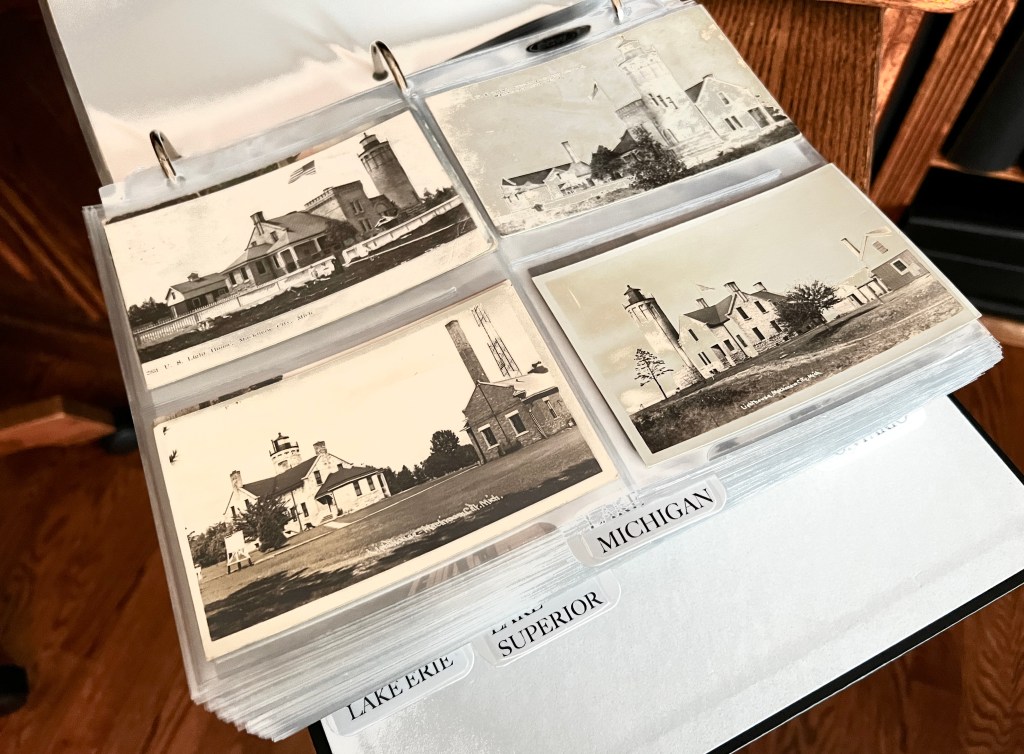
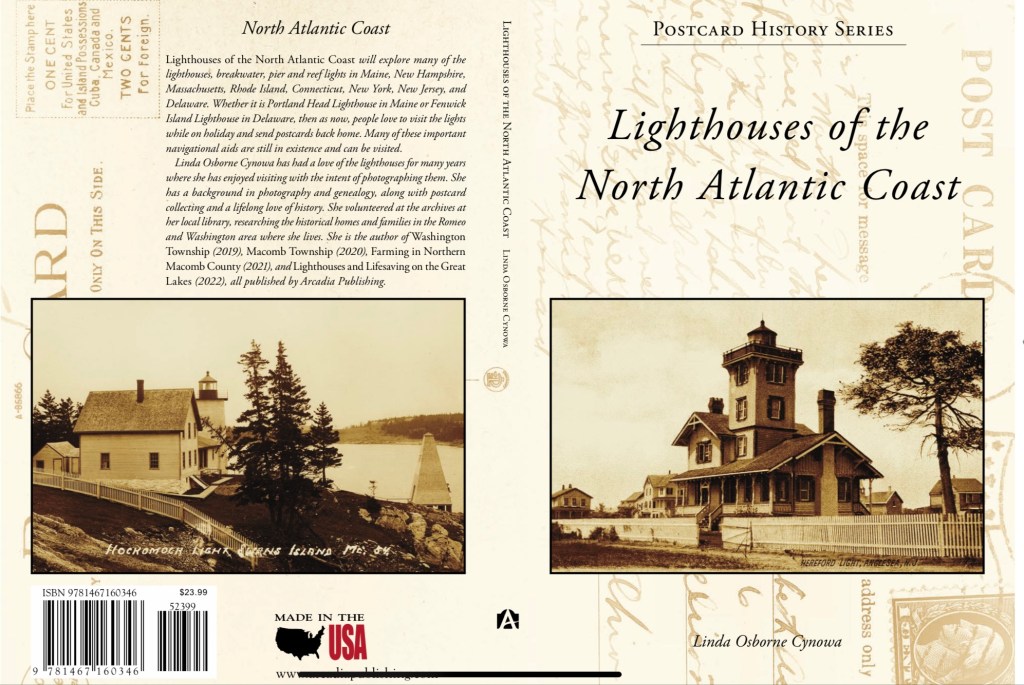
A thank you to the ‘Lighthouse Digest’ magazine, their May / June edition for the top two images of the Chatham Lighthouse and content. Bottom two postcards, part of the authors collection. The Chatham Light Station is one of many lights highlighted in the July 26 publication of Arcadia’s new ‘Lighthouses of the North Atlantic Coast’.

On that ‘wee note’ till Monday June 5, 2023.


Thank you for visiting and reading today. Please be sure to share with your friends, using the share button and if you haven’t already, please enter your email address in the subscription form below to receive my stories by mail.

Au Sable Point Lighthouse Lake Superior

Linda’s Monthly Monday Mornings Moaning’s for April 3, 20023

Two of the early lighthouses established on Lake Superior were at Whitefish Point in 1849 and on the northern end of Grand Island in 1856. In 1867, the Lighthouse Board felt that the eighty miles between these two early lights remained unmarked and requested $40,000 for a lighthouse to rectify this situation. The Lighthouse Board repeated its request annually, and then in 1871, it added that the lighthouse was “more needed than any other light in the district.” This seems to have prompted Congress to act, as the following year $40,000 was appropriated for “a light between White Fish Point and Grand Island Harbor.”

The Lighthouse Board selected Big Sable Point, named for the towering nearby sand dunes, as the site for the lighthouse, and work at the point began in July 1873. A circular brick tower was built on a cut-stone base with cut-stone lintels and sills. The eighty-six-foot-tall tower tapers from a diameter of sixteen-and-a-half feet at its base to twelve feet, at the circular gallery that is supported by sixteen cast-iron corbels. A spiral cast-iron stairway leads to the top of the tower where arched windows provide light for the watchroom. A third-order, L. Sautter & Cie. Fresnel lens was installed in the tower’s lantern room to produce a fixed white light, which thanks to the lofty bluff on which the lighthouse stands, has a focal plane of 107 feet. For the convenience of the keepers, a twelve-and-a-half-foot-long passage was built to link the base of the tower to the two-story dwelling. While the tower was whitewashed, the redbrick dwelling was left unpainted.

By the end of June 1874, work at the station was finished except for plastering, outside whitewashing, and installing the Fresnel lens. After this work was finished, Keeper Casper Kuhn displayed the light for the first time on the night of August 19, 1874.

Up until 1910, when control of the country’s lighthouses passed from the Lighthouse Board to the Bureau of Lighthouses, the lighthouse was known as Big Sable Lighthouse, but for some reason, the Bureau of Lighthouses started using the name Au Sable Lighthouse. While some say this was to prevent confusion with Big Sable Lighthouse on Lake Michigan, the change to Au Sable Lighthouse gave the station the same name as another light on Lake Huron. The characteristic of the light was changed from fixed white to a group of two white flashes every fifteen seconds in 1944. Au Sable Lighthouse was automated in 1958, and its keepers were no longer needed.

In 1968, Au Sable Light Station became part of the surrounding Pictured Rocks National Lakeshore, which had been created in 1966. When the station’s third-order lens was removed from the tower sometime after 1972, it was placed on display at the old Grand Marais Lifeboat Station, which doubled as a maritime museum and the lakeshore’s ranger station. After the lantern room was restored, the lens was returned to its rightful home atop Au Sable Lighthouse in 1996. 

Top image take from the water side, circa 1920, courtesy of the National Archives, three other images authors vintage postcards. Images from the Arcadia Publishing book, ‘Lighthouses and Lifesaving on the Great Lakes’. Thank you to Lighthousefriends.com for their content and their love of all the lighthouses. On that ‘wee note’ till next month, Monday May 1, 2023.


Thank you for visiting and reading today. Please be sure to share with your friends, using the share button and if you haven’t already, please enter your email address in the subscription form below to receive my stories by mail.

‘Lighthouse of the North Atlantic Coast’

Linda’s Monthly Monday Morning Moaning’s March 6, 2023

Part Two:

I am very humbled to write, that my fifth book with Arcadia Publishing will be released on July 26, 2023, and once again the excitement begins in the editing process that happens twice along the way and then receiving the finished form of a book. When you are ‘presented’ with your new cover, this images below is how you receive it, both back and front images.

Chapter Five- Sheffield Island Lighthouse, Norwalk Harbor, Connecticut

While previously called the Smith Island Light, it is one of many names the light was called through the years. There are sixteen islands in the Norwalk Island chain and Sheffield is known to be the largest. In 1869 a new school house style, keepers dwelling, with two-and-a-half-stories, made out of granite stone was built. The tower with lantern room were forty-six-feet tall. The tower, was fitted with a fourth-order Fresnel lens. The old light tower was torn down and the previous keepers house was used as a storage building. The light was deactivated in 1902 and  went into private hands after being put up for auction in 1914.

EPSON MFP image

Chapter Six- Hudson-Athens Lighthouse, Hudson, New York

Located between the towns of Hudson and Athens, on a sandy ridge called Middle Ground Flats a lighthouse was constructed in 1874. A Second Empire style brick dwelling with a mansard roof, situated on a granite foundation. A sixth-order Fresnel lens in the light tower is centered on the western face of the redbrick, eight-room dwelling.The light was automated n 1949.

EPSON MFP image

Chapter Seven – Point Comfort Lighthouse, Keansburg, New Jersey

Keansburg had two lighthouses that worked in conjunction with one another. In a range line, the lower one, the Point Comfort Beacon on Raritan Bay and the higher one Waackaack Light (yes that is what it’s called) on Creek Road. The Point Comfort Beacon was built in 1856, a wooden, one-and-a-half-story, school house type structure that served as the keepers dwelling, with a square wooden tower attached to the middle of the roof line. By 1867, repairs to the kitchen, and roof reshingling were needed, along with a coat of paint. In 1883, jetties were built because of the erosion of the bank, riprap was added to aid protection to the lighthouse foundation. 1904 was to see 400 tons of riprap deposited again to help the jetties hold back the erosion. The lighthouse was destroyed by fire in the 1950’s.

Chapter Eight – Cape Helopen, Lighthouse, Lewes, Delaware

In 1926, the Cape Helopen Lighthouse collapsed into the Atlantic Ocean. The light was built on a foundation on top of a sand dune. Although at a great distance from the sea, with erosion encroaching on the shoreline the stability of the light tower was endangered. In 1914, the Lighthouse Service found that the costly erosion could not be halted except at great cost. The stone built, sixty-nine-foot tower was first built in 1767, and survived the British in 1777. The keepers had a two-story wood-framed dwelling with a wrap-around-porch. The lantern room was fitted with a first-order lens. By 1897, the sand surrounding the tower was thought to be blowing away at a rate of 3 to 5 feet each year. The light was deactivated in 1924 shortly before its collapse.

EPSON MFP image

I hope that this small taste of ‘The Lighthouse of the North Atlantic Coast’ may have peaked your interest in how much more will be between the pages of this up coming book.

On that ‘wee note’ till next month. Monday April 3, 2023.


Thank you for visiting and reading today. Be sure to share with your friends, using the share button and if you haven’t already, please enter your email address in the subscription form below to receive my stories by email. 

‘Lighthouses of the North Atlantic Coast’

Linda’s Monthly Monday Morning Moaning’s February 6, 2023

Part One:

I am now getting to the point of wrapping up this latest book with vintage postcard images that I have been working on these past few months, and getting it to the publisher with in a few weeks. Here is a sample of the different chapters and the different type of lighthouses, that will be covered in the book.

Chapter One: Burnt Coat Harbor (Hockamock Head), Swans Island, Maine

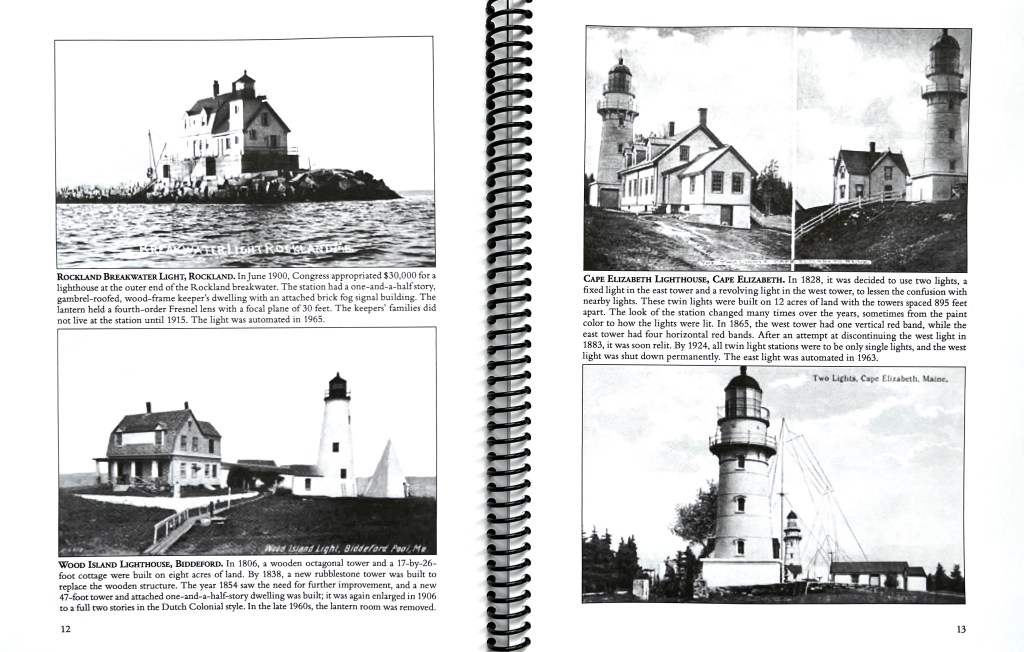
At the entrance to Burnt Coat Harbor, a light station was built on the southern most point called Hockamock Head on Swans Island in 1872. Originally built with twin towers, to be used as range lights, the second light was removed in 1884. A story-and-a-half  white clapboard keepers house that connected to the thirty-two-foot tower, was erected for a lantern room to house the fourth-order Fresnel lens. In 1975, the original Fresnel lens was removed and replaced with an automatic light nearby, soon found to be not as bright, in 1978 the tower was relit with a 250-mm optic lens. Now maintained by the Town of Swans Island, it is now listed on the National Register of Historic Places.

Chapter Two: Portsmouth Harbor Lighthouse, New Castle, New Hampshire

The fort of William and Mary, so named by the British, was rebuilt after the War of Independence and renamed Fort Constitution in 1800. A new light was built in 1804 a short distance from the original and a bridge built of wood was used to access the light. The light tower was eighty-feet tall, with the keeper residing in the village, not at the light. By 1851 the tower was shortened to fifty-five feet, and a fourth-order Fresnel lens was added. The lighthouse was replaced in 1877 with a cast iron tower lined with brick. A brown color was used as it’s day mark. In 1902 the color was changed to white. The light became automated in 1960. It came under the care of the Friends of Portsmouth Harbor Lighthouses in 2001.

Chapter Three: Edgartown Harbor Lighthouse, Edgartown, Massachusetts

In 1828, the first lighthouse was a two-story dwelling with a side-gabled roof where a lantern room was centered on the roof, with a 1,500 foot walk way built to connect the dwelling to the mainland. A stone pier was soon replacing the original wood used to support the light. In 1938 a hurricane caused enough damage to the light to give thought to demolishing the building. From 1939 through 1980 the light was maintained by the Coast Guard and they would refurbish the dwelling in 1985. By 2014 the Town of Edgartown took ownership of the lighthouse.

Chapter Four: Block Island North Lighthouse, New Shoreham, Rhode Island

There were at least four lighthouses built over the years on the north end of the six-mile long Block Island. In 1837 saw a rectangular, granite keepers dwelling, with a light tower at each end of the roof, on the top of the buildings roof. These two lights were lined up on a north-south axis, where they would look like one light until the ships were within two or three miles of the lighthouse. In 1867, the currant lighthouse was built in the Victorian and Gothic Revival style as a two-story dwelling with Connecticut granite, with a pitched, slate covered roof, where the iron lantern room and tower were situated on the northern end of the roof line. Block Island Lighthouse was automated in 1956 and by 1973 it had been deactivated.

Next month, Connecticut, New York, New Jersey and Delaware, and by that time a cover image. I hope I might have peaked your interest, if you are a lighthouse lover, as I am. On that ‘wee note’ till next month. Monday March 6, 2023.


Thank you for visiting and reading today. Be sure to share with your friends, using the share button and if you haven’t already, please enter your email address in the subscription form below to receive my stories by email.