Mission Point Lighthouse

Linda’s Monthly Monday Morning Moaning’s for January 2, 2023 – Happy New Year!

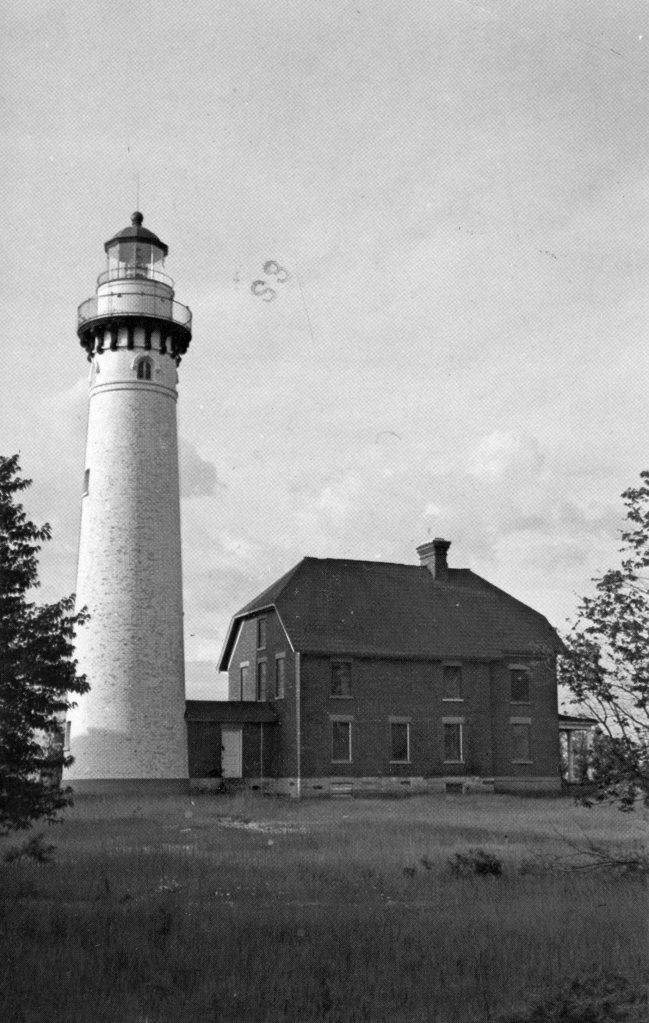
Sitting near the 45th Parallel between the water and forest on three sides, at the end of the Old Mission Peninsula, you will find the Mission Point Lighthouse. On the water side you can look out over the rocky beach at the north end of Grand Traverse Bay. Just one of Lake Michigan’s finest.

Back of the light where the road is situated.

When lighthouse when built in 1870, not having been done earlier due to the Civil War, the school house design was decided upon. It had six rooms on the ground floor and a bedroom and supply area on the second floor. The tower above the second floor had a small area made for the lightning mechanism. Whale oil and later kerosene was used to light the 5th Order Fresnel Lens, and with its intense light, it had a visibly of 13 miles.

Here was the start of the fence, shown above, that was soon needed in order to protect the lighthouse, because of visitors to the area. The light would only be lit for navigational purposes from 1870 to 1933 when it was decommissioned by using an automatic buoy light off shore.

Vandals made it necessary to find a solution to protect this light after it was automated in 1933, by 1948, 43 residents of the Old Mission Peninsula made a collection of $1,900. in order that the township could purchase the lighthouse and grounds surrounding it. The Old Mission Peninsula Historical Society have devoted their time and funds, from visitors, to seeing that this light is today still protected and cared for.

Water side view with beach.

Only seven keepers lived in the lighthouse during its important years for navigation. Sarah Noyes Lane was the only female keeper at Mission Point. Sarah was born in October of 1839, she married John Lane in 1857, a prominent Great Lakes ship captain, who went on to be a keeper at the light. For the last eight years of her husbands life, Sarah upheld her husbands duties, due to his ill health. When her husband passed away, Sarah was appointed the keeper in December 1906, and would hold the position until December of 1907. Sarah passed away in 1919 in Detroit, and laid to rest next to her husband in the Woodlawn Cemetery in Monroe, Michigan.

Thank you to the Lighthouse Digest, the Mission Point Lighthouse Historical Society. The booklet ‘Mission Point Lighthouse’ by Laura Johnson and Stefanie Staley. Postcard images property of the author.

On that ‘wee note’ till Monday, February 6, 2023


Thank you for visiting and reading today. Be sure to share with your friends, using the share button and if you haven’t already, please enter your email address in the subscription form below to receive my stories by email.

Lessons Learned While Researching

Linda’s Monthly Monday Morning Moaning’s for December 5, 2022

You would ‘assume’ if you are coming into contact with a hundred year old postcard that is showing the most beautiful image or real photograph of a lighthouse, especially one you are looking for, and the name is listed on the card, that you are home free, right? WRONG!

Or you are looking at an image a lighthouse, with no name listed and now you have to hope that, one, the lighthouse still looks the same, which is doubtful, or two, when you do find the light information there is, not only a new image of the lighthouse in todays light, or hopefully have an image of what it used to look like that might match the image you now have!

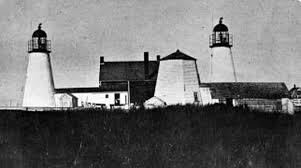
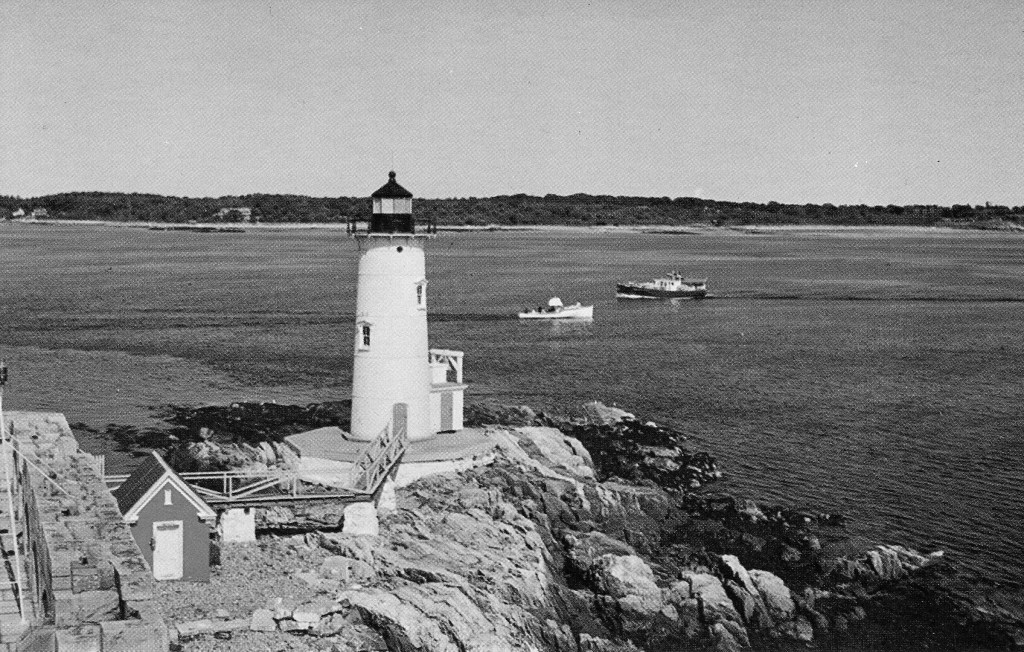
An example, this image is from 1913 as listed: the Bug Light Breakwater in Portland Harbor. New name Portland Harbor Breakwater Light.

EPSON MFP image

Having had the opportunity to be in Portland, Maine but a few months ago, I was very interested in how I managed to miss this great building and an opportunity to capture some images of it myself!

Apparently I hadn’t missed it, just the realization that this light had changed quit drastically since 1913, and having a tour guide that happened not to know the name of this light, didn’t help. Somewhere along the course of time, those in charge of this light at the time, realized the outer buildings were no longer needed, in the course of running this light. And the man from the 1913 image above, might still be the same man who keep many waiting for him to remove himself from the view (by walking behind the light) in order to get a photograph of this light without him in it.

Another example:

EPSON MFP image

You would think that because the card is listed as the ‘Plum Island Lighthouse’, you might be correct. But you would be wrong. This is the ‘Newburyport Lighthouse’, at some point over the years the caretakers decided to change the lights name, and many images were printed using the original name. It is still on Plum Island, but it is now not apart of the name.

EPSON MFP image

The Burnt Coat Harbor Light is really the Hockamock Head Light, one of many with name changes over the years. I have learned not to take any of what is written at face value, always double check your research.

With its getting darker now, much earlier and the Christmas lights are glowing to make the darkness a little more joyful, I wish everyone a very Safe and Happy Holiday’s and the best the New Year has coming.

On that ‘wee note’ till Monday January 2, 2023.


Thank you for visiting and reading today. Be sure to share with your friends using the share buttons and if you haven’t already, please enter your email address in the subscription form below to receive my stories by email.

The Start of New Research

Linda’s Monthly Monday Morning Moaning’s for November 7, 2022

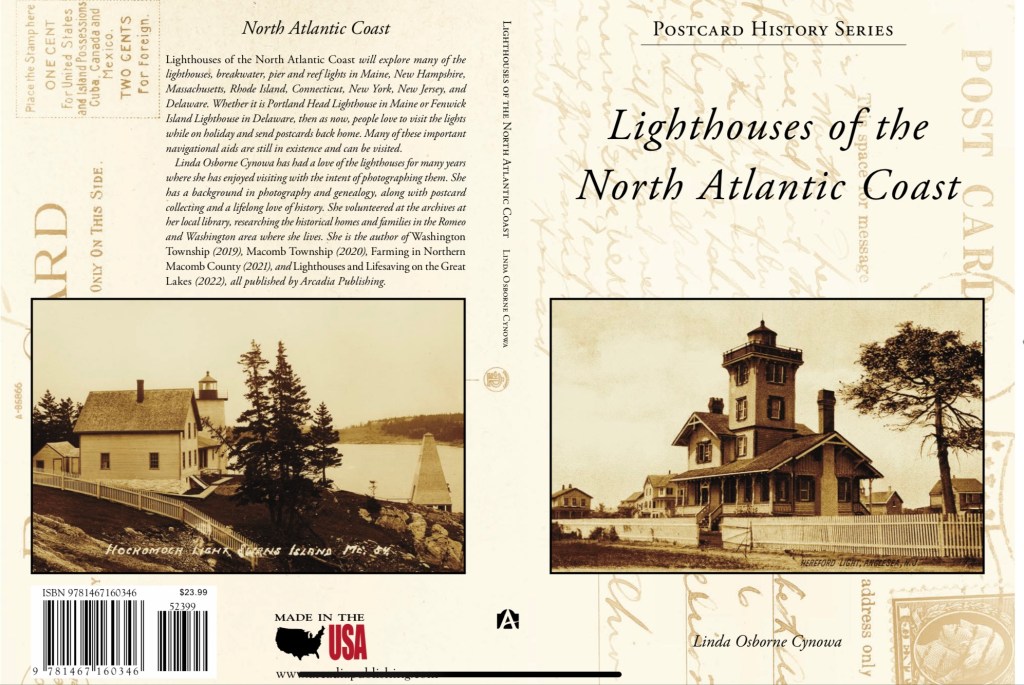
This week into my mail inbox came a lovely surprise and attached was a contract for a fifth book for Arcadia Publishing. I had submitted a proposal for a book to my editor a couple of weeks ago and their answer was the go ahead I needed. This book will be also a part of their ‘Historical Postcard Series’, as my ‘Lighthouse and Lifesaving on the Great Lakes’ was in vintage postcards.

While researching the first lighthouse book, collecting vintage postcards to use was an important part of the research, after finding the images, the learning came, and what could I find out about these long loved lights. Now the learning starts again in obtaining the vintage postcards that will be needed for ‘Lighthouses of the Northern Atlantic Coast’, lighthouses along the coast of Maine, New Hampshire, Massachusetts, Rhode Island, Connecticut, New York, New Jersey and Delaware.

So the ‘mock book’ (this was explained in an earlier blog, but basically I put together a book/binder with 128 pages, the same as the completed book, and print images and make placements to see what fits and what is still needed to give me a well round look at the lights in each of these states, then the writing comes later) has been started and images have been catalogued. Below are a sample of some of the images I have acquired.

Bringing attention to these lights here and on the Great Lakes is the best way to bring to the public the desperate need historical societies and commissions need in protecting these navigational marvels that were so valued during an important part of our history.

On that ‘wee note’ till next month, Monday December 5, 2022.


Thank you for visiting and reading today. Be sure to share with your friends using the share buttons above and if you haven’t already please enter your email address in the firm below to receive my stories by email.

Vintage Portland Head Light

Linda’s Monthly Monday Morning Moaning’s for October 3, 2022

Portland Head Lighthouse, Cape Elizabeth, Maine:

With the ratification of the United States Constitution in June 1788, the new federal government of the United States came into being. On August 7, 1789, (a lovely date in 1970 to be married, also) the First Congress of the United States passed its first Public Works Act when it federalized all lighthouses in the United States. Control was placed in the hands of Alexander Hamilton the first Secretary of the Treasury. Funds were arranged and construction at Portland Head was completed in 1791.

Postcard image courtesy of the author

Although Alexander Hamilton was in charge of the lighthouses it was the President of the United States who personally appointed the light keepers, usually as a reward for services performed. As it was Revolutionary War veteran Joseph Greenleaf was given the opportunity to be the first appointed lighthouse keeper. He was allowed to live at the light for free, and some time later they came up with $160.00 a year in salary for him.

Postcard image courtesy of the author

The original plans called for the tower to the Portland Head Light to be 58 feet tall, but this would be changed during construction to 72 feet. But in 1813 the tower was lower by 20 feet. In 1864 it was raised by 20 feet. In 1883 the tower was once again shortened by 20 feet and the less powerful fourth-order lens was used instead of the more powerful second-order lens. Soon complaints about the less powerful lens and shorter tower that in 1884 the tower was again raised by twenty feet and the second-order lens installed in the lantern room.

Postcard image courtesy of the author

Many light keepers tended this most photographed light and saved many lives by their hard work and helped maritime navigation around the rocky shores of this northern Atlantic light. There are many great books about this light, one of them being “Portland Head Light, A Pictorial Journey Through Time” by Timothy E Harrison.

Postcard image courtesy of the author

On that ‘wee note’ till next month Monday, November 7, 2022.


Thank you for visiting and reading today. Be sure to share with your friends using the share buttons above and if you haven’t already please enter your email address in the firm above to receive my stories by email.

The Portland Head Light

Linda’s Monthly Monday Morning Moaning’s for September 5, 2022.

This month, I am writing about a lighthouse that is further east than our Great Lakes Lights, the Portland Head Light in Cape Elizabeth, Maine. Once again I was given a great opportunity to see and photograph one of the most photographed lighthouses in the United States, the Portland Head Light.

“Portland Head and it’s light seem to symbolize the state of Maine — rocky coast, breaking waves, sparkling water, and clear, pure salt air.” As anyone seeing this beautiful light would probably agree. The city of Portland took it’s name from the headland where the lighthouse now stands, but Portland Head is actually within the boundaries of the town of Cape Elizabeth.

In 1790, President George Washington remarked ‘that it should be possible to build the tower from rubblestone found in the fields and shores of Cape Elizabeth, and that the stone could be handled nicely when hauled by oxen on a drag’. The original plan was for a 58-foot tower, but the realization that it would be blocked from the south by a headland, it was to raised to the height of 72 feet.

By 1812, it was felt that the upper 20 feet of the tower, which had problems with leaking and the opinion that it had not be properly built, was soon removed and it became 25 feet shorter with the removal of the stonework. The headland that had blocked the light to the south was no longer a great concern. A single story stone cottage 20 by 34 feet and comprised of two rooms, with an attached kitchen was built in 1816. Could this be a path to further my love of lighthouses by heading to the eastern US and the lights of the Atlantic coast?

Next month, Part 2 on the Portland Head Light of Cape Elizabeth, Maine with vintage images of this most photographed light. On that ‘wee note’ till next month Monday, October 3, 2022.

Content from the books of Jeremy D’Entremont, ‘The Lighthouses of Maine’.


Thank you for visiting and reading today. Be sure to share with your friends using the share buttons below and if you haven’t already please enter your email address in the firm below to receive my stories by email.